THE CLASSIC COLLECTION✦An outlaw’s diary: the CommuneCLASSIC FREE BOOKS
An outlaw’s diary: the Commune
Cécile Tormay
THE CLASSIC COLLECTION · 1867
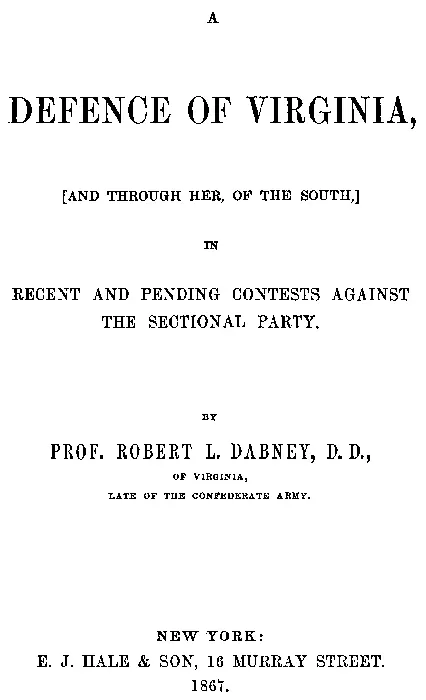
"A Defence of Virginia" by Robert Lewis Dabney is a historical account written in the late 19th century. The book serves as a justification for the institution of slavery and the Southern cause during and after the American Civil War, arguing that the principles of slavery are both moral and historically valid. Dabney presents a defense of Virginia and through it, the Southern states, against what he perceives as a misrepresentation by abolitionists and their sympathizers. The opening of the text introduces the author's intent to defend Virginia, whom he views as slandered by the Northern anti-slavery sentiments that emerged during and after the Civil War. Dabney critiques the moral and social judgments placed upon Southern slavery, asserting that such judgments are rooted in a misunderstanding of history and human rights. He emphasizes that while other nations and regions continued the practice of slavery, the Southern states were unfairly targeted for disdain. Dabney sets the tone for a thorough examination of the ethical and scriptural justifications for slavery, asserting the need for a historical perspective that acknowledges Virginia's significance and the complexities surrounding the institution of slavery in America. This summary covers only the opening portion of the book.
Introduction adapted from the source catalogue; source summaries may be automatically generated.
Free to read · English · 98,110 words · No account needed
MAKE TIME FOR A GOOD BOOK
On by default. Untick to stop anonymous reading totals. Each page counts after 10 seconds in view. How this works.
Anonymous counting is on unless you have switched it off.
The North having arrogated to itself the name of chief manufacturer of literary material, and having chief control of the channels of foreign intercourse, of course our plea has been less listened to across the Atlantic than in America. The South has been condemned unheard. Well-informed men in Great Britain, we presume, are ignorant of the names and works of the able and dignified advocates to whom the South confidently and proudly committed her justification; and were willing to render their verdict upon the mere accusations of our interested slanderers. But while the United States yet existed unbroken, there was one forum, where we could have demanded a hearing upon the fundamental question: the Federal Legislature. From that centre of universal attention, our defence of the righteousness of the relation of master and slave, as existing among us, might have been spread before the public mind; and the abstract question having been decided by triumphant argument, the troubles of our Federal relations might possibly have been quieted. There were two courses, either of which might have been followed by our politicians, in defending our Federal rights against Abolitionism. One plan would have been, to exclude the whole question of slavery persistently from the national councils, as extra-constitutional and dangerous, and to assert this exclusion always, and at every risk, as the essential condition of the continuance of the South in those councils. The other plan was, to meet that abstract question from the first, as underlying and determining the whole subject, and to debate it everywhere, until it was decided, and the verdict of the national mind was passed upon it. Unfortunately, the Southern men did neither persistently. After temporary resistance, they permitted the debate; and then failed to conduct it on fundamental principles. With the exception of Mr. Calhoun, (whom events have now shown to have been the most far-seeing of our statesmen, notwithstanding the fashion of men to depreciate him as an "abstractionist" while he lived,) Southern politicians usually satisfied themselves with saying, that the whole matter was, according to the Constitution, one of State sovereignty; that Congress had no right to legislate concerning its merits; and that therefore they would not seem to admit such a right, by condescending to argue the matter on its merits. The premise was true; but the inference was practically most mischievous. If the Congress had no right to legislate about slavery, then it should not have been permitted to debate it. And Southern men, if they intended to make their stand on that ground, should have exacted the exclusion of all debate, at every cost. But this was perhaps impossible. The debate came; and, of course, the principles agitated ran at once back of the Constitution, to the abstract ethical question: "Is the holding of an African slave in the South a moral wrong in itself?" Southern men should have industriously followed them there; but they did not do it: and soon the heat and animosity of an aggressive and growing faction hurried the country beyond the point of calm consideration. A moment's reflection should have shown that the decisive question was the abstract righteousness of the relation of master and slave. The Constitution gave to the Federal Government no power over that relation in the States. True; but that Constitution was a compact between sovereign commonwealth: it certainly gave recognition and protection to the relation of master and slave; and if that relation is intrinsically unrighteous, then it protected a wrong. Then the sovereign States of the North were found in the attitude of protecting a wrong by their voluntary compact; and therefore it would have been the duty of all citizens of those States to seek, by all righteous means, the amendment or repeal of that compact. They would not, indeed, have been justified to claim all the benefits of the compact, and still agitate under it a matter which the compact excluded. But they would have been more than justified, they would have been bound to clear their skirts of the wrong, by surrendering the compact, if necessary. There was no evasion from the duty, except by proving that the Constitution did nothing unrighteous by protecting the relation; in other words, that the relation was not unrighteous. Again, on the subject of the "Higher Law," our conservative statesmen and divines threw up a vast amount of pious dust. This partially quieted the country for a time; but, as might have been foreseen, it was destined to be inevitably blown away. There is a higher law, superior to constitutions and statutes; not, indeed, the perjured and unprincipled cant which has no conscience against swearing allegiance to a Constitution and laws which it declares sinful, in order to grasp emoluments and advantages, and then pleads "conscience" for disobeying what it had voluntarily sworn to obey; but the everlasting law of right in the word of God. Constitutions and laws which contravene this, ought to be lawfully amended or repealed; and it is the duty of all citizens to seek it. Let this be applied to the Fugitive Slave Law. If the bondage was intrinsically unrighteous, then the Federal law which aided in remanding the fugitive to it, legalized a wrong. It became, therefore, the duty of all United States officers, who were required by statute to execute this law--not, indeed, to hold their offices and emoluments, and swear fidelity, and then plead conscientious scruples for the neglect of these sworn functions, (for this is a detestable union of theft and perjury with hypocrisy,)--but to resign those offices wholly, with their profits and their sinful functions. It would have become the duty of any private citizen, who might have been summoned by a United States officer, to act in a posse, guard, or any other way in enforcing this law, to decline obedience; and then, in accordance with Scripture, to submit meekly to the legal penalty of such a refusal, until the unrighteous law were repealed. But, moreover, it would have become the right and duty of these and all other citizens to seek the repeal of that law, or, if necessary, the abrogation of that Federal compact which necessitated it. But on the other hand, when we proved that the relation of master and slave is not unrighteous, and that therefore the Fugitive Slave Law required the perpetration of no wrong, and was constitutional, it became the clear moral duty of every citizen to concur in obeying it.
Your reading position is saved on this browser. Take it to another device with a library code. Reading pages adapt to text, rather than matching a printed edition.
BEHIND THE BOOK
This eBook is for the use of anyone anywhere in the United States and most other parts of the world at no cost and with almost no restrictions whatsoever. You may copy it, give it away or re-use it under the terms of the Project Gutenberg License included with this eBook or online at www.gutenberg.org. If you are not located in the United States, you will have to check the laws of the country where you are located before using this eBook. Read the source licence.
The original source file, including credits and licence, is retained by this library. Request an original-format copy at no charge. Please include the book title and Project Gutenberg identifier #47422.
KEEP YOUR CURIOSITY GOING
Cécile Tormay

Moritz Busch
John L. Ransom
Frances Wright
Cécile Tormay

Mabel Potter Daggett