THE CLASSIC COLLECTION✦An outlaw’s diary: the CommuneCLASSIC FREE BOOKS
An outlaw’s diary: the Commune
Cécile Tormay
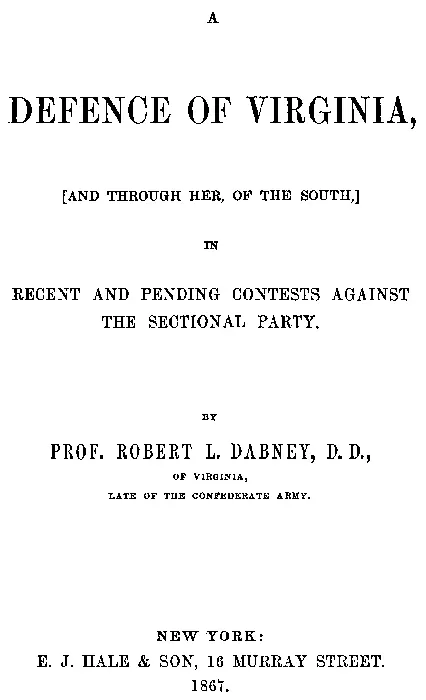
THE CLASSIC COLLECTION · 1867
"A Defence of Virginia" by Robert Lewis Dabney is a historical account written in the late 19th century. The book serves as a justification for the institution of slavery and the Southern cause during and after the American Civil War, arguing that the principles of slavery are both moral and historically valid. Dabney presents a defense of Virginia and through it, the Southern states, against what he perceives as a misrepresentation by abolitionists and their sympathizers. The opening of the text introduces the author's intent to defend Virginia, whom he views as slandered by the Northern anti-slavery sentiments that emerged during and after the Civil War. Dabney critiques the moral and social judgments placed upon Southern slavery, asserting that such judgments are rooted in a misunderstanding of history and human rights. He emphasizes that while other nations and regions continued the practice of slavery, the Southern states were unfairly targeted for disdain. Dabney sets the tone for a thorough examination of the ethical and scriptural justifications for slavery, asserting the need for a historical perspective that acknowledges Virginia's significance and the complexities surrounding the institution of slavery in America. This summary covers only the opening portion of the book.
Introduction adapted from the source catalogue; source summaries may be automatically generated.
Free to read · English · 98,110 words · No account needed
MAKE TIME FOR A GOOD BOOK
On by default. Untick to stop anonymous reading totals. Each page counts after 10 seconds in view. How this works.
Anonymous counting is on unless you have switched it off.
This, cries the anti-slavery man, was only temporary servitude. We reply: but it was involuntary servitude, though temporary. It gave to the master the right to compel the labour of the servant without his consent; and this is a sanction of the principle of our institution. What will be said then to the following? Leviticus xxv. 44 to 46: "Both thy bondmen and thy bondmaids which thou shalt have, shall be of the heathen that are round about you; of them shall ye buy bondmen and bondmaids. Moreover, of the children of the strangers that do sojourn among you, of them shall ye buy and of their families that are with you, which they begat in your land; and they shall be your possession," (your property.) "And ye shall take them as an inheritance for your children after you, to inherit them for a possession; they shall be your bondmen forever; but over your brethren, the children of Israel, ye shall not rule over one another with rigour."
The antithesis in the position of the two laws shows that these heathen slaves were not to go free at the year of Jubilee, like Hebrew slaves. They are to be bondmen forever. They and their children, slaves by birth, are to descend from father to son, as heritable property. There was to be "no seventh year freedom here; there is no Jubilee liberation." So says the learned divine, Moses Stuart, of Andover, himself an anti-slavery man. And so say all respectable Hebrew antiquaries. Indeed it would be hard to construct language defining more strongly and fully all those features of domestic slavery most contradictory to the theory of Abolitionists. They were to be bought and sold. They were heritable property: (Mr. Sumner would prove hence, "mere chattels.") Here is involuntary slavery for life, expressly authorized to God's own peculiar and holy people, in the strongest and most careful terms. The relation, then, must be innocent in itself. With what show of candour can men say, in the face of a sanction so full, so emphatic, so hearty, that Moses, finding the hoary institution of domestic slavery so deeply rooted that it would be impossible then to abolish it, tolerated it, and limited it by all the restrictions which he could apply, calculated to cut off its worst horrors? We ask, was Moses the author of these laws, or God? Does the Almighty, the Unchangeable, the Holy, connive at moral abuses, like a puny human magistrate, and content himself, where he dare not denounce a sin, with pruning its growth a little? We ask again: Is this gloss borne out by the facts? Was Moses, in fact, timid in assailing old and deeply-rooted vices, and in demanding that they should be eradicated wholly? Let his uncompromising legislation against Idolatry and Adultery answer. The truth is, such writers as use the above language know nothing about the true nature of domestic slavery, and draw their inferences only from their prejudices. God and Moses knew it well. They knew that it was an institution which, when not abused, was suitable to the character of the depraved persons for whom it was designed, and wholesome and benign. Hence, they prohibit all inhuman abuses of it; and then they do not tolerate it merely as an unavoidable wrong; but they expressly legalize it, as right. An honest mind can make nothing less of their words. But in Numbers xxxi. 25 to 30, and Joshua ix. 20 to 27, we have instances which are, if possible, still stronger. In the former passage the people of Midian had been conquered by God's command, and the captives and spoils brought home; the captives to be slaves for life according to the law of Leviticus, ch. xxv. The book of Numbers then proceeds: "And the Lord spake unto Moses saying, Take the sum of prey that was taken both of man and of beast, thou and Eleazer the priest and the chief fathers of the congregation; and divide the prey into two parts; between them that took the war upon them who went out to battle, and between all the congregation. And levy a tribute unto the Lord of the men of war which went out to battle: one soul of five hundred, both of the persons, and of the beeves, and of the asses and of the sheep: Take it of their half, and give it unto Eleazer the priest, for an heave-offering of the Lord. And of the children of Israel's half thou shalt take one portion of fifty, of the persons, of the beeves, of the asses and of the flocks, of all manner of beasts, and give them unto the Levites which keep the charge of the tabernacle of the Lord." In verses 40th and 46th, we read farther that the "Lord's tribute of the persons" of the first half, "was thirty and two persons," and of the second half, "three hundred and twenty." Here God commands a portion of these slaves to be set apart to a sacred use, and dedicated to himself, that they might become the property of the ministers of religion. The second instance is not contained in the books of Moses, but in the history of his successor Joshua: we group it with the former, for its similarity. In Joshua, ch. ix., we are told that while he was triumphantly engaged in the destruction of the condemned heathen tribes of Palestine, according to God's command, the people of Gibeon, a part of the doomed race, despairing of a successful defence, adopted this stratagem to save themselves. Under pretence that they were not of Palestine at all, but from a very distant place, their ambassadors obtained from the leaders of the Israelites a very stringent oath of amity. This pledge the elders incautiously gave, without seeking the divine direction. In a very few days they learned to their astonishment, that these Gibeonites lived in the very heart of Palestine, close to the spot where they were encamped, and that they were of the very race which they were appointed to destroy. But they had sworn in the name of Jehovah not to destroy them. In this state of things, the princes and Joshua determined to punish them for their falsehood, and at the same time substantially observe their oath, by leaving them unhurt, but reducing them to slavery as the serfs of the Tabernacle and its ministers. In verses 23d and 27th, Joshua told them: "Now, therefore, ye are cursed, and there shall none of you be freed from being bondmen," (Ebed, i. e., slaves,) "and hewers of wood and drawers of water for the house of my God." "And Joshua made them that day hewers of wood and drawers of water for the congregation and for the altar of the Lord, even unto this day, in that place which he should choose." This compact the Gibeonites seem gladly to have accepted. In 2d Samuel, ch. xxi., we find this same race of serfs still living among the Israelites, under the same compact. King Saul, David's predecessor, having broken it by killing many of them, God himself interposed, and required a satisfaction for the breach. Here we have evidence that the slaves of heathen origin were not freed by the Jubilee, for centuries had now elapsed and they were still slaves. We also see evidence that the contract made by Joshua was not regarded by God as unlawful. In this case, also, we find God accepting a religious offering of slaves for the service of his sanctuary. And these, while real slaves, did not belong each to an individual master, but were slaves to an institution and a caste, a form of bondage always justly regarded as less benevolent than the former.
Your reading position is saved on this browser. Take it to another device with a library code. Reading pages adapt to text, rather than matching a printed edition.
BEHIND THE BOOK
This eBook is for the use of anyone anywhere in the United States and most other parts of the world at no cost and with almost no restrictions whatsoever. You may copy it, give it away or re-use it under the terms of the Project Gutenberg License included with this eBook or online at www.gutenberg.org. If you are not located in the United States, you will have to check the laws of the country where you are located before using this eBook. Read the source licence.
The original source file, including credits and licence, is retained by this library. Request an original-format copy at no charge. Please include the book title and Project Gutenberg identifier #47422.
KEEP YOUR CURIOSITY GOING
Cécile Tormay

Moritz Busch
John L. Ransom
Frances Wright
Cécile Tormay

Mabel Potter Daggett