THE CLASSIC COLLECTION✦An outlaw’s diary: the CommuneCLASSIC FREE BOOKS
An outlaw’s diary: the Commune
Cécile Tormay
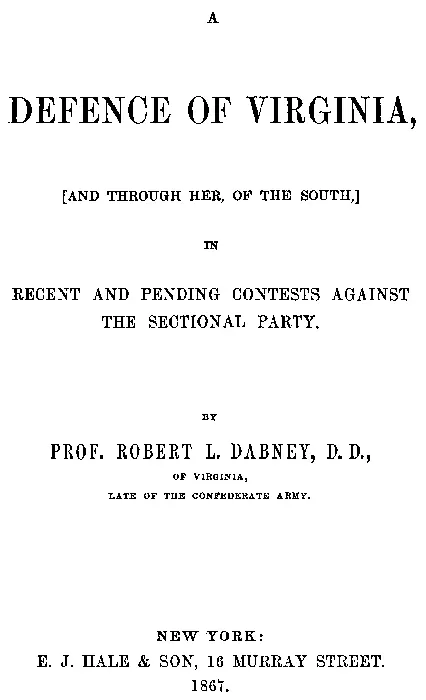
THE CLASSIC COLLECTION · 1867
"A Defence of Virginia" by Robert Lewis Dabney is a historical account written in the late 19th century. The book serves as a justification for the institution of slavery and the Southern cause during and after the American Civil War, arguing that the principles of slavery are both moral and historically valid. Dabney presents a defense of Virginia and through it, the Southern states, against what he perceives as a misrepresentation by abolitionists and their sympathizers. The opening of the text introduces the author's intent to defend Virginia, whom he views as slandered by the Northern anti-slavery sentiments that emerged during and after the Civil War. Dabney critiques the moral and social judgments placed upon Southern slavery, asserting that such judgments are rooted in a misunderstanding of history and human rights. He emphasizes that while other nations and regions continued the practice of slavery, the Southern states were unfairly targeted for disdain. Dabney sets the tone for a thorough examination of the ethical and scriptural justifications for slavery, asserting the need for a historical perspective that acknowledges Virginia's significance and the complexities surrounding the institution of slavery in America. This summary covers only the opening portion of the book.
Introduction adapted from the source catalogue; source summaries may be automatically generated.
Free to read · English · 98,110 words · No account needed
MAKE TIME FOR A GOOD BOOK
On by default. Untick to stop anonymous reading totals. Each page counts after 10 seconds in view. How this works.
Anonymous counting is on unless you have switched it off.
§ 4. Hagar remanded to Slavery by God.
Sarah, in a season of desperation at her childless condition, seems to have been tempted to imitate the corrupt expedient which was prevalent among the Canaanites around her, and which still prevails in the East. According to this usage, the chief wife, or wife proper, gives to her husband a concubine from among her slaves, as a sort of substitute for herself; and the offspring of the connexion is regarded as her own child. Abram, misled by evil example, and by the solicitations of his wife--the person who would have had the best right to complain of his act--concurred temporarily in the arrangement, and received his Egyptian slave Hagar as an inferior wife. The favour of her master, and the prospective honour of being the mother of offspring, which has always been exceedingly prized by Oriental women, so inflated the servant with impudence, that she no longer treated her mistress with decent respect. When Sarah bitterly complained of this, Abram replied by reminding her that Hagar was still her slave; and that she was entitled, as a mistress, to compel her to observe a suitable demeanour. When Sarah proceeded to exert this authority, probably administering corporal punishment to Hagar for some instance of impertinence, the latter ran away, and pursued the direction which led to her native country, Egypt. It was then that the angel of the LORD found her "by the fountain in the way to Shur. And he said, Hagar, Sarai's maid, whence camest thou? and whither wilt thou go? And she said, I flee from the face of my mistress Sarai. And the angel of the LORD said unto her, Return to thy mistress, and submit thyself under her hands." Genesis xvi., 7 to 9. He then proceeded to unfold the future of her unborn son, and Hagar obeyed his commands. From verses 10th and 13th, we learn certainly that this angel was a Divine Person. For, in the first place, he promises Hagar, "I will multiply thy seed exceedingly;" but none but the Almighty could truthfully make such a promise in his own name, as it is here made. In the latter place we are informed that it was the LORD (in Hebrew, Jehovah; the most characteristic and incommendable name of God) that spake unto her; and Hagar called his name: "Thou God, seest me." We remark again, that Hagar was certainly in the relation of domestic slavery, and not of a hired servant, to Abraham and Sarai. She is called Shiphheh, which is the regular word for female slave in the Old Testament. Had she not been an actual slave, Sarai would never have presumed, according to Oriental usage, to dispose of her person in the manner related. Here, then, we have God, himself, the Angel Jehovah, who can be no other than the Second Person of the Trinity, Christ, commanding this fugitive to return into the relation of domestic slavery, and submit to it. Can that relation be in itself sinful? To assert this, would make our adorable Saviour particeps criminis. He cannot have required a soul to return into a sinful state. He never requires of his servants more than their duty; so that if Sarai had possessed no real and just title to Hagar's services as a slave--if the claim had been a mere imposition and injustice, she would not have been required to submit to it. Abolitionists attempt to evade this by saying that Hagar was instructed to return and submit to bondage on the same principle on which Christ instructs us, when wrongfully smitten on one cheek to turn the other likewise. This, say they, by no means implies that the smiting was just. We reply, that the parallel cannot be drawn. Had Hagar been in the hand of an unjust mistress, it would have been her duty in Christian forbearance to "take it patiently, though buffeted wrongfully." But she was not now in Sarai's hand. She had successfully escaped it, and was far advanced in her' journey to her native Egypt, where she evidently expected to find friends and shelter. Under these circumstances, it is preposterous to say that the grace of Christian forbearance required of her to return voluntarily whither no claim of right drew her, and subject herself to unjust and unauthorized persecution again. We ask, Does Christ so press the duty of peaceableness, as to sacrifice to it the whole personal well-being and rightful interests of the innocent victim of unjust aggression? Is his chief object, in these lessons of forbearance, to gratify and pamper the lust of persecution in the aggressor? Is there no right of just self-defence left? Surely he teaches us that we owe a duty to our own life and well-being, as well as to our fellow-men's. When we are wronged, we are to defend this right only in such ways as become a son of peace--a man of forgiveness. But the same Saviour who taught his disciples to render good for evil when injured, also commanded them: "When they persecute you in one city, flee ye into another." When a peaceable escape can be secured from injustice, it is both the privilege and duty of the most forgiving Christian on earth to use it. Now Hagar was in such a condition; had her subjection to Sarai been, as the Abolitionists say slavery is, a condition of unjust persecution, the Saviour's instructions to her would doubtless have been: "Now that you have escaped the injustice of her that wronged you, flee to another city." His remanding her to Sarai shows that the subjection was lawful and right.
Your reading position is saved on this browser. Take it to another device with a library code. Reading pages adapt to text, rather than matching a printed edition.
BEHIND THE BOOK
This eBook is for the use of anyone anywhere in the United States and most other parts of the world at no cost and with almost no restrictions whatsoever. You may copy it, give it away or re-use it under the terms of the Project Gutenberg License included with this eBook or online at www.gutenberg.org. If you are not located in the United States, you will have to check the laws of the country where you are located before using this eBook. Read the source licence.
The original source file, including credits and licence, is retained by this library. Request an original-format copy at no charge. Please include the book title and Project Gutenberg identifier #47422.
KEEP YOUR CURIOSITY GOING
Cécile Tormay

Moritz Busch
John L. Ransom
Frances Wright
Cécile Tormay

Mabel Potter Daggett