THE CLASSIC COLLECTION✦An outlaw’s diary: the CommuneCLASSIC FREE BOOKS
An outlaw’s diary: the Commune
Cécile Tormay
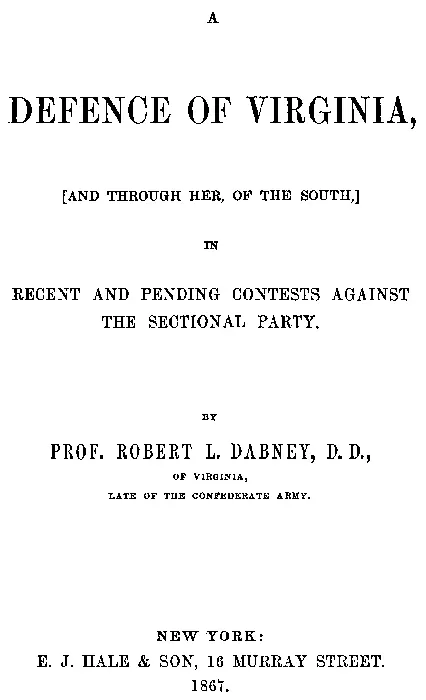
THE CLASSIC COLLECTION · 1867
"A Defence of Virginia" by Robert Lewis Dabney is a historical account written in the late 19th century. The book serves as a justification for the institution of slavery and the Southern cause during and after the American Civil War, arguing that the principles of slavery are both moral and historically valid. Dabney presents a defense of Virginia and through it, the Southern states, against what he perceives as a misrepresentation by abolitionists and their sympathizers. The opening of the text introduces the author's intent to defend Virginia, whom he views as slandered by the Northern anti-slavery sentiments that emerged during and after the Civil War. Dabney critiques the moral and social judgments placed upon Southern slavery, asserting that such judgments are rooted in a misunderstanding of history and human rights. He emphasizes that while other nations and regions continued the practice of slavery, the Southern states were unfairly targeted for disdain. Dabney sets the tone for a thorough examination of the ethical and scriptural justifications for slavery, asserting the need for a historical perspective that acknowledges Virginia's significance and the complexities surrounding the institution of slavery in America. This summary covers only the opening portion of the book.
Introduction adapted from the source catalogue; source summaries may be automatically generated.
Free to read · English · 98,110 words · No account needed
MAKE TIME FOR A GOOD BOOK
On by default. Untick to stop anonymous reading totals. Each page counts after 10 seconds in view. How this works.
Anonymous counting is on unless you have switched it off.
But second: this narrative gives us more than a prediction. The words of Noah are not a mere prophecy; they are a verdict, a moral sentence pronounced upon conduct, by competent authority; that verdict sanctioned by God. Now if the verdict is righteous, and the execution blessed by God, it can hardly be, that the executioners of it are guilty for putting it in effect. Can one believe that the descendants of Shem and Japhet, with this sentence in their hands, and the divine commendation just bestowed on them for acting unlike Ham, could have reasonably felt guilty for accepting that control over their guilty fellow-men which God himself had assigned? For the vital difference between the case of the Assyrians, when their guilty ambition was permissively employed by God to punish the back-slidings of his own people, and the case of Shem and Japhet, is this: The Assyrians were cursed by God for doing their predicted work, in the very sentence; Shem and Japhet were blessed by Him in the very verdict which assigns Canaan as their servant.
It may be that we should find little difficulty in tracing the lineage of the present Africans to Ham. But this inquiry is not essential to our argument. If one case is found where God has authorized domestic slavery, the principle is settled, that it cannot necessarily be sin in itself. It is proper that we should say, in conclusion, that this passage of Scripture is not regarded, nor advanced, as of prime force and importance in this argument. Others more decisive will follow.
§ 3. Abraham a Slaveholder.
The references to the bondsmen of Abraham and his son Isaac are the following: Genesis xiv., 14, "And when Abram heard that his brother," (or relative, viz.: Lot,) "was taken captive, he armed his trained servants, born in his own house, three hundred and eighteen, and pursued them unto Dan. And he divided himself against them, he and his servants, by night," etc. Genesis xvii., 10, etc., "This is my covenant which ye shall keep, between me and you, and thy seed after thee; every man-child among you shall be circumcised," ... v. 12, "And he that is eight days old shall be circumcised among you, every man-child in your generations; he that is born in the house, or bought with money of any stranger, which is not of thy seed. He that is born in thy house and he that is bought with thy money must needs be circumcised," and v. 26, 27, "In the self-same day was Abraham circumcised, and Ishmael his son; and all the men of his house, born in the house and bought with money of the stranger, were circumcised with him." Genesis xviii. 17 to 19, "And the Lord said, Shall I hide from Abraham that thing which I do: seeing that Abraham shall surely become a great and mighty nation, and all the nations of the earth shall be blessed in him? For I know him, that he will command his children and his household after him, and they shall keep the way of the Lord, to do justice and judgment: that the Lord may bring upon Abraham that which he hath spoken of him." Genesis xx. 14, "And Abimelech" (seeking reconciliation with Abraham for the wrong intended to Sarah his wife, at God's command,) "took sheep and oxen, and men-servants and women-servants, and gave them unto Abraham, and restored him Sarah his wife." Genesis xxiv. 35, Eliezer, when seeking a wife for Isaac, says: "And the Lord hath blessed my master greatly, and he is become great; and he hath given him flocks, and herds, and silver, and gold, and men-servants, and maid-servants, and camels and asses." And Genesis, xxvi. 12, 14, it is said of Isaac: "And the LORD blessed him. And the man waxed great and went forward and grew until he became very great. For he had possession of flocks, and possession of herds, and great store of servants."
Your reading position is saved on this browser. Take it to another device with a library code. Reading pages adapt to text, rather than matching a printed edition.
BEHIND THE BOOK
This eBook is for the use of anyone anywhere in the United States and most other parts of the world at no cost and with almost no restrictions whatsoever. You may copy it, give it away or re-use it under the terms of the Project Gutenberg License included with this eBook or online at www.gutenberg.org. If you are not located in the United States, you will have to check the laws of the country where you are located before using this eBook. Read the source licence.
The original source file, including credits and licence, is retained by this library. Request an original-format copy at no charge. Please include the book title and Project Gutenberg identifier #47422.
KEEP YOUR CURIOSITY GOING
Cécile Tormay

Moritz Busch
John L. Ransom
Frances Wright
Cécile Tormay

Mabel Potter Daggett