THE CLASSIC COLLECTION✦An outlaw’s diary: the CommuneCLASSIC FREE BOOKS
An outlaw’s diary: the Commune
Cécile Tormay
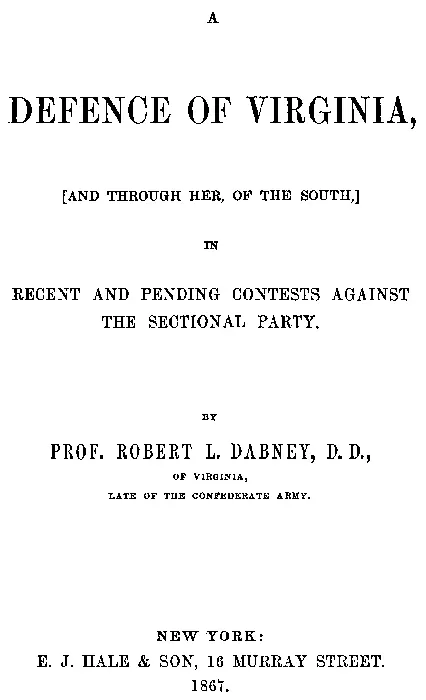
THE CLASSIC COLLECTION · 1867
"A Defence of Virginia" by Robert Lewis Dabney is a historical account written in the late 19th century. The book serves as a justification for the institution of slavery and the Southern cause during and after the American Civil War, arguing that the principles of slavery are both moral and historically valid. Dabney presents a defense of Virginia and through it, the Southern states, against what he perceives as a misrepresentation by abolitionists and their sympathizers. The opening of the text introduces the author's intent to defend Virginia, whom he views as slandered by the Northern anti-slavery sentiments that emerged during and after the Civil War. Dabney critiques the moral and social judgments placed upon Southern slavery, asserting that such judgments are rooted in a misunderstanding of history and human rights. He emphasizes that while other nations and regions continued the practice of slavery, the Southern states were unfairly targeted for disdain. Dabney sets the tone for a thorough examination of the ethical and scriptural justifications for slavery, asserting the need for a historical perspective that acknowledges Virginia's significance and the complexities surrounding the institution of slavery in America. This summary covers only the opening portion of the book.
Introduction adapted from the source catalogue; source summaries may be automatically generated.
Free to read · English · 98,110 words · No account needed
MAKE TIME FOR A GOOD BOOK
On by default. Untick to stop anonymous reading totals. Each page counts after 10 seconds in view. How this works.
Anonymous counting is on unless you have switched it off.
[Footnote 49: See, on all the following statements from Lord Mansfield, Lofft's Reports, 12th Geo. 3d, pp. 1, 8, 17, 18, etc.]
[Footnote 50: What the villein in gross was, may be learned from the following, of Bracton, Lib. iv., 208:
"Purum villenagium est, a quo præstatur servilium incertum et indeterminatum; ubi scire non potest vespere, quale servitium fieri debet mane, viz., ubi quis facere tenetur quicquid ei præceptum fuit." See also Blackstone, Lib. ii., 93.]
In fact, not only were there then fifteen thousand negro slaves in England, but they were publickly bought and sold in the markets of London. The prevalence of slavery is attested by another species of historical evidence, very different from that of learned judges, but at least as authentick. The pictures by which Hogarth has fixed the follies and peculiarities of fashionable life on his immortal canvass, frequently contain the African valet; showing that the possession of this species of servants was demanded by high life. From the Normans, those noted slaveholders, to 1775, no statute had been passed upon the subject of personal slavery.[51] There then existed, in the northern part of the kingdom of Great Britain, from thirty thousand to forty thousand persons, of whom the Parliament said, "Many colliers, coal-heavers, and salters, are in a state of slavery, or bondage, bound to the collieries or salt-works where they work, for life, transferable with the collieries and salt-works, when their original masters have no use for them."[52] Again in 1799, they declare that "many colliers and coal-heavers still continue in a state of bondage."
[Footnote 51: Justice Campbell, on Dred Scott case, 19th Howard, 109.]
[Footnote 52: Parliament, 15th Geo. 3d.]
Thus it appears that England was itself slave territory, at the time the thirteen colonies, declaring their independence, brought away her laws and institutions. But our argument of this fact is ex abundantia; it may be waived, and still our conclusion holds, because, by existing laws, all the plantations and colonies of England in America were then, yet more indisputably, slave territory. No stronger proof of this proposition can be imagined, than the manner in which slavery was planted in these communities. Not only were all the thirteen colonies, and all the West India plantations, slaveholding; but it required no statute, either of Parliament or of colonial legislature, to introduce African slavery, or to establish the right of the owner, because it was already established by imperial law and usage. The first negroes were bought in Virginia in 1620; the first act touching their bondage was passed by the Burgesses in 1659; and this does not enact their slavery, but recognizes it as existing. It was not until 1670,[53] that any law was passed which expressly enacted their slavery. But for fifty years they had been unquestioned slaves, had paid impost duty as such, had been bought and sold, had been bequeathed, had been subject of suits. By what law? Obviously by the general law of the British Empire, and of nations. The manner of the introduction of slavery into Massachusetts was the same. "The involuntary servitude of Indians and negroes in the several colonies originated under a law not promulgated by legislation, and rested upon prevalent views of universal jurisprudence, or the law of nations, supported by the express or implied authority of the Home Government."[54] But the "canny" Puritans, more careful than the Virginians to fortify their slave property, enacted slavery of both classes, in their earliest codes of laws, 1641 and 1660.[55]
Your reading position is saved on this browser. Take it to another device with a library code. Reading pages adapt to text, rather than matching a printed edition.
BEHIND THE BOOK
This eBook is for the use of anyone anywhere in the United States and most other parts of the world at no cost and with almost no restrictions whatsoever. You may copy it, give it away or re-use it under the terms of the Project Gutenberg License included with this eBook or online at www.gutenberg.org. If you are not located in the United States, you will have to check the laws of the country where you are located before using this eBook. Read the source licence.
The original source file, including credits and licence, is retained by this library. Request an original-format copy at no charge. Please include the book title and Project Gutenberg identifier #47422.
KEEP YOUR CURIOSITY GOING
Cécile Tormay

Moritz Busch
John L. Ransom
Frances Wright
Cécile Tormay

Mabel Potter Daggett