THE CLASSIC COLLECTION✦An outlaw’s diary: the CommuneCLASSIC FREE BOOKS
An outlaw’s diary: the Commune
Cécile Tormay
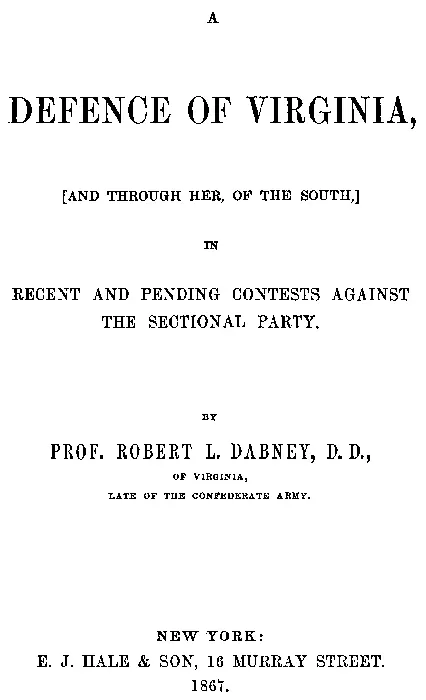
THE CLASSIC COLLECTION · 1867
"A Defence of Virginia" by Robert Lewis Dabney is a historical account written in the late 19th century. The book serves as a justification for the institution of slavery and the Southern cause during and after the American Civil War, arguing that the principles of slavery are both moral and historically valid. Dabney presents a defense of Virginia and through it, the Southern states, against what he perceives as a misrepresentation by abolitionists and their sympathizers. The opening of the text introduces the author's intent to defend Virginia, whom he views as slandered by the Northern anti-slavery sentiments that emerged during and after the Civil War. Dabney critiques the moral and social judgments placed upon Southern slavery, asserting that such judgments are rooted in a misunderstanding of history and human rights. He emphasizes that while other nations and regions continued the practice of slavery, the Southern states were unfairly targeted for disdain. Dabney sets the tone for a thorough examination of the ethical and scriptural justifications for slavery, asserting the need for a historical perspective that acknowledges Virginia's significance and the complexities surrounding the institution of slavery in America. This summary covers only the opening portion of the book.
Introduction adapted from the source catalogue; source summaries may be automatically generated.
Free to read · English · 98,110 words · No account needed
MAKE TIME FOR A GOOD BOOK
On by default. Untick to stop anonymous reading totals. Each page counts after 10 seconds in view. How this works.
Anonymous counting is on unless you have switched it off.
This contrast between the policy and principles of Virginia and of the New England colonies will be concluded with two evidences. The one is presented in the history of the Declaration of Independence. Mr. Jefferson, the author, states that he had inserted in the enumeration of grievances against the King of Great Britain, a paragraph strongly reprobating his arbitrary support of the slave trade, against the remonstrances of some of the colonies. When the Congress discussed the paper, this paragraph was struck out, "in complaisance," he declares, "to South Carolina and Georgia, who had never attempted to restrain the importation of slaves, and who, on the contrary, still wished to continue it. Our Northern brethren also, I believe, felt a little tender under these censures; for though their people had very few slaves themselves, yet they had been pretty considerable carriers of them to others."[37] Thus New England assisted to expunge from that immortal paper a testimony against the slave trade, which Virginia endeavoured to place there.
[Footnote 37: Jefferson's Correspondence, vol i., p. 15.]
The other evidence is presented by a case much more practical. In the Convention of 1787, which framed the Constitution of the United States, two questions concerning African slaves caused dissension. Upon the supreme right of the States over the whole subject of slavery within their own dominions, upon the recognition of slaves as property protected by the federal laws, wherever slavery existed, and upon the fugitive slave law, not a voice was raised in opposition. But the Convention presumed (what subsequent history did not confirm,) that the main expenses of the federal government would be met by direct taxation; and some principle was to be adopted, for determining how slaves should rank with freemen, in assessing capitation taxes, and apportioning representation. The other question of difficulty was the suppression of the African slave trade, which, upon the return of peace, had been actively revived by New England, with the connivance of Carolina and Georgia. The Southern States, who expected to have nearly the whole tax on slaves to pay, desired to rate them very low; some members proposed that five slaves should count as equal to only one white freeman; others, that three slaves should count for one. The New England colonies generally desired to make a negro count as a white man, both for representation and taxation! After much difference, the majority of the Convention agreed to a middle conclusion proposed by Mr. Madison, that five negroes should count for three persons.[38] But the other question was not so easily arranged. The Committee of eleven appointed to draw up a first draught of a constitution had proposed that in Art. vii., § 4, of their draught, Congress should be prohibited from laying any import duty on African slaves brought into the country. The effect of this, so far as the federal government was concerned, would be to legalize the slave trade forever, and protect it from all burdens.[39] Maryland (by her legislature, then sitting,) to her immortal honour, and Pennsylvania and Virginia, exhibited a determination to change this section, so as to arrest the trade through the action of the federal government, either by prohibition or tax. The New England States, South Carolina, and Georgia, opposed them, and advocated the original section, assigning various grounds. The difference threatened to make shipwreck of the whole work of the Convention, when Gouverneur Morris adroitly proposed to commit the subject, along with that of the proposed navigation law, in order that disagreeing parties might be induced, by private conference, to combine mutual concessions into a sort of bargain. The subjects were accordingly committed to a Committee of one from each State. This Committee reported, August 24th, "in favour of not allowing Congress to prohibit the importation of slaves before 1800, but giving them power to impose a duty at a rate not exceeding the average of other imports." South Carolina (through General Pinckney) moved to prolong the importation from 1800 to 1808, and Massachusetts (through Mr. Gorham) seconded the motion. It was then passed, as last proposed, New Hampshire, Massachusetts, Connecticut, (the only New England States then present,) Maryland, North Carolina, and South Carolina, voting in the affirmative, and New Jersey, Pennsylvania, Delaware, and Virginia in the negative.[40] The maritime States soon after gained their point, of authorizing Congress to pass, by a majority vote, a navigation law for their advantage.
Your reading position is saved on this browser. Take it to another device with a library code. Reading pages adapt to text, rather than matching a printed edition.
BEHIND THE BOOK
This eBook is for the use of anyone anywhere in the United States and most other parts of the world at no cost and with almost no restrictions whatsoever. You may copy it, give it away or re-use it under the terms of the Project Gutenberg License included with this eBook or online at www.gutenberg.org. If you are not located in the United States, you will have to check the laws of the country where you are located before using this eBook. Read the source licence.
The original source file, including credits and licence, is retained by this library. Request an original-format copy at no charge. Please include the book title and Project Gutenberg identifier #47422.
KEEP YOUR CURIOSITY GOING
Cécile Tormay

Moritz Busch
John L. Ransom
Frances Wright
Cécile Tormay

Mabel Potter Daggett