THE CLASSIC COLLECTION✦An outlaw’s diary: the CommuneCLASSIC FREE BOOKS
An outlaw’s diary: the Commune
Cécile Tormay
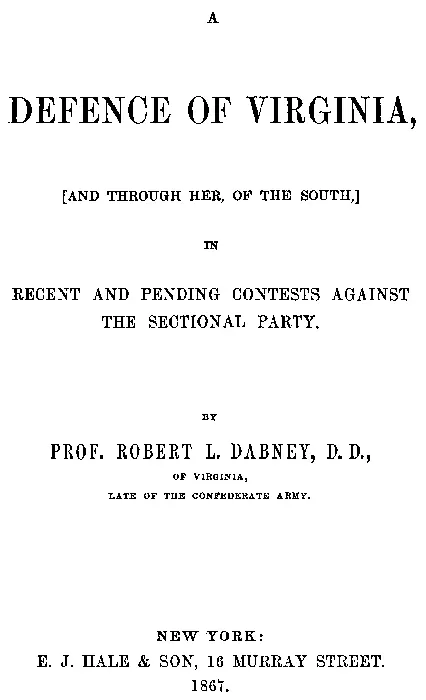
THE CLASSIC COLLECTION · 1867
"A Defence of Virginia" by Robert Lewis Dabney is a historical account written in the late 19th century. The book serves as a justification for the institution of slavery and the Southern cause during and after the American Civil War, arguing that the principles of slavery are both moral and historically valid. Dabney presents a defense of Virginia and through it, the Southern states, against what he perceives as a misrepresentation by abolitionists and their sympathizers. The opening of the text introduces the author's intent to defend Virginia, whom he views as slandered by the Northern anti-slavery sentiments that emerged during and after the Civil War. Dabney critiques the moral and social judgments placed upon Southern slavery, asserting that such judgments are rooted in a misunderstanding of history and human rights. He emphasizes that while other nations and regions continued the practice of slavery, the Southern states were unfairly targeted for disdain. Dabney sets the tone for a thorough examination of the ethical and scriptural justifications for slavery, asserting the need for a historical perspective that acknowledges Virginia's significance and the complexities surrounding the institution of slavery in America. This summary covers only the opening portion of the book.
Introduction adapted from the source catalogue; source summaries may be automatically generated.
Free to read · English · 98,110 words · No account needed
MAKE TIME FOR A GOOD BOOK
On by default. Untick to stop anonymous reading totals. Each page counts after 10 seconds in view. How this works.
Anonymous counting is on unless you have switched it off.
In bright contrast with its guilty cupidity, stands the consistent action of Virginia, which, from its very foundation as a colony, always denounced and endeavoured to resist the trade. It is one of the strange freaks of history, that this commonwealth, which was guiltless in this thing, and which always presented a steady protest against the enormity, should become, in spite of herself, the home of the largest number of African slaves found within any of the States, and thus, should be held up by Abolitionists as the representative of the "sin of slaveholding;" while Massachusetts, which was, next to England, the pioneer and patroness of the slave trade, and chief criminal, having gained for her share the wages of iniquity instead of the persons of the victims, has arrogated to herself the post of chief accuser of Virginia. It is because the latter colony was made, in this affair, the helpless victim of the tyranny of Great Britain and the relentless avarice of New England. The sober evidence of history which will be presented, will cause the breast of the most deliberate reader to burn with indignation for the injustice suffered by Virginia, and the profound hypocrisy of her detractors.
The preamble to the State Constitution of Virginia, drawn up by George Mason, and adopted by the Convention June 29th, 1776, was written by Thomas Jefferson. In the recital of grievances against Great Britain, which had prompted the commonwealth to assume its independence, this preamble contains the following words: "By prompting our negroes to rise in arms among us; those very negroes whom, by an inhuman use of his negative, he had refused us permission to exclude by law."[24] Mr. Jefferson, long a leading member of the House of Burgesses, and most learned of all his contemporaries in the legislation of his country, certainly knew whereof he affirmed. His witness is more than confirmed by that of Mr. Madison,[25] who says: "The British Government constantly checked the attempts of Virginia to put a stop to this infernal traffick." Mr. Jefferson, in a passage which was expunged from the Declaration of Independence by New England votes in the Congress, strongly stated the same charge. And George Mason, perhaps the greatest and most influential of Virginians, next to Washington, reiterated the accusation with equal strength, in the speech in the Federal Convention, 1787, in which he urged the immediate prohibition of the slave trade by the United States. See Madison Papers, vol. iii., pp. 1388-1398. A learned Virginian antiquary has found, notwithstanding the destruction of the appropriate evidences, which will be explained anon, no less than twenty-eight several attempts made by the Burgesses to arrest the evil by their legislation, all of which were either suppressed or negatived by the proprietary or royal authority. A learned and pious Huguenot divine, having planted his family in the colony, in the first half of the last century, bears this testimony: "But our Assembly, foreseeing the ill consequences of importing such numbers among us, hath often attempted to lay a duty upon them which would amount to a prohibition, such as ten or twenty pounds a head; but no governor dare pass such a law, having instructions to the contrary from the Board of Trade at home. By this means they are forced upon us, whether we will or not. This plainly shows the African Company hath the advantage of the colonies, and may do as it pleases with the ministry."[26] These personal testimonies are recited the more carefully, because the Vandalism of the British officers at the Revolution annihilated that regular documentary evidence, to which the appeal might otherwise be made. Governor Dunmore first, and afterwards Colonel Tarleton and Earl Cornwallis, carried off and destroyed all the archives of the colony which they could seize, and among them the whole of the original journals of the House of Burgesses, except the volumes containing the proceedings of 1769 and 1772. The only sure knowledge which remains of those precious records is derived from other documents and fragmentary copies of some passages, found afterwards in the desks of a few citizens. The wonderfully complete collection of their laws edited by Hening, under the title of "Statutes at Large," was drawn from copies and collections of the acts which, having received the assent of the governors and kings, were promulgated to the counties as actual law. Of course the suppressed and negatived motions against the slave trade are not to be sought among these, but could only have been found in the lost journals of the House. But enough of the documentary evidence remains, to substantiate triumphantly the testimony of individuals.
Your reading position is saved on this browser. Take it to another device with a library code. Reading pages adapt to text, rather than matching a printed edition.
BEHIND THE BOOK
This eBook is for the use of anyone anywhere in the United States and most other parts of the world at no cost and with almost no restrictions whatsoever. You may copy it, give it away or re-use it under the terms of the Project Gutenberg License included with this eBook or online at www.gutenberg.org. If you are not located in the United States, you will have to check the laws of the country where you are located before using this eBook. Read the source licence.
The original source file, including credits and licence, is retained by this library. Request an original-format copy at no charge. Please include the book title and Project Gutenberg identifier #47422.
KEEP YOUR CURIOSITY GOING
Cécile Tormay

Moritz Busch
John L. Ransom
Frances Wright
Cécile Tormay

Mabel Potter Daggett