THE CLASSIC COLLECTION✦An outlaw’s diary: the CommuneCLASSIC FREE BOOKS
An outlaw’s diary: the Commune
Cécile Tormay
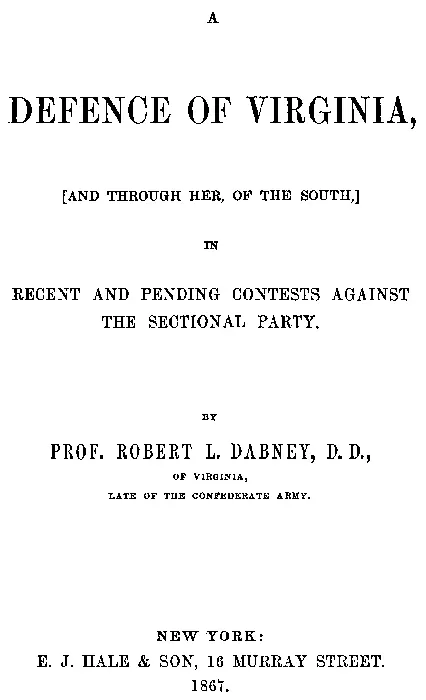
THE CLASSIC COLLECTION · 1867
"A Defence of Virginia" by Robert Lewis Dabney is a historical account written in the late 19th century. The book serves as a justification for the institution of slavery and the Southern cause during and after the American Civil War, arguing that the principles of slavery are both moral and historically valid. Dabney presents a defense of Virginia and through it, the Southern states, against what he perceives as a misrepresentation by abolitionists and their sympathizers. The opening of the text introduces the author's intent to defend Virginia, whom he views as slandered by the Northern anti-slavery sentiments that emerged during and after the Civil War. Dabney critiques the moral and social judgments placed upon Southern slavery, asserting that such judgments are rooted in a misunderstanding of history and human rights. He emphasizes that while other nations and regions continued the practice of slavery, the Southern states were unfairly targeted for disdain. Dabney sets the tone for a thorough examination of the ethical and scriptural justifications for slavery, asserting the need for a historical perspective that acknowledges Virginia's significance and the complexities surrounding the institution of slavery in America. This summary covers only the opening portion of the book.
Introduction adapted from the source catalogue; source summaries may be automatically generated.
Free to read · English · 98,110 words · No account needed
MAKE TIME FOR A GOOD BOOK
On by default. Untick to stop anonymous reading totals. Each page counts after 10 seconds in view. How this works.
Anonymous counting is on unless you have switched it off.
Now, had slavery been intrinsically a moral and social evil, yet its protection was in the compact between the States; and to the honest mind, there was but one course for the North to adopt when she concluded that she could no longer endure her connexion with slavery. This was, to restore to the South the pledges, the fulfilment of which had become irksome; and to dissolve the Union peacefully and fairly, as it had been formed, leaving us in possession of our own country and rights, to bear our own sin, and pursue our own destiny. It was the federal compact alone, which gave the North any right to govern the South. If they repudiated that contract, it was annihilated equally for both parties. Thenceforward their claim to legislate for the South, or exercise any power over her, was baseless and iniquitous. No fair mind will dispute, that even though slavery had been an indefensible wrong, the South ought not to have permitted herself to be assailed for it, in an equal Union which she had sovereignly entered with this institution expressly recognized. But that basis of argument we utterly repudiate. We will not defend ourselves from such premises. We claim to have been justified, not only by the Constitution of the United States, but by God and the right, in our rights to slaves. Our status in the Federal Union was, so far, as equal, as honourable, as legal, as free from ethical taint, as that of any other States with their property in horses, ships, land, and factories.
We have, in another place, (the Life of Jackson,) stated with sufficient fulness, the admitted facts and doctrines of the Constitution, which justified the Southern States in resuming their independence, when the compact, to which they had partially yielded it, was destroyed. The indisputable proofs (now fully admitted by anti-slavery men) might be cited, which showed that their election of a sectional President, with other aggressions, were intended to destroy the most acknowledged and vital rights of the States. Had Virginia assumed her attitude of resistance upon that event, she might have defended it by that maxim, so obvious to every just mind, that it is righteous and wise to meet the first clear aggression, even though its practical mischiefs be unimportant: that "a people should rather contend for their rights upon their threshold than upon their hearthstone." But we had stronger justification still. The aggression intended was practically vast and ruinous in its results. It has been shown in previous chapters, that the destruction of African slavery among us was vital to us, because emancipation by such means would be destructive of the very framework of society, and of our most fundamental rights and interests. All our statesmen, of all parties, had taught us, not only that the reserved rights of the States were the bulwarks of the liberties of the people, but that emancipation by federal aggression would lead to the destruction of all other rights. A Clay, as much as a Calhoun, proclaimed that when abolition overthrew slavery in the South, it also would equally overthrow the Constitution. Calhoun, and other Southern statesmen, with a sagacity which every day confirms, had forewarned us, that when once abolition by federal aggression came, these other sure results would follow: that the same greedy lust of power which had meddled between masters and slaves, would assuredly, and for the stronger reason, desire to use the political weight of the late slaves against their late masters: that having enforced a violent emancipation, they would enforce, of course, negro suffrage, negro eligibility to office, and a full negro equality: that negro equality thus theoretically established would be practical negro superiority: that the tyrant section, as it gave to its victims, the white men of the South, more and more causes of just resentment, would find more and more violent inducements to bribe the negroes, with additional privileges and gifts, to assist them in their domination: that this miserable career must result in one of two things, either a war of races, in which the whites or the blacks would be, one or the other, exterminated; or amalgamation. But while we believe that "God made of one blood all nations of men to dwell under the whole heavens," we know that the African has become, according to a well-known law of natural history, by the manifold influences of the ages, a different, fixed species of the race, separated from the white man by traits bodily, mental and moral, almost as rigid and permanent as those of genus. Hence the offspring of an amalgamation must be a hybrid race, stamped with all the feebleness of the hybrid, and incapable of the career of civilization and glory as an independent race. And this apparently is the destiny which our conquerors have in view. If indeed they can mix the blood of the heroes of Manassas with this vile stream from the fens of Africa, then they will never again have occasion to tremble before the righteous resistance of Virginian freemen; but will have a race supple and vile enough to fill that position of political subjection, which they desire to fix on the South.
Your reading position is saved on this browser. Take it to another device with a library code. Reading pages adapt to text, rather than matching a printed edition.
BEHIND THE BOOK
This eBook is for the use of anyone anywhere in the United States and most other parts of the world at no cost and with almost no restrictions whatsoever. You may copy it, give it away or re-use it under the terms of the Project Gutenberg License included with this eBook or online at www.gutenberg.org. If you are not located in the United States, you will have to check the laws of the country where you are located before using this eBook. Read the source licence.
The original source file, including credits and licence, is retained by this library. Request an original-format copy at no charge. Please include the book title and Project Gutenberg identifier #47422.
KEEP YOUR CURIOSITY GOING
Cécile Tormay

Moritz Busch
John L. Ransom
Frances Wright
Cécile Tormay

Mabel Potter Daggett