THE CLASSIC COLLECTION✦An outlaw’s diary: the CommuneCLASSIC FREE BOOKS
An outlaw’s diary: the Commune
Cécile Tormay
THE CLASSIC COLLECTION · 1867
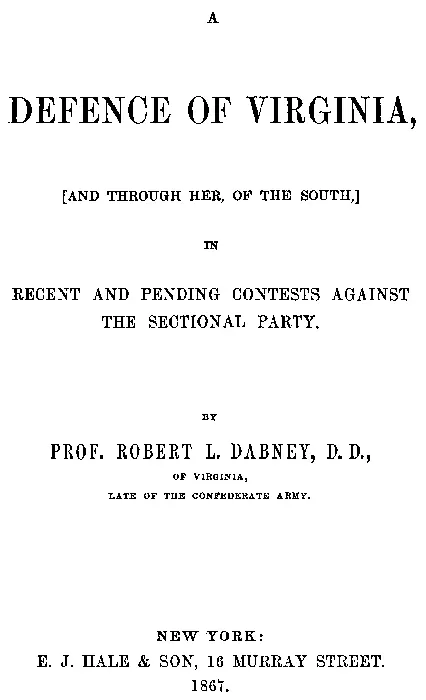
"A Defence of Virginia" by Robert Lewis Dabney is a historical account written in the late 19th century. The book serves as a justification for the institution of slavery and the Southern cause during and after the American Civil War, arguing that the principles of slavery are both moral and historically valid. Dabney presents a defense of Virginia and through it, the Southern states, against what he perceives as a misrepresentation by abolitionists and their sympathizers. The opening of the text introduces the author's intent to defend Virginia, whom he views as slandered by the Northern anti-slavery sentiments that emerged during and after the Civil War. Dabney critiques the moral and social judgments placed upon Southern slavery, asserting that such judgments are rooted in a misunderstanding of history and human rights. He emphasizes that while other nations and regions continued the practice of slavery, the Southern states were unfairly targeted for disdain. Dabney sets the tone for a thorough examination of the ethical and scriptural justifications for slavery, asserting the need for a historical perspective that acknowledges Virginia's significance and the complexities surrounding the institution of slavery in America. This summary covers only the opening portion of the book.
Introduction adapted from the source catalogue; source summaries may be automatically generated.
Free to read · English · 98,110 words · No account needed
MAKE TIME FOR A GOOD BOOK
On by default. Untick to stop anonymous reading totals. Each page counts after 10 seconds in view. How this works.
Anonymous counting is on unless you have switched it off.
In dismissing this head of our discussion, we would briefly touch two points. One is the annual production of the industry of the North and the South. Without burdening the reader with statistical details, it is sufficient to sum up the annual results of the three great branches, of agriculture, mining, and manufactures. The North exceeds the South in proportion to population, in wheat, hay, dairy products, and manufactures; while the South greatly exceeds the North in the great staples of Indian corn and tobacco, and surpasses it almost immeasurably in rice, cotton, and naval stores. Summing up the varied productions of each section, we find that the industry of the South is, on the whole, more productive than that of the North, relatively to its numbers. And of the great commodities which constitute the basis of foreign commerce, the South yields more than the North, in about the ratio of four to one!
The other point is the relative improvement of the soil. According to the census of 1860, there were four acres of improved land to each inhabitant of the North, appraised, with their rateable proportion of stock and implements, at $223. This gives about $56 for each acre and its stock. In the South, on the other hand, each inhabitant claims nine acres of improved land, valued, with their stock and implements, at $322. This allows about $36 for each acre and its stock. It has been argued that this evinces the slovenly and imperfect agriculture of the slaveholding States, and the comparative exhaustion of their soils. It is said, their rude tillage is spread over a far wider surface, and conducted with inferiour appointments. And this depreciating result slavery has brought about, they assert, in spite of superiour natural advantages. We remark that, contrary to the usual assertion, the natural fertility was superiour in the free States. The soil of the Middle States had a better natural average than that of the old Atlantic slave States, and the North-western States had a vastly larger proportion of fertile lands than the South-western. In the next place, the agriculture of the South is of such a character that it requires a wider area; and yet this requirement argues nothing of its greater imperfection. It may require more space to fly a kite than to spin a top, and yet it does not follow that the kite-flying is less skillful sport than the top-spinning. An iron manufactory must necessarily cover more ground than a chemical laboratory; but no one argues thence, that the ironmonger is less a master of his trade than the manufacturer of drugs, of his. Last: the fact that the Southern planter accounts the labour of his farm as property, and so, as a part of his invested capital, causes a lower nominal valuation of his lands, though there be no inferiority of actual production. Grain and grass lands in the county of Rockingham have always sold higher than grain and grass lands in the county of Albemarle, which were actually yielding the same products annually. The former were tilled by free labour, and the latter by slave; but the Albemarle farming was confessedly as skillful, as economical, and as profitable, as the Rockingham. The explanation is the following: The Rockingham farmer, hiring his free labour, needed no more capital for this purpose than was sufficient to pay the wages of a few months in advance of the realization of his crop. The Albemarle farmer expended a large portion of his farming capital in the purchase of slaves, and afterwards paid no money in hire. The former, investing twenty thousand dollars in agriculture, could expend the whole sum in land, except what was required to stock it and pay wages for a few months. Thus he would begin by buying three hundred acres of land for eighteen thousand dollars. But the slaveholding farmer began by expending eight thousand dollars in the purchase of servants, leaving him but ten thousand to pay for the three hundred acres of land. For this reason land of the same actual value must be rated at a smaller nominal price among slaveholders than among farmers employing free labour. But the true profits of the farming are not reduced thereby, in the proportion of eighteen thousand to ten thousand. For the slaveholder no longer has to tax his crops, (equal in gross amount to those of the Rockingham farmer,) with the hire of labourers. That tax he pays in the shape of the annual interest on the eight thousand dollars, which, in the first instance, he paid for his servants. Hence the facts do not argue that the land is intrinsically less productive or less profitable; they only argue a different distribution of capital between the two sources of production, land and labour. In consequence of that difference, the land must be represented by less money. This obvious explanation explodes much that has been taught concerning the comparative barrenness of Southern farming.
Your reading position is saved on this browser. Take it to another device with a library code. Reading pages adapt to text, rather than matching a printed edition.
BEHIND THE BOOK
This eBook is for the use of anyone anywhere in the United States and most other parts of the world at no cost and with almost no restrictions whatsoever. You may copy it, give it away or re-use it under the terms of the Project Gutenberg License included with this eBook or online at www.gutenberg.org. If you are not located in the United States, you will have to check the laws of the country where you are located before using this eBook. Read the source licence.
The original source file, including credits and licence, is retained by this library. Request an original-format copy at no charge. Please include the book title and Project Gutenberg identifier #47422.
KEEP YOUR CURIOSITY GOING
Cécile Tormay

Moritz Busch
John L. Ransom
Frances Wright
Cécile Tormay

Mabel Potter Daggett