THE CLASSIC COLLECTION✦An outlaw’s diary: the CommuneCLASSIC FREE BOOKS
An outlaw’s diary: the Commune
Cécile Tormay
THE CLASSIC COLLECTION · 1867
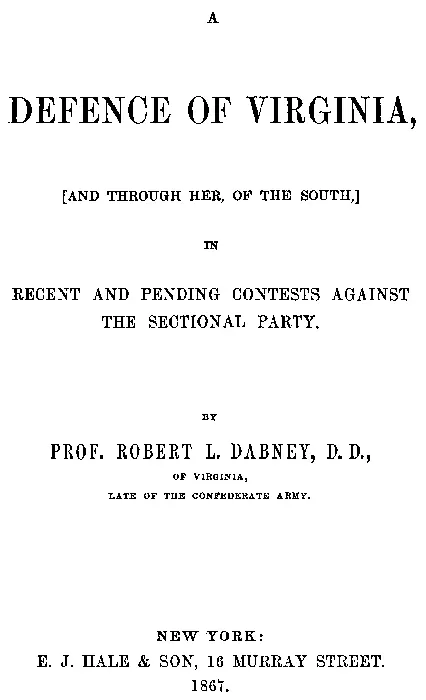
"A Defence of Virginia" by Robert Lewis Dabney is a historical account written in the late 19th century. The book serves as a justification for the institution of slavery and the Southern cause during and after the American Civil War, arguing that the principles of slavery are both moral and historically valid. Dabney presents a defense of Virginia and through it, the Southern states, against what he perceives as a misrepresentation by abolitionists and their sympathizers. The opening of the text introduces the author's intent to defend Virginia, whom he views as slandered by the Northern anti-slavery sentiments that emerged during and after the Civil War. Dabney critiques the moral and social judgments placed upon Southern slavery, asserting that such judgments are rooted in a misunderstanding of history and human rights. He emphasizes that while other nations and regions continued the practice of slavery, the Southern states were unfairly targeted for disdain. Dabney sets the tone for a thorough examination of the ethical and scriptural justifications for slavery, asserting the need for a historical perspective that acknowledges Virginia's significance and the complexities surrounding the institution of slavery in America. This summary covers only the opening portion of the book.
Introduction adapted from the source catalogue; source summaries may be automatically generated.
Free to read · English · 98,110 words · No account needed
MAKE TIME FOR A GOOD BOOK
On by default. Untick to stop anonymous reading totals. Each page counts after 10 seconds in view. How this works.
Anonymous counting is on unless you have switched it off.
Virginia presents other facts demonstrating the economy and efficiency of slave labour. The great Valley of Virginia (between the Blue Ridge and North Mountain Ranges,) is a farming and grazing region, of fertile soil and prosperous agriculture. In its great extent, some counties are occupied almost exclusively by free labour, and some have a large slave population. Now it is perfectly well known to all intelligent persons here, that precisely in those counties of this beautiful valley where there are most slaves, is the land highest in price, the agriculture most profitable and skillful, the farm buildings most elegant, and the community most prosperous and wealthy. Virginia east of the Blue Ridge is partly a farming and partly a planting region, having a mixed agriculture. Its soil is exceedingly different from that of the great valley, even where as fertile; and consequently the tillage is unlike. But there too, the neatest, most thorough and most profitable agriculture, and the highest priced lands, the finest farm stock, and the most prosperous landholders, are to be found precisely where the slave labour is most prevalent. And there is no agriculture in America superior to that of these favoured regions.
But, in conclusion, even if the industrial pursuits of the South were in the unfavourable condition which the Yankees love to assert, the sufficient cause would be found, not in slavery, but in the exactions and swindlings of their own section, through sectional federal legislation. Let a sober statement of these exactions be weighed, and the wonder will be, not that the South should be depleted, but that she is not bled to death. In the first place, the Federal Government, at its foundation, adopted the policy of giving a fishing bounty, (to encourage, as it said, a school of sailors for the national marine,) which went wholly into the pockets of New Englanders. It is said that the bounties paid are yearly about one and a half millions. Supposing that half only of the sum thus taken from the Federal Treasury was paid in by the South, (which we shall see is less than the truth,) this bounty, with that part of its increase which has accrued by simple interest alone, amounts now to one hundred and seventy-one millions, transferred by this unfair legislation from the South to the North. Next are to be mentioned the tonnage duties on foreign ships carrying between American ports, which, as the South had few ships, constituted a perpetual tax on us for the benefit of the North. Its amount cannot possibly be estimated with exactness, but it must have amounted to millions annually. Next came the oppression of a protective tariff, raising upon imports as high a revenue as sixty or seventy millions annually, in the last years of the government. As the South had few manufactures, and the North many, and as these duties, even where laid for revenue, were discriminating against the cheaper and better foreign manufactures which the South desired, in every case where discrimination was possible; it is manifest that the system constituted a simple robbery of the South of annual millions, for the benefit of the North. But we lost far more than the actual tariff on that portion of the national imports which were consumed at the South; because the restrictive policy, by throwing the balance of trade against the nations which took our grand staples of tobacco and cotton, deprived them of the ability to buy so freely, and at so large prices, as they would have done under a policy of free trade. Thus, the Southern planter not only paid the Northern manufacturer a profit on his goods equal to the protective tariff, but in the process of that robbery, lost several times as much more, in the prices which he should have received for his cotton or tobacco, had he been permitted to go with it to a free European market. This method of legislative plunder was so wasteful, that the Yankee, in stealing one dollar from us, annihilated several other dollars of our values. Next may be mentioned the advantage which the North gained in the funding of the Federal debt incurred at the Revolutionary war. This was so juggled by the Hamilton party, as to give the avails of it chiefly to the North. The enjoyment of that fund, with its increase since, has made a difference of untold millions in favour of the North. Last: the North twice enjoyed the advantage of having the National Bank situated in its midst, and wielding for purposes of traffic a large part of the funds of the Government. This superior command of ready money, acquired in these various ways, enabled the North to develope commercial centres, and to fix the great markets in her territory, thus ensuring to her the countless profits of commissions, freights, etc., on Southern trade.
Your reading position is saved on this browser. Take it to another device with a library code. Reading pages adapt to text, rather than matching a printed edition.
BEHIND THE BOOK
This eBook is for the use of anyone anywhere in the United States and most other parts of the world at no cost and with almost no restrictions whatsoever. You may copy it, give it away or re-use it under the terms of the Project Gutenberg License included with this eBook or online at www.gutenberg.org. If you are not located in the United States, you will have to check the laws of the country where you are located before using this eBook. Read the source licence.
The original source file, including credits and licence, is retained by this library. Request an original-format copy at no charge. Please include the book title and Project Gutenberg identifier #47422.
KEEP YOUR CURIOSITY GOING
Cécile Tormay

Moritz Busch
John L. Ransom
Frances Wright
Cécile Tormay

Mabel Potter Daggett