THE CLASSIC COLLECTION✦An outlaw’s diary: the CommuneCLASSIC FREE BOOKS
An outlaw’s diary: the Commune
Cécile Tormay
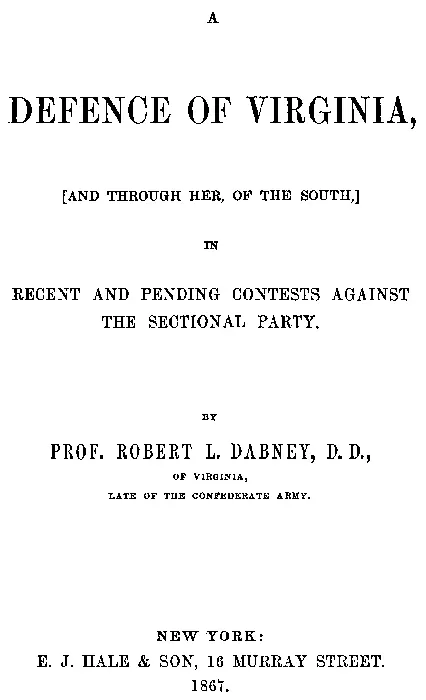
THE CLASSIC COLLECTION · 1867
"A Defence of Virginia" by Robert Lewis Dabney is a historical account written in the late 19th century. The book serves as a justification for the institution of slavery and the Southern cause during and after the American Civil War, arguing that the principles of slavery are both moral and historically valid. Dabney presents a defense of Virginia and through it, the Southern states, against what he perceives as a misrepresentation by abolitionists and their sympathizers. The opening of the text introduces the author's intent to defend Virginia, whom he views as slandered by the Northern anti-slavery sentiments that emerged during and after the Civil War. Dabney critiques the moral and social judgments placed upon Southern slavery, asserting that such judgments are rooted in a misunderstanding of history and human rights. He emphasizes that while other nations and regions continued the practice of slavery, the Southern states were unfairly targeted for disdain. Dabney sets the tone for a thorough examination of the ethical and scriptural justifications for slavery, asserting the need for a historical perspective that acknowledges Virginia's significance and the complexities surrounding the institution of slavery in America. This summary covers only the opening portion of the book.
Introduction adapted from the source catalogue; source summaries may be automatically generated.
Free to read · English · 98,110 words · No account needed
MAKE TIME FOR A GOOD BOOK
On by default. Untick to stop anonymous reading totals. Each page counts after 10 seconds in view. How this works.
Anonymous counting is on unless you have switched it off.
In all this argument, the anti-slavery men keep out of view a simple fact which is decisive of the absurdity of their position. They shall now be made to look it in the face. That fact is, that in free States, a large portion of all those who, from their moneyless condition, ought to pursue manual labour, are too lazy to do so voluntarily. But they must live, and they do it by some expedient which is a virtual preying on the means of the more industrious, by stealing, by begging, by some form of swindling, by perambulating the streets with a barrel-organ and monkey, or by vending toys or superfluities. Their labour is lost to the community; and their maintenance, together with their dishonest arts and crimes, is a perpetual drain from the public wealth. But slavery made the lazy do their part with the industrious, by the wholesome fear of the birch. Slavery allowed no loafers, no swindlers, no "b'hoys," no "plug-uglies," no grinders of hurdy-gurdies, among her labouring class. Who does not see that, even if the average slave in Virginia did only two-thirds of the day's work accomplished by the industrious free labourer in New York, yet, if all the idle classes in that great commonwealth, together with those now industrious, were compelled to do just the tasks of the average Virginia slave, there would be, on the whole, a vast and manifold gain to the public?
Another potent source of the economy of the slave system in its influences upon publick wealth, is found in a fact which Northern men not only admit, but assert with a foolish pride. It is the far greater development of the local traffic of merchants among them. When your down-East commercial traveller, whose only conception of productive industry was of some arts of "living by his wits," saw this contrast between Northern and Southern villages and country neighbourhoods, he pointed to it with undoubting elation, as proof of the vastly superior wealth and productive activity of the North. But in fact, he was a fool; he mistook what was a villainous, eating ulcer upon the public wealth of the North, and on the true prosperity of the people, for a spring of profits. In a farming neighbourhood of the hireling States, he saw at every hamlet and cross-road, pretentious shingle-palaces, occupied as large stores, where great accumulations of farm produce were paraded; sacks of meal, barrels of flour, bins of corn, packs of wool, garners of wheat, tubs of eggs, cans of butter, hogsheads of bacon, and even kegs of home-made soap, together with no little show of cheap finery. In the farming districts of the South, he rode along a quiet, shady road, with the country-seats of the planters reposing at a distance, in the bosoms of their estates; and found at long intervals a little country store, where a few groceries, medicines, and cloths were exposed for sale to sparse customers. Now this narrow trafficker, whose only heaven was buying and selling, very naturally jumped to the conclusion, that the South was so much poorer than the North, as she exhibited less local trade. Whereas in fact, she was just so much richer. And this unpopular assertion is, still, perfectly easy to demonstrate. The necessary labour of distributing commodities from producers to consumers, is a legitimate element of that fair market value, which they have when they finally reach the hand which consumes them. But political economists well know, and uniformly teach, that if any unnecessary middle-men interpose themselves between first producer and ultimate consumer, whose labour is not truly promotive of the economical distribution of commodities, then their industry is misdirected, the wages they draw for it in the shape of increased price of commodities passed through their hands is unproductive consumption, and they are a useless, a mischievous drain upon the common wealth. For instance, if a class of middle-men, retailers, or forwarding merchants, juggle themselves unnecessarily into the importing dry-goods trade of the country; if they place themselves between the manufacturer in England, and the consumer in rural New York, grasping wages for their intervention, in the shape of an additional profit which falls ultimately upon the retail purchaser; while yet they really contribute nothing to the economical distribution of the dry-goods; every one sees that they are a nuisance; they grasp something for nothing; and are preying upon the publick wealth, instead of promoting it like the legitimate merchant. Honest men will speedily require legislation, to expel them and abate the nuisance. Apply now this well-known principle to the case in hand. The simple system of slaveholding distributed that part of the products of farms, which properly went to the labourers' subsistence, direct to the consumers, without taxing it unnecessarily with the profits of the local merchant. The master was himself the retail merchant; and he distributed his commodities to the proper consumers, at wholesale prices, without profit. The consumers were his own servants. He remarked, in the language of the country, that, for this part of his products, he "had his market at home." Now, is it not obvious that the consumer, the slave, got more for his labour, and that the system of hireling labour, by invoking this local storekeeper, instead of the master, to do this work of distribution to consumers, which the master did better without him, and without charge, has brought in a useless middle-man? And his industry being useless and unproductive, its wages are a dead loss to the publick wealth. This coarse fellow behind the counter, retailing the meal and bacon and soap, at extortionate retail prices, to labourers, should be compelled to labour himself, at some really productive task; and the labourers should have gotten these supplies, untaxed with his extortion, on the farms where their own labour produced them, and at the farmer's prices. Is not this true science, and true common sense? But this is just the old Virginian system.
Your reading position is saved on this browser. Take it to another device with a library code. Reading pages adapt to text, rather than matching a printed edition.
BEHIND THE BOOK
This eBook is for the use of anyone anywhere in the United States and most other parts of the world at no cost and with almost no restrictions whatsoever. You may copy it, give it away or re-use it under the terms of the Project Gutenberg License included with this eBook or online at www.gutenberg.org. If you are not located in the United States, you will have to check the laws of the country where you are located before using this eBook. Read the source licence.
The original source file, including credits and licence, is retained by this library. Request an original-format copy at no charge. Please include the book title and Project Gutenberg identifier #47422.
KEEP YOUR CURIOSITY GOING
Cécile Tormay

Moritz Busch
John L. Ransom
Frances Wright
Cécile Tormay

Mabel Potter Daggett