THE CLASSIC COLLECTION✦An outlaw’s diary: the CommuneCLASSIC FREE BOOKS
An outlaw’s diary: the Commune
Cécile Tormay
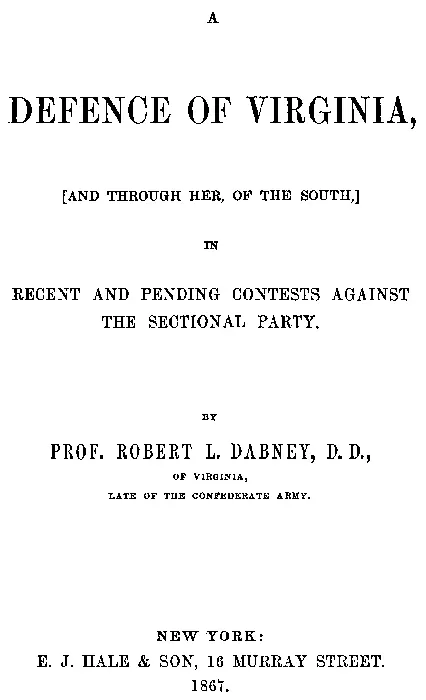
THE CLASSIC COLLECTION · 1867
"A Defence of Virginia" by Robert Lewis Dabney is a historical account written in the late 19th century. The book serves as a justification for the institution of slavery and the Southern cause during and after the American Civil War, arguing that the principles of slavery are both moral and historically valid. Dabney presents a defense of Virginia and through it, the Southern states, against what he perceives as a misrepresentation by abolitionists and their sympathizers. The opening of the text introduces the author's intent to defend Virginia, whom he views as slandered by the Northern anti-slavery sentiments that emerged during and after the Civil War. Dabney critiques the moral and social judgments placed upon Southern slavery, asserting that such judgments are rooted in a misunderstanding of history and human rights. He emphasizes that while other nations and regions continued the practice of slavery, the Southern states were unfairly targeted for disdain. Dabney sets the tone for a thorough examination of the ethical and scriptural justifications for slavery, asserting the need for a historical perspective that acknowledges Virginia's significance and the complexities surrounding the institution of slavery in America. This summary covers only the opening portion of the book.
Introduction adapted from the source catalogue; source summaries may be automatically generated.
Free to read · English · 98,110 words · No account needed
MAKE TIME FOR A GOOD BOOK
On by default. Untick to stop anonymous reading totals. Each page counts after 10 seconds in view. How this works.
Anonymous counting is on unless you have switched it off.
But the more complete answer is as follows. We will attempt now to point out an influence which enabled domestic slavery to resist and repair the evils of over-population, vastly better than any other form of labour. As population increases, the size of fortunes which are accumulated increases. Instances of accumulation are more numerous and far more excessive. Density of population, facility of large industrial operations, concentration of number of labourers, with other causes, ensure that rich men will be vastly richer than while population was sparse; and that there will be many more rich men. While a few of these will be misers, as a general rule they will seek to expend their overflowing incomes. But as man's real wants lie within very narrow limits, and the actual necessaries and comforts of life are cheap, the larger part of these overgrown incomes must be spent in superfluities. The money of the many excessively rich men is profusely spent in expensive jewelry, clothing, equipage, ostentatious architecture, useless menials, fine arts, and a thousand similar luxuries. Now the production of all these superfluities absorbs a vast amount of the national labour, and thus diminishes greatly the production of those values which satisfy real wants. A multitude of the labourers are seduced from the production of those more essential values, by the higher prices which luxury and pride are enabled to pay for their objects. Now, although the manufacturers of these superfluities may, individually, secure a better livelihood than those laborers who produce the necessaries of life, yet the result of the withdrawal of so many producing hands is, that the total amount of necessaries produced in the nation is much smaller. There is, then, a less mass of the necessaries of life to divide among the whole number of the citizens; and some people must draw a smaller share from the common stock. Every sensible man knows that these will be the landless, labouring men. The wealth of the rich will, of course, enable them to engross a liberal supply for their own wants, however scant may be that left for the poor. The ability to expend in superfluities is, therefore, a misdirection of just so much of the productive labour of the country, from the creation of essential values, to the producing of that which fills no hungry stomach, clothes no naked back, and relieves no actual, bodily want. And here, after all, is the chief cause why the Malthusian law is found a true and efficient one in civilized communities. For, were the increasing labour of a growing nation wisely and beneficiently directed to draw from the soil and from nature all that they can be made to yield, their fecundity would be found to be practically so unlimited, that the means of existence would keep pace with the increase of population, to almost any extent. The operative cause of the growing depression of the poor is, not that the same acres are compelled to feed more mouths, and clothe more backs, so much as this: that the inducements which excessive wealth gives to the production of superfluities, misdirects so much precious labour, that the fruitfulness of those acres is not made to increase with the increase of mouths. This is proved by the simple fact, that in all the old countries the misery of the lowest classes tends to keep pace with the luxury of the highest. It is proved emphatically by the industrial condition of Great Britain. There is no country in which production is so active; none in which agriculture and the arts are more stimulated by science and intelligence; and yet there is a growing mass of destitution, yearly approaching more frightful dimensions, and testing the endurance of human nature by lower grades of physical discomfort. The reason is not to be sought in her limited territory or crowded population; for if the British Islands have not acres enough to grow their own bread for so many, why is it that so productive a people are not able to pay for abundance of imported bread? It is to be found in the existence of their vast incomes, and the excessive luxury practised by the numerous rich. True, these magnates excuse their vast expenditures in superfluities by the plea, that one of the motives is the "encouragement of industry." But they effect, as we have seen, not an encouragement, but a misdirection of industry. The reason why so many British poor have a scanty share of physical comforts is, that there are so many British rich men who, by their lavish expenditure, tempt and seduce so large a multitude of producing hands from the creation of actual comforts to the creation of superfluities.
Your reading position is saved on this browser. Take it to another device with a library code. Reading pages adapt to text, rather than matching a printed edition.
BEHIND THE BOOK
This eBook is for the use of anyone anywhere in the United States and most other parts of the world at no cost and with almost no restrictions whatsoever. You may copy it, give it away or re-use it under the terms of the Project Gutenberg License included with this eBook or online at www.gutenberg.org. If you are not located in the United States, you will have to check the laws of the country where you are located before using this eBook. Read the source licence.
The original source file, including credits and licence, is retained by this library. Request an original-format copy at no charge. Please include the book title and Project Gutenberg identifier #47422.
KEEP YOUR CURIOSITY GOING
Cécile Tormay

Moritz Busch
John L. Ransom
Frances Wright
Cécile Tormay

Mabel Potter Daggett