THE CLASSIC COLLECTION✦An outlaw’s diary: the CommuneCLASSIC FREE BOOKS
An outlaw’s diary: the Commune
Cécile Tormay
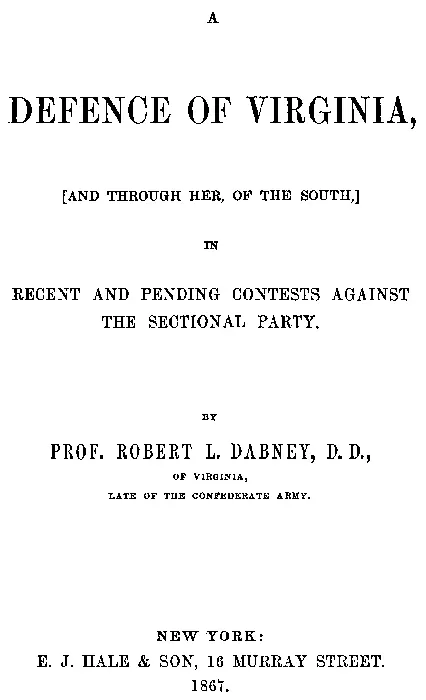
THE CLASSIC COLLECTION · 1867
"A Defence of Virginia" by Robert Lewis Dabney is a historical account written in the late 19th century. The book serves as a justification for the institution of slavery and the Southern cause during and after the American Civil War, arguing that the principles of slavery are both moral and historically valid. Dabney presents a defense of Virginia and through it, the Southern states, against what he perceives as a misrepresentation by abolitionists and their sympathizers. The opening of the text introduces the author's intent to defend Virginia, whom he views as slandered by the Northern anti-slavery sentiments that emerged during and after the Civil War. Dabney critiques the moral and social judgments placed upon Southern slavery, asserting that such judgments are rooted in a misunderstanding of history and human rights. He emphasizes that while other nations and regions continued the practice of slavery, the Southern states were unfairly targeted for disdain. Dabney sets the tone for a thorough examination of the ethical and scriptural justifications for slavery, asserting the need for a historical perspective that acknowledges Virginia's significance and the complexities surrounding the institution of slavery in America. This summary covers only the opening portion of the book.
Introduction adapted from the source catalogue; source summaries may be automatically generated.
Free to read · English · 98,110 words · No account needed
MAKE TIME FOR A GOOD BOOK
On by default. Untick to stop anonymous reading totals. Each page counts after 10 seconds in view. How this works.
Anonymous counting is on unless you have switched it off.
We believe, therefore, that we have no cause, in this respect, to lament the condition which Providence had assigned us, in placing this African Race among us. We do not envy the political condition of our detractors, Yankee and British radicals; of the former with their colluvies gentium, the off-scouring of all the ignorance and discontent of Europe, and their frantic agrarianism, which will turn, so soon as it has exhausted its expected prey from the homesteads of Southern planters, to ravage at home; and of the latter, with their disorganizing theories of human right, subversive of every bulwark of the time-honored British Constitution, and their increasing mass of turbulent pauperism.
§ 2. Slavery and Malthusianism.
Taking mankind as they are, and not as we may desire them to be, domestic slavery offered the best relation which has yet been found, between labour and capital. It is not asserted that it would be best for a Utopia, where we might imagine the humblest citizen virtuous, intelligent, and provident. But there are no such societies on earth. The business of the legislator, whether human or divine, is with mankind as they are; and while he adapts his institutions to their defects, so as to avoid making them impracticable or mischievous, he should also shape them to elevate and reform as far as possible. The legislator, therefore, in devising a frame of society, should adapt it to a state in which the rich are selfish and the poor indolent and improvident. For, after all that has been boasted of human improvement, this is usually man's condition. Now, in adjusting social institutions, it is all-important to secure physical comfort; because in a state of physical misery and degradation, moral and intellectual improvement are hopeless; and the business of the legislator is more especially to take care of the weak: the strong will take care of themselves. Property is the chief element of political strength; it is this which gives to individuals power in society; for "money answereth all things;" it commands for its possessor whatever he needs for his physical comfort and safety. The great desideratum in all benign legislation is to sustain the class which has no property, against the social depression and physical suffering to which they always tend. That there will always be such a class, at least till the millennium, is certain, for reasons already stated. Now all civilized communities exhibit a natural law which tends to depress the physical condition of those who have no property, who are, usually, the laboring classes. That law is the tendency of population to increase. The area of a country grows no larger, while the number of people in it is perpetually increasing, unless that tendency is already arrested by extreme physical evils. The same acres have, therefore, more and more mouths to feed, and backs to clothe. Consequently, each person must receive a smaller and smaller share of the total proceeds of the earth. The demand perpetually increases in proportion to the supply; and therefore the price of those productions rises, as compared with the price of labour. Hence in every flourishing community, the relative proportion between the price of land, its rents, and the food and clothing which it produces, on the one hand, and the price of manual labour on the other, is perpetually, though slowly, changing. The former rises, the latter sinks. Improvements in agriculture and the arts, extensive conquests, emigrations, or some other cause, may for a time arrest, or even reverse, this process; but such is the general law, and the constant tendency. The very prosperity and growth of the community work this result. The owners of land become richer: those who live by labour become poorer. Physical depression works moral depression, and these overcrowded and under-fed labourers, becoming more reckless, are familiarized with a lower standard of comfort, and continue to increase. This law has wrought in every growing nation on the globe which is without domestic slavery. It is felt in Great Britain, in spite of her vast colonies, where she has disgorged her superfluous mouths and hands, to occupy and feed them on virgin soils: in spite of her conquests, which have centred in her lap the wealth of continents. It has begun to work in the Northern States of America, notwithstanding the development of the arts, and the proximity of the Great West. Every where it reduces the quantity or quality of food and raiment which a day's labour will earn, and perpetually tends to approximate that lowest grade at which the labouring classes can vegetate, multiply, and toil.
Your reading position is saved on this browser. Take it to another device with a library code. Reading pages adapt to text, rather than matching a printed edition.
BEHIND THE BOOK
This eBook is for the use of anyone anywhere in the United States and most other parts of the world at no cost and with almost no restrictions whatsoever. You may copy it, give it away or re-use it under the terms of the Project Gutenberg License included with this eBook or online at www.gutenberg.org. If you are not located in the United States, you will have to check the laws of the country where you are located before using this eBook. Read the source licence.
The original source file, including credits and licence, is retained by this library. Request an original-format copy at no charge. Please include the book title and Project Gutenberg identifier #47422.
KEEP YOUR CURIOSITY GOING
Cécile Tormay

Moritz Busch
John L. Ransom
Frances Wright
Cécile Tormay

Mabel Potter Daggett