THE CLASSIC COLLECTION✦An outlaw’s diary: the CommuneCLASSIC FREE BOOKS
An outlaw’s diary: the Commune
Cécile Tormay
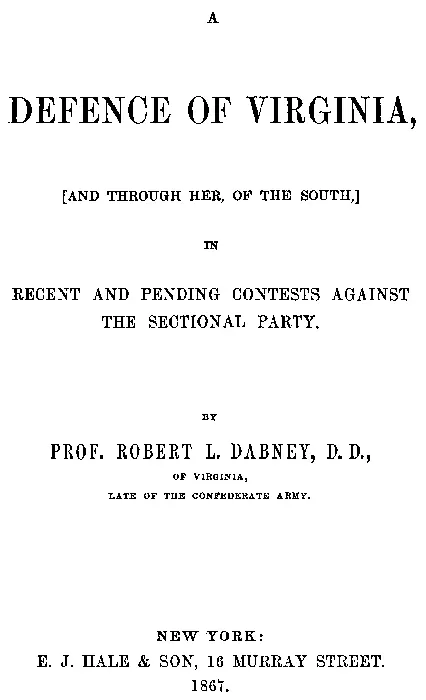
THE CLASSIC COLLECTION · 1867
"A Defence of Virginia" by Robert Lewis Dabney is a historical account written in the late 19th century. The book serves as a justification for the institution of slavery and the Southern cause during and after the American Civil War, arguing that the principles of slavery are both moral and historically valid. Dabney presents a defense of Virginia and through it, the Southern states, against what he perceives as a misrepresentation by abolitionists and their sympathizers. The opening of the text introduces the author's intent to defend Virginia, whom he views as slandered by the Northern anti-slavery sentiments that emerged during and after the Civil War. Dabney critiques the moral and social judgments placed upon Southern slavery, asserting that such judgments are rooted in a misunderstanding of history and human rights. He emphasizes that while other nations and regions continued the practice of slavery, the Southern states were unfairly targeted for disdain. Dabney sets the tone for a thorough examination of the ethical and scriptural justifications for slavery, asserting the need for a historical perspective that acknowledges Virginia's significance and the complexities surrounding the institution of slavery in America. This summary covers only the opening portion of the book.
Introduction adapted from the source catalogue; source summaries may be automatically generated.
Free to read · English · 98,110 words · No account needed
MAKE TIME FOR A GOOD BOOK
On by default. Untick to stop anonymous reading totals. Each page counts after 10 seconds in view. How this works.
Anonymous counting is on unless you have switched it off.
§ 1. Slavery and Republican Government.
Intelligent men at the South found something to reconcile them to their condition, in the wholesome influence of their form of labour, upon their republican institutions. The effect of slavery to make the temper of the ruling caste more honourable, self-governed, reflective, courteous, and chivalrous, and to foster in them an intense love of, and pride in, their free institutions, has been already asserted, and substantiated by resistless facts. The testimony of these facts is concurrent with that of all history. But those qualities are just the ones which fit a people for beneficent self-government. Again: our system disposed, at one potent touch, of that great difficulty which has beset all free governments: the difficulty of either entrusting the full franchises of the ruling caste to, or refusing them to, the moneyless class. The Word of God tells us that the poor shall always be with us. Natural differences of capacity, energy, and thrift, will always cause one part to distance the other part of the society, in the race of acquisition; and the older and denser any population becomes, the larger will be the penniless class, and the more complete their destitution as compared with the moneyed class. Shall they be refused all participation in the suffrage and powers of government? Then, by what means shall the constitution make them secure against the iniquities of class-legislation, which wickedly and selfishly sacrifices their interests and rights to the ruling class? And yet more: by what argument can they be rendered content in their political disfranchisement, when they are of the same race, colour, and class, with their unauthorized oppressors, save as money makes an artificial distinction? The perpetual throes and reluctations of the oppressed class against the oppressors, will agitate and endanger any free government; as witness the strifes of the conservative and radical parties in England, and the slumbering eruptions which the ideas of the democrats of 1848 have kindled under every throne in Western Europe. But on the other hand, if the full franchises of the ruling class be conceded to the moneyless citizens, they seize the balance of power, and virtually hold the reins over the rights, property, and lives of the moneyed classes. But the qualities which have made them continue penniless in a liberal government, together with the pressure of immediate hardship, destitution, ignorance and passion, will ever render them most unsafe hands to hold this power. The man who has "the wolf at his door," who knows not where to-morrow's dinner for his wife and babes is to be obtained, is no safe man to be entrusted with power over others' property, and submitted to all the arts and fiery passions of the demagogue. The inevitable result will be, that his passions will drive him, under the pressure of his destitution, to some of those forms of agrarianism or legislative plunder, by which order and economical prosperity are blighted; and society is compelled, like democratic France and New England, to take refuge from returning anarchy and barbarism, in the despotism of a single will. This truth cannot be more justly stated than in the language of Lord Macaulay, himself once an ardent advocate of British Reform. If the democratic States of America seemed, for a time, to offer an exception to these tendencies, it proves nothing; for in those States, the intense demand for labour, the cheapness of a virgin soil, and the rapid growth of a new and sparse population, rendered the working of the law, for a time, imperceptible. But even there, it had begun to work with a portentous power. Witness the violence and frightful mutations of their parties, the loathsome prevalence of demagogueism, and the great party of free-soil, which is but a form of agrarianism reaching out its plundering hand against the property class across Mason's and Dixon's lines, instead of the property class at home. So completely had the danger we have described been verified, even in these new and prosperous communities, that the moment a serious strain came upon their institutions, the will of the mob burst over constitutions and publick ethics like a deluge, and the pretended republicks rushed into a centralized despotism, with a speed and force which astounded the world. All the pleas of universal suffrage have received a damning and final refutation, from the events of this revolution.
Your reading position is saved on this browser. Take it to another device with a library code. Reading pages adapt to text, rather than matching a printed edition.
BEHIND THE BOOK
This eBook is for the use of anyone anywhere in the United States and most other parts of the world at no cost and with almost no restrictions whatsoever. You may copy it, give it away or re-use it under the terms of the Project Gutenberg License included with this eBook or online at www.gutenberg.org. If you are not located in the United States, you will have to check the laws of the country where you are located before using this eBook. Read the source licence.
The original source file, including credits and licence, is retained by this library. Request an original-format copy at no charge. Please include the book title and Project Gutenberg identifier #47422.
KEEP YOUR CURIOSITY GOING
Cécile Tormay

Moritz Busch
John L. Ransom
Frances Wright
Cécile Tormay

Mabel Potter Daggett