THE CLASSIC COLLECTION✦An outlaw’s diary: the CommuneCLASSIC FREE BOOKS
An outlaw’s diary: the Commune
Cécile Tormay
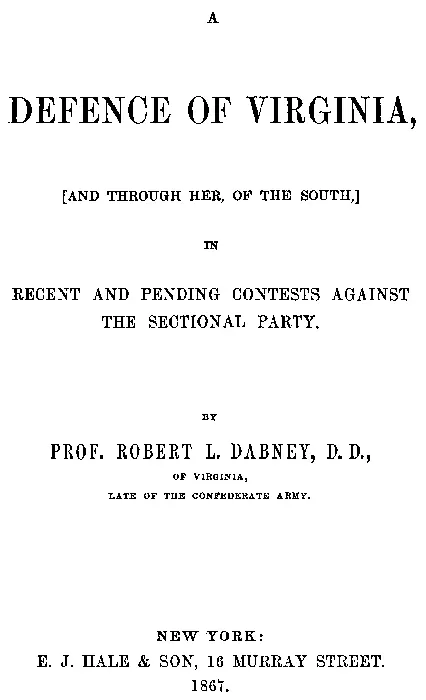
THE CLASSIC COLLECTION · 1867
"A Defence of Virginia" by Robert Lewis Dabney is a historical account written in the late 19th century. The book serves as a justification for the institution of slavery and the Southern cause during and after the American Civil War, arguing that the principles of slavery are both moral and historically valid. Dabney presents a defense of Virginia and through it, the Southern states, against what he perceives as a misrepresentation by abolitionists and their sympathizers. The opening of the text introduces the author's intent to defend Virginia, whom he views as slandered by the Northern anti-slavery sentiments that emerged during and after the Civil War. Dabney critiques the moral and social judgments placed upon Southern slavery, asserting that such judgments are rooted in a misunderstanding of history and human rights. He emphasizes that while other nations and regions continued the practice of slavery, the Southern states were unfairly targeted for disdain. Dabney sets the tone for a thorough examination of the ethical and scriptural justifications for slavery, asserting the need for a historical perspective that acknowledges Virginia's significance and the complexities surrounding the institution of slavery in America. This summary covers only the opening portion of the book.
Introduction adapted from the source catalogue; source summaries may be automatically generated.
Free to read · English · 98,110 words · No account needed
MAKE TIME FOR A GOOD BOOK
On by default. Untick to stop anonymous reading totals. Each page counts after 10 seconds in view. How this works.
Anonymous counting is on unless you have switched it off.
It is a plausible ground of opposition to slavery, to charge it with the guilt of the slave trade. It is argued that unless we are willing to justify the capture of free and innocent men, on their own soil, and their reduction from freedom to slavery, with all the enormous injustice and cruelty of the African slave trade, we must acknowledge that the title of the Southern master to his slave at this day is unrighteous; that a system which had its origin in wrong cannot become right by the lapse of time; that, if the title of the piratical slave catcher on the coast of Africa was unrighteous, he cannot sell to the purchaser any better title than he has; and that an unsound title cannot become sound by the passage of time. It need hardly be said that we abhor the injustice, cruelty, and guilt of the African slave trade. It is justly condemned by the public law of Christendom--a law which not Wilberforce, nor the British Parliament, nor British, nor Yankee Abolitionists, have the honour of originating, but the slaveholding Commonwealth of Virginia. It is condemned by the law of God. Moses placed this among the judicial statutes of the Jews: "And he that stealeth a man and selleth him, or if he be found in his hand, he shall surely be put to death." We fully admit, then, that the title of the original slave catcher to the captured African was most unrighteous. But few can be ignorant of the principle, that a title, originally bad, may be replaced by a good one, by transmission from hand to hand, and by lapse of time. When the property has been acquired, by the latest holder, fairly and honestly; when, in the later transfers, a fair equivalent was paid for it, and the last possessor is innocent of fraud in intention and in the actual mode of his acquisition of it, more wrong would be effected by destroying his title, than by leaving the original wrong unredressed. Common sense says, that whatever may have been the original title, a new and valid one has arisen out of the circumstances of the case. If this principle be denied, half the property of the civilized world will be divorced from its present owners. All now agree that the pretext which gave ground for the conquest of William of Normandy was wicked; and however just it might have been, by the laws of nations, the conquest of the government of a country ought not to disturb the rights of individuals in private property. The Norman Conquest resulted in a complete transfer of almost all the land in England to the hands of new proprietors; and nearly all the land titles of England, at the present day, are the legal progeny of that iniquitous robbery, which transferred the territory of the kingdom from the Saxon to the Norman barons. If lapse of time, and change of hands, cannot make a bad title good, then few of the present landlords of England have any right to their estates. Upon the same principles, the tenants leasing from them have no right to their leases, and consequently they have no right to the productions of the farms they hold. If they have no right to those productions, then they cannot communicate any right to those who purchase from them; so that no man eating a loaf of English bread, or wearing a coat of English wool, could be certain that he was not consuming what was not his own. Thus extravagant and absurd are the results of such a principle. Let us apply to the abolitionists their own argument, and we shall unseat the most of them from the snug homes whence they hurl denunciations at us. It is well known that their forefathers obtained the most of that territory from the poor Indians, either by fraud or violence. If lapse of time and subsequent transfers cannot make a sound title in place of an unsound one, then few of the people of the North have any right to the lands they hold; and, as honest men, they are bound to vacate them. To this even as great a man as Dr. Wayland, the philosopher of abolitionism, has attempted an answer, by saying that this right, arising from possession, only holds so long as the true, original owner, or the inheritor of his right, does not appear; and that, when he appears, the right of possession perishes at once. But he argues, the original and true claimant to the ownership of the slave is always present, in the person of the slave himself; so that the right originating in possession cannot exist for a moment. Without staying to inquire whether the presence of the inheritor of the original right necessarily puts an end to this right of possession--a proposition worse than questionable--I would simply remark, that, to represent the slave himself as the possessor of the original right, is a complete begging of the question. It assumes the very point in dispute, whether the right of the master is sound or not. And we would add, what would the courts of New England, what would Dr. Wayland say, should the feeble remnants of the New England Indians, who are yet lingering in those States, claim all the fair domains of their tribe? And what would be said in England, if the people of Saxon descent should rise upon all those noble houses who boast a Norman origin, and claim their princely estates?
Your reading position is saved on this browser. Take it to another device with a library code. Reading pages adapt to text, rather than matching a printed edition.
BEHIND THE BOOK
This eBook is for the use of anyone anywhere in the United States and most other parts of the world at no cost and with almost no restrictions whatsoever. You may copy it, give it away or re-use it under the terms of the Project Gutenberg License included with this eBook or online at www.gutenberg.org. If you are not located in the United States, you will have to check the laws of the country where you are located before using this eBook. Read the source licence.
The original source file, including credits and licence, is retained by this library. Request an original-format copy at no charge. Please include the book title and Project Gutenberg identifier #47422.
KEEP YOUR CURIOSITY GOING
Cécile Tormay

Moritz Busch
John L. Ransom
Frances Wright
Cécile Tormay

Mabel Potter Daggett