THE CLASSIC COLLECTION✦An outlaw’s diary: the CommuneCLASSIC FREE BOOKS
An outlaw’s diary: the Commune
Cécile Tormay
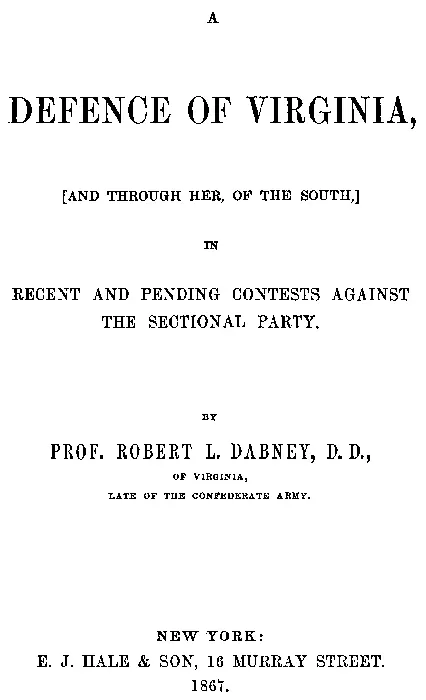
THE CLASSIC COLLECTION · 1867
"A Defence of Virginia" by Robert Lewis Dabney is a historical account written in the late 19th century. The book serves as a justification for the institution of slavery and the Southern cause during and after the American Civil War, arguing that the principles of slavery are both moral and historically valid. Dabney presents a defense of Virginia and through it, the Southern states, against what he perceives as a misrepresentation by abolitionists and their sympathizers. The opening of the text introduces the author's intent to defend Virginia, whom he views as slandered by the Northern anti-slavery sentiments that emerged during and after the Civil War. Dabney critiques the moral and social judgments placed upon Southern slavery, asserting that such judgments are rooted in a misunderstanding of history and human rights. He emphasizes that while other nations and regions continued the practice of slavery, the Southern states were unfairly targeted for disdain. Dabney sets the tone for a thorough examination of the ethical and scriptural justifications for slavery, asserting the need for a historical perspective that acknowledges Virginia's significance and the complexities surrounding the institution of slavery in America. This summary covers only the opening portion of the book.
Introduction adapted from the source catalogue; source summaries may be automatically generated.
Free to read · English · 98,110 words · No account needed
MAKE TIME FOR A GOOD BOOK
On by default. Untick to stop anonymous reading totals. Each page counts after 10 seconds in view. How this works.
Anonymous counting is on unless you have switched it off.
Wisdom would infer, on the contrary, that the habitual exercise of authority, approved as righteous by the ruler's conscience, tends to elevate his character. He who would govern others must first govern himself. Hence, we should expect to find him who is compelled to exercise a hereditary and rightful authority, a man more self-governed, thoughtful, considerate, firm, and dignified, than other men. The habit of providing constantly for a number of persons, whom he is impelled by the strongest self-interest to care for efficiently, should render a man considerate of others, and benevolent. Experience will soon teach the head of such an estate, that his relation with his dependents must be any thing else than a carnival of self-indulgence, violence, and tyranny; for such a life will speedily leave him no servants to abuse. On the contrary, the very necessities of his position compel him to be, to a certain extent, provident, methodical, and equitable. Without these virtues, his estate slips rapidly away. And who, that knows human nature, can fail to see the powerful effects of the institution in developing, in the ruling caste, a higher sentiment of personal honour, chivalry, and love of liberty? This was asserted of the slaveholders of Virginia and the Carolinas by the sagacious Burke. It is very true, that if every man in the country were under the vital influence of Christian sanctification, he would not need these more human influences to elevate his character. But the wise statesman takes men as they are, not as they should be. Until the millennium, the elevating influences of social position will continue to be of great practical value. Yankeedom, at least, continues thus far to exhibit a great want of them.
But now, in considering the actual influences of slavery on the morals of the Africans, let the reader remember what they actually were before they were placed under this tutelage. He may be sure they were not what abolitionism loves to picture them, a sort of Ebony Arcadians, full of simple, pastoral purity, and of what infidels vainly prate as the dignity of native virtue. It is not slavery which has degraded them from that imaginary elevation. On the contrary, they were what God's word declares human depravity to be under the degrading effects of paganism. Let the reader see the actual and true picture, in the first chapter of Romans, and in authentic descriptions of the negro in his own jungles, such as the invaluable work of Dr. John Leighton Wilson, on the tribes of the Guinea coast. And here, moreover, he will find proof, that the type of savage life brought to America originally by the slave trade, was far below that witnessed in Africa among the more noticeable tribes; because the great bulk of the slaves were either the Pariahs of that barbarous society, or the kidnapped members of the feeble fragments of bush tribes, who had nearly perished before the comparative civilization of the Mandingoes and Greboes, living but one remove above the apes around them. Now cannot common sense see the moral advantage to such a people, of subjection to the will of a race elevated above them, in morals and intelligence, to an almost measureless degree? Is it no moral advantage to be compelled to wear decent clothing, and to observe at least the outward proprieties which should obtain between the sexes? None to be taught industry, in place of pagan laziness; and methodical habits, in place of childish waste and unthrift? The destructive effects of the savage's common vices, lying, theft, drunkenness, laziness, waste, upon business and pecuniary interests, will of course prompt masters to repress those vices, if no higher motive does. Is this no gain for the poor pagan? Especially does the matter of drunkenness illustrate, in a splendid manner, the benign effects of our system on African character and happiness. Place any savage race beside a civilized and commercial people, and leave them free; and the speedy result is, that the "fire-water" consumes and depopulates them. Witness the North American Indians. But here was just such a race, in the midst of the temptation and opportunity, and yet preserved from all appreciable evil from this source, and advancing in physical comfort, manners, and numbers, more rapidly than any white race in Christendom. While numbers of Africans exhibited just that weakness for ardent spirits, which is to be expected in people lately barbarians, yet so wholesome were the restraints of that regular and constant occupation enforced upon them, it was the rarest thing in the world that a farm-servant filled a drunkard's grave among us. But now the flood-gates are opened. Was not Dr. Wayland a temperance man? Southern slavery was the most efficient temperance society in the world.
Your reading position is saved on this browser. Take it to another device with a library code. Reading pages adapt to text, rather than matching a printed edition.
BEHIND THE BOOK
This eBook is for the use of anyone anywhere in the United States and most other parts of the world at no cost and with almost no restrictions whatsoever. You may copy it, give it away or re-use it under the terms of the Project Gutenberg License included with this eBook or online at www.gutenberg.org. If you are not located in the United States, you will have to check the laws of the country where you are located before using this eBook. Read the source licence.
The original source file, including credits and licence, is retained by this library. Request an original-format copy at no charge. Please include the book title and Project Gutenberg identifier #47422.
KEEP YOUR CURIOSITY GOING
Cécile Tormay

Moritz Busch
John L. Ransom
Frances Wright
Cécile Tormay

Mabel Potter Daggett