THE CLASSIC COLLECTION✦An outlaw’s diary: the CommuneCLASSIC FREE BOOKS
An outlaw’s diary: the Commune
Cécile Tormay
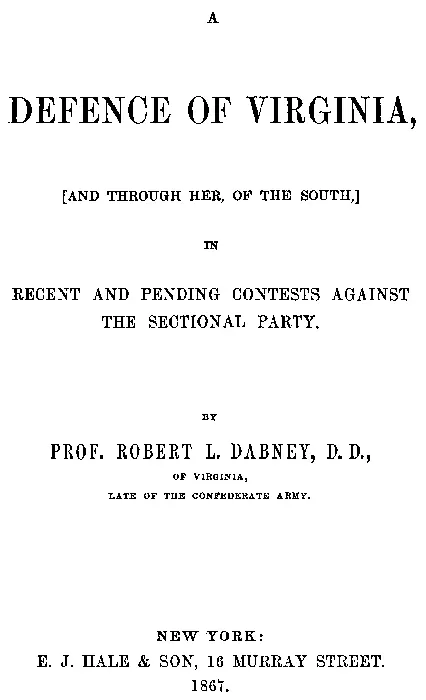
THE CLASSIC COLLECTION · 1867
"A Defence of Virginia" by Robert Lewis Dabney is a historical account written in the late 19th century. The book serves as a justification for the institution of slavery and the Southern cause during and after the American Civil War, arguing that the principles of slavery are both moral and historically valid. Dabney presents a defense of Virginia and through it, the Southern states, against what he perceives as a misrepresentation by abolitionists and their sympathizers. The opening of the text introduces the author's intent to defend Virginia, whom he views as slandered by the Northern anti-slavery sentiments that emerged during and after the Civil War. Dabney critiques the moral and social judgments placed upon Southern slavery, asserting that such judgments are rooted in a misunderstanding of history and human rights. He emphasizes that while other nations and regions continued the practice of slavery, the Southern states were unfairly targeted for disdain. Dabney sets the tone for a thorough examination of the ethical and scriptural justifications for slavery, asserting the need for a historical perspective that acknowledges Virginia's significance and the complexities surrounding the institution of slavery in America. This summary covers only the opening portion of the book.
Introduction adapted from the source catalogue; source summaries may be automatically generated.
Free to read · English · 98,110 words · No account needed
MAKE TIME FOR A GOOD BOOK
On by default. Untick to stop anonymous reading totals. Each page counts after 10 seconds in view. How this works.
Anonymous counting is on unless you have switched it off.
[Footnote 5: Herring, Stat. at Large, vol. ii., p. 516.]
[Footnote 6: Campbell's Virginia, p. 304.]
The planting of the commercial States of North America began with the colony of Puritan Independents at Plymouth, in 1620, which was subsequently enlarged into the State of Massachusetts. The other trading colonies, Rhode Island and Connecticut, as well as New Hampshire (which never had an extensive shipping interest), were offshoots of Massachusetts. They partook of the same characteristics and pursuits; and hence, the example of the parent colony is taken here as a fair representation of them. The first ship from America, which embarked in the African slave trade, was the Desire, Captain Pierce, of Salem; and this was among the first vessels ever built in the colony. The promptitude with which the "Puritan Fathers" embarked in this business may be comprehended, when it is stated that the Desire sailed upon her voyage in June, 1637.[7] The first feeble and dubious foothold was gained by the white man at Plymouth less than seventeen years before; and as is well known, many years were expended by the struggle of the handful of settlers for existence. So that it may be correctly said, that the commerce of New England was born of the slave trade; as its subsequent prosperity was largely founded upon it. The Desire, proceeding to the Bahamas, with a cargo of "dry fish and strong liquors, the only commodities for those parts," obtained the negroes from two British men-of-war, which had captured them from a Spanish slaver.
[Footnote 7: Winthrop's Journal, i., 254. Moore's Slavery in Mass.,
pp. 5, 6.]
To understand the growth of the New England slave trade, two connected topics must be a little illustrated. The first of these is the enslaving of Indians. The pious "Puritan Fathers" found it convenient to assume that they were God's chosen Israel, and the pagans about them were Amalek and Amorites. They hence deduced their righteous title to exterminate or enslave the Indians, whenever they became troublesome. As soon as the Indian wars began, we find the captives enslaved. The ministers and magistrates solemnly authorized the enslaving of the wives and posterity of their enemies for the crimes of the fathers and husbands in daring to defend their own soil. In 1646, the Commissioners of the United Colonies made an order,[8] that upon complaint of a trespass by Indians, any of that plantation of Indians that should entertain, protect, or rescue the offender, might be seized by reprisal, and held as hostages for the delivery of the culprits; in failure of which, the innocent persons seized should be slaves, and be exported for sale as such. In 1677, the General Court of Massachusetts[9] ordered the enslaving of the Indian youths or girls "of such as had been in hostility with the colony, or had lived among its enemies in the time of the War." In the winter of 1675-6, Major Waldron, commissioner of the General Court for that territory now included in Maine, issued a general warrant for seizing, enslaving, and exporting every Indian "known to be a manslayer, traitor, or conspirator."[10] The reader will not be surprised to hear, that so monstrous an order, committed for execution to any or every man's irresponsible hands, was employed by many shipmasters for the vilest purposes of kidnapping and slave hunting. But in addition, in numerous instances whole companies of peaceable and inoffensive Indians, submitting to the colonial authorities, were seized and enslaved by publick order. In one case one hundred and fifty of the Dartmouth tribe, including their women and children, coming in by a voluntary submission, and under a general pledge of amnesty, and in another instance, four hundred of a different tribe, were shamelessly enslaved. By means of these proceedings, the numbers of Indian servants became so large, that they were regarded as dangerous to the Colony. They were, moreover, often untameable in temper, prone to run away to their kinsmen in the neighbouring wilderness, and much less docile and effective for labour than the "blackamoors." Hence the prudent and thrifty saints saw the advantage of exporting them to the Bermudas, Barbadoes, and other islands, in exchange for negroes and merchandise; and this traffick, being much encouraged, and finally enjoined, by the authorities, became so extensive as to substitute negroes for Indian slaves, almost wholly in the Colony.[11] Among the slaves thus deported were the favourite wife and little son of the heroic King Philip. The holy Independent Divines, Cotton, Arnold, and Increase Mather, inclined to the opinion that he should be slain for his father's sins, after the example of the children of Achan and Agag;[12] but the authorities probably concluded that his deportation would be a more profitable, as well as a harsher punishment. These shocking incidents will no longer appear incredible to the reader, when he is informed that the same magistrates sold and transported into foreign slavery two English children, one of them a girl, for attending a Quaker meeting;[13] while the adult ladies present were fined £10 each, and whipped.[14]
Your reading position is saved on this browser. Take it to another device with a library code. Reading pages adapt to text, rather than matching a printed edition.
BEHIND THE BOOK
This eBook is for the use of anyone anywhere in the United States and most other parts of the world at no cost and with almost no restrictions whatsoever. You may copy it, give it away or re-use it under the terms of the Project Gutenberg License included with this eBook or online at www.gutenberg.org. If you are not located in the United States, you will have to check the laws of the country where you are located before using this eBook. Read the source licence.
The original source file, including credits and licence, is retained by this library. Request an original-format copy at no charge. Please include the book title and Project Gutenberg identifier #47422.
KEEP YOUR CURIOSITY GOING
Cécile Tormay

Moritz Busch
John L. Ransom
Frances Wright
Cécile Tormay

Mabel Potter Daggett