THE CLASSIC COLLECTION✦An outlaw’s diary: the CommuneCLASSIC FREE BOOKS
An outlaw’s diary: the Commune
Cécile Tormay
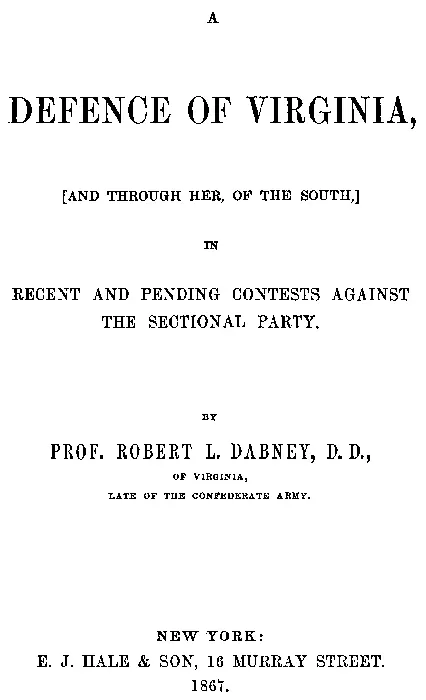
THE CLASSIC COLLECTION · 1867
"A Defence of Virginia" by Robert Lewis Dabney is a historical account written in the late 19th century. The book serves as a justification for the institution of slavery and the Southern cause during and after the American Civil War, arguing that the principles of slavery are both moral and historically valid. Dabney presents a defense of Virginia and through it, the Southern states, against what he perceives as a misrepresentation by abolitionists and their sympathizers. The opening of the text introduces the author's intent to defend Virginia, whom he views as slandered by the Northern anti-slavery sentiments that emerged during and after the Civil War. Dabney critiques the moral and social judgments placed upon Southern slavery, asserting that such judgments are rooted in a misunderstanding of history and human rights. He emphasizes that while other nations and regions continued the practice of slavery, the Southern states were unfairly targeted for disdain. Dabney sets the tone for a thorough examination of the ethical and scriptural justifications for slavery, asserting the need for a historical perspective that acknowledges Virginia's significance and the complexities surrounding the institution of slavery in America. This summary covers only the opening portion of the book.
Introduction adapted from the source catalogue; source summaries may be automatically generated.
Free to read · English · 98,110 words · No account needed
MAKE TIME FOR A GOOD BOOK
On by default. Untick to stop anonymous reading totals. Each page counts after 10 seconds in view. How this works.
Anonymous counting is on unless you have switched it off.
It has been currently asserted that the premises of the abolitionists were embraced in the Declaration of Independence; so that the United States have been committed to them from the beginning. The words usually referred to are the following: "That all men are created equal: that they are endowed by their Creator with certain inalienable rights: that among these are life, liberty, and the pursuit of happiness. That to secure these rights governments are instituted among men, deriving their just powers from the consent of the governed," etc. If by these celebrated propositions it was meant that there ever was, or could be, a government where all men enjoyed the same measure of privilege, then it is false. If it was meant that there ever was, or could be, a state of society in which all men could indulge their volitions to the same extent, and that, in every case, the full extent, it is false; for natural and unavoidable differences of persons must ever prevent this. If it were meant that all men are naturally equal, then it would be false; for men are born with different bodily and mental powers, different moral qualities, and different inheritances of rights. If it was meant that every person enters life free from just controul, it is false; for we all begin our existence rightfully subject, irrespective of our consent, to authority in family and State. Neither God nor nature makes it optional with us whether we will be subject to government. But if it be meant that all men are created equal in this sense, that all are children of a common heavenly Father, all common subjects of the law of equity expressed in the "Golden Rule," each one as truly entitled to possess the set of rights justly appropriate to him, (and by the same reason,) as any other is entitled to his set of rights; this is true, and a glorious truth. This is man's moral equality. It means that, under God, the servant is as much entitled to the rights and privileges of a justly-treated servant, as the master is to the rights of a master; that the commoner is as much entitled to the just privileges of a commoner, as a peer to those of a peer. It is the truthful boast of Englishmen, that in their land every man is equal before the law. What does this mean? Does it mean that Lord Derby has no other franchises and privileges than the day-labourer? By no means. But the privileges allotted to the day-labourer by the laws are defended by the same institutions, and adjudicated by the same free principles, and made legally as inviolable, as the very different and larger privileges of Earl Derby. It is in this sense that a just and liberal government holds all men by nature equal. And if, when the Declaration of Independence says that the right of all men to their liberty is "inalienable," the proper definition of civil liberty is accepted, (that it only means privilege to do what each man, in his peculiar circumstances, has a moral right to do,) this also is universally true. But all this is perfectly consistent with differences of social condition, and station, and privilege; where characters and relations are different. As we have seen, the servant for life, who as a slave receives "those things which are just and equal," has his true liberty, though it is different from that of the free citizen; and the servant can no more be justly stripped of this his modicum of liberty, than the master of his. Last, when it is declared that "governments derive their just powers from the consent of the governed," there is a sense in which it is true, and one in which it is false. In one sense, they derive their just powers from God, his law, and providence. In the other sense, that the people are not for their rulers, but the rulers for their people, the selection of particular forms of constitution and of the individuals to execute the functions, belongs to the aggregate rectitude and intelligence of the commonwealth, expressed in some way practically fair. But by "the consent of the governed," our wise fathers never intended the consent of each particular human being, competent and incompetent. They intended the representative commonwealth as a body, the "populus," or aggregate corporation of that part of the human beings properly wielding the franchises of full citizens. Their proposition is general, and not particular. The men of 1776 were not vain Ideologues; they were sagacious, practical Englishmen. Thus understood, as every correct thinker does, they teach nothing against difference of privilege among the subjects of government; and consequently, nothing inconsistent with the servitude of those who are found incapable of beneficially possessing a fuller liberty.
Your reading position is saved on this browser. Take it to another device with a library code. Reading pages adapt to text, rather than matching a printed edition.
BEHIND THE BOOK
This eBook is for the use of anyone anywhere in the United States and most other parts of the world at no cost and with almost no restrictions whatsoever. You may copy it, give it away or re-use it under the terms of the Project Gutenberg License included with this eBook or online at www.gutenberg.org. If you are not located in the United States, you will have to check the laws of the country where you are located before using this eBook. Read the source licence.
The original source file, including credits and licence, is retained by this library. Request an original-format copy at no charge. Please include the book title and Project Gutenberg identifier #47422.
KEEP YOUR CURIOSITY GOING
Cécile Tormay

Moritz Busch
John L. Ransom
Frances Wright
Cécile Tormay

Mabel Potter Daggett