THE CLASSIC COLLECTION✦An outlaw’s diary: the CommuneCLASSIC FREE BOOKS
An outlaw’s diary: the Commune
Cécile Tormay
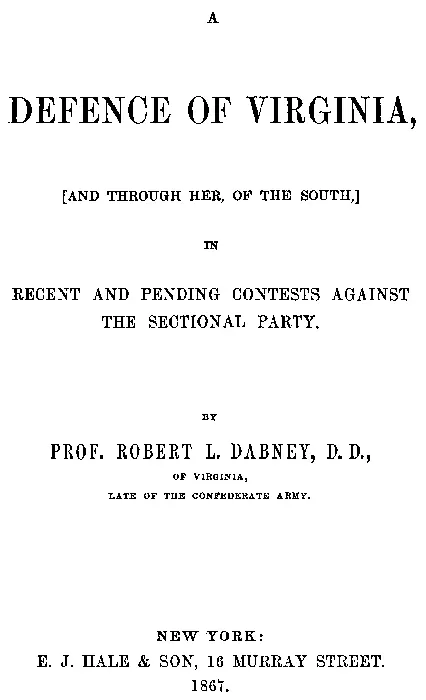
THE CLASSIC COLLECTION · 1867
"A Defence of Virginia" by Robert Lewis Dabney is a historical account written in the late 19th century. The book serves as a justification for the institution of slavery and the Southern cause during and after the American Civil War, arguing that the principles of slavery are both moral and historically valid. Dabney presents a defense of Virginia and through it, the Southern states, against what he perceives as a misrepresentation by abolitionists and their sympathizers. The opening of the text introduces the author's intent to defend Virginia, whom he views as slandered by the Northern anti-slavery sentiments that emerged during and after the Civil War. Dabney critiques the moral and social judgments placed upon Southern slavery, asserting that such judgments are rooted in a misunderstanding of history and human rights. He emphasizes that while other nations and regions continued the practice of slavery, the Southern states were unfairly targeted for disdain. Dabney sets the tone for a thorough examination of the ethical and scriptural justifications for slavery, asserting the need for a historical perspective that acknowledges Virginia's significance and the complexities surrounding the institution of slavery in America. This summary covers only the opening portion of the book.
Introduction adapted from the source catalogue; source summaries may be automatically generated.
Free to read · English · 98,110 words · No account needed
MAKE TIME FOR A GOOD BOOK
On by default. Untick to stop anonymous reading totals. Each page counts after 10 seconds in view. How this works.
Anonymous counting is on unless you have switched it off.
Another charge against us is, that our laws abrogated the rights of marriage among slaves, authorized their capricious separation by masters, and thus consigned them to promiscuous concubinage, like that of beasts. Now, first, admitting defect in our legislation here, let us ask, how much of the blame of the continuance of this defect is chargeable upon the frantic attacks of abolitionists upon us? Every sensible man can understand, that a people so fiercely assailed in their vital rights should be occupied solely by righteous defence, and should feel the time unsuited for the discussion of innovations, however needful. And next, let it be understood what the South has really done, and has not done, herein, and it will appear that an amazing misrepresentation is made of the whole case. The form of the charge usually is, that our laws deprived the slaves of all marital rights. This is, first, a monstrous perversion of the facts, in that the Africans never had any marital rights or domestic institutions to be deprived of. Have men forgotten, that in their native country there was no marriage, and no marriage law, but the negroes either lived in vagrant concubinage, or held their plurality of wives as slaves, to be either sold or slain at will? They have, at least, lost nothing, then; and the utmost that could be charged upon our legislation is, that it did not undertake to innovate upon their own native usages; that it did not force upon them marital restraints, and penalties for their breach, which the Africans were disqualified either to understand or value, which they would have regarded as a more cruel burden than their bondage. Next, our laws did not, as many seem to represent, prohibit, or delegalize the marriage of slaves; but were simply silent about them. The meaning of this silence was, to leave the whole matter to the controul of the master. It appears almost impossible for anti-slavery men to be made to apprehend the nature of the institution, as described in the words, 'domestic slavery.' Their minds, perverted with vain dreams of the powers and perfectibility of the State, cannot be made to apprehend that God has made other parties than the commonwealth and the civil magistrate, depositories of ruling power; and that this arrangement is right and benevolent. Now, it is the genius of slavery, to make the family the slave's commonwealth. The family is his State. The master is his magistrate and legislator, in all save certain of the graver criminal relations, in which the commonwealth deals directly and personally with him. He is a member of municipal society only through his master, who represents him. The commonwealth knows him as only a life-long minor under the master's tutelage. The integers of which the commonwealth aggregate is made up, are not single human beings, but single families, authoritatively represented in the father and master. And this is the fundamental difference between the theory of the Bible, and that of radical democracy. The silence of our laws, then, concerning the marriage of slaves, means precisely this: that the whole subject is remitted to the master, the chief magistrate of the little integral commonwealth, the family. Obviously, therefore, the question whether our laws were defective therein, is in no sense a question between the living of the slaves in marriage or in beastly license; it is only a question whether, in the distribution of ruling functions, those of the master were not made too large and responsible, herein. And if error be admitted in this respect, it cannot be one which makes the relation of servitude sinful; for then the same crime must be fixed on all the patriarchs, notwithstanding their care in rightly ordering and preserving, as family heads, the marital relations of their children and slaves, because, forsooth, there happened to be no commonwealth law above them, as patriarchs, regulative of these marriages. This is nonsense. Where the modern patriarch, the Southern master, rightly ordered and protected the marriage relations of his slaves, the silence of the commonwealth no more made their connexions concubinage, than were those of Isaac, and of Abraham's steward, Eliezer of Damascus. What magistrate or legislature, other than Abraham, issued their marriage license? Who else enforced their marriage law or defined its rights? What civic agent solemnized the ceremonial for them? And this leads to another remark: that that ceremonial is wholly unessential to the validity of marriage. Of course, where the laws enjoin it for any class, every good citizen will observe it. But the absence of such ordained ceremonial does not make lawful marriage impossible. In this sense, consensus facit nuptias. It was thus that the holiest wedlock ever seen on earth was instituted, that of Adam and Eve; thus Abraham and Sarah, Isaac and Rebekah, were united. The fact that our laws pronounce the unions of Quakers and of Jews, legitimate marriage, although announced with different forms, and indeed almost without form, evinces this truth.
Your reading position is saved on this browser. Take it to another device with a library code. Reading pages adapt to text, rather than matching a printed edition.
BEHIND THE BOOK
This eBook is for the use of anyone anywhere in the United States and most other parts of the world at no cost and with almost no restrictions whatsoever. You may copy it, give it away or re-use it under the terms of the Project Gutenberg License included with this eBook or online at www.gutenberg.org. If you are not located in the United States, you will have to check the laws of the country where you are located before using this eBook. Read the source licence.
The original source file, including credits and licence, is retained by this library. Request an original-format copy at no charge. Please include the book title and Project Gutenberg identifier #47422.
KEEP YOUR CURIOSITY GOING
Cécile Tormay

Moritz Busch
John L. Ransom
Frances Wright
Cécile Tormay

Mabel Potter Daggett