
In the Name of the People
Arthur W. Marchmont
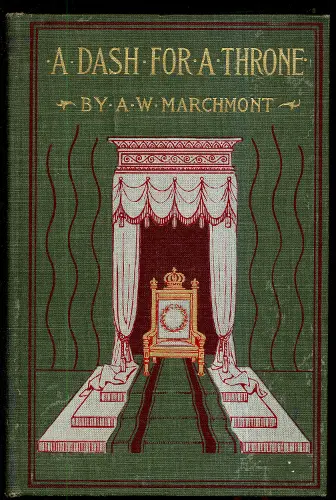
THE CLASSIC COLLECTION · 1899
"A Dash for a Throne" by Arthur W. Marchmont is a novel written in the late 19th century. The narrative revolves around a complex tale of intrigue, identity, and royal ambition as the protagonist grapples with the consequences of a long-hidden past and the burden of sudden responsibility. At the center is the main character, who, after faking his own death to escape the repercussions of a fatal altercation, finds himself thrust into a web of courtly politics upon assumed royal lineage—and the looming peril that accompanies it. At the start of the book, the protagonist is introduced as a man who has spent five years evading the past after an incident with a royal prince nearly cost him his life. Feeling compelled to disappear, he is assumed dead by all, but fate complicates things when he learns of the death of a prince and discovers he is now positioned as the potential heir. He experiences conflicting emotions about his new role while reflecting on a beautiful young woman, Minna, who is entangled in his fate. The opening sets the stage for a narrative filled with deception, ambition, and the stirring challenges of leadership as he must navigate treacherous court dynamics and confront the pending threats to both Minna and his newfound authority.
Introduction adapted from the source catalogue; source summaries may be automatically generated.
Free to read · English · 97,145 words · No account needed
MAKE TIME FOR A GOOD BOOK
On by default. Untick to stop anonymous reading totals. Each page counts after 10 seconds in view. How this works.
Anonymous counting is on unless you have switched it off.
For another week at least I dared not make an enemy of my altogether unexpected and vastly unwelcome visitor, so I answered her with a smile, and went to greet her with outstretched hand, as though glad enough to renew our old acquaintance.
"I know you now," I said cordially. "Of course it is my old friend and comrade Clara Weylin. This is an unexpected pleasure," said I warmly.
But she stepped back, and did not take my hand.
"Unexpected, no doubt; but pleasure, scarcely. You were not much of an actor at any time; but that would not take in a fool. You are very much astonished to see me, and equally angry; so you may as well acknowledge it."
She tapped her foot again angrily. Next she removed an outer veil, which she had of course put on to mystify me on her entrance; and she stood staring me in the face with a look of defiant hostility.
I shrugged my shoulders, and said:
"You are always more beautiful in a passion, Clara; but I'm sorry to find you in one now with me. Won't you sit down and tell me all about yourself?"
And I recalled regretfully our last interview, and bitterly deplored my stupidity in not having answered her letter. An angry woman, knowing what she knew, could do no end of mischief at this juncture.
"The chief thing about myself, as you say," she exclaimed spitefully, "is that my feelings toward you have changed. I was your friend then, now I will be your enemy."
"Then I am very sorry to hear it"--and the tone was genuine enough.
"But, under the circumstances, why take the trouble to come and tell me
so?"
"Because I wished to see your Highness, to observe how your Highness bore your great honors, and to bask in the radiant light of your Highness's eyes--ugh! Your Highness, indeed!"
I began to hope. Her bitterness was so very bitter that I thought some of it at least might be assumed.
"How do you play at that game, Clara?" I laughed. "While you are
'basking,' what should I do?"
"Not flatter me with lies about being glad to see me," she burst out angrily, "when you would rather have seen the devil."
"I won't go so far as that," said I lightly. "I don't admire the devil, and I always did admire you, though, if you wish me to be candid, I would much rather have seen you at another time."
"Perhaps after you are married," she cried, with a vicious glance.
"I did not say I wished never to see you again," I returned.
Your reading position is saved on this browser. Take it to another device with a library code. Reading pages adapt to text, rather than matching a printed edition.
Arthur W. Marchmont
Arthur W. Marchmont
Arthur W. Marchmont
Arthur W. Marchmont
BEHIND THE BOOK
This eBook is for the use of anyone anywhere in the United States and most other parts of the world at no cost and with almost no restrictions whatsoever. You may copy it, give it away or re-use it under the terms of the Project Gutenberg License included with this eBook or online at www.gutenberg.org. If you are not located in the United States, you will have to check the laws of the country where you are located before using this eBook. Read the source licence.
The original source file, including credits and licence, is retained by this library. Request an original-format copy at no charge. Please include the book title and Project Gutenberg identifier #40907.
KEEP YOUR CURIOSITY GOING
Coulson Kernahan

Maurice Baring
Frances Wright
Cécile Tormay

Frederic Jesup Stimson

W. H. P. (William Henry Pope) Jarvis