
Europe and elsewhere
Mark Twain
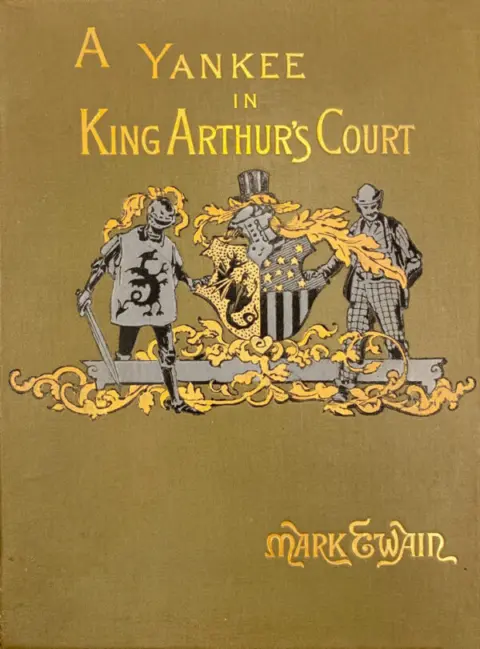
THE CLASSIC COLLECTION · 1889
"A Connecticut Yankee in King Arthur's Court" by Mark Twain is a novel published in 1889. When Hank Morgan, a Connecticut engineer, receives a blow to the head, he awakens in medieval England during King Arthur's reign. Using his modern knowledge, he poses as a powerful magician and becomes the king's chief adviser. Hank attempts to modernize the past and implement democratic reforms, but faces opposition from Merlin, the nobility, and the Church in this satirical tale about progress, power, and conflicting eras.
Introduction adapted from the source catalogue; source summaries may be automatically generated.
Free to read · English · 117,579 words · No account needed
MAKE TIME FOR A GOOD BOOK
On by default. Untick to stop anonymous reading totals. Each page counts after 10 seconds in view. How this works.
Anonymous counting is on unless you have switched it off.
The next morning Sandy assembled the swine in the dining-room and gave them their breakfast, waiting upon them personally and manifesting in every way the deep reverence which the natives of her island, ancient and modern, have always felt for rank, let its outward casket and the mental and moral contents be what they may. I could have eaten with the hogs if I had had birth approaching my lofty official rank; but I hadn't, and so accepted the unavoidable slight and made no complaint. Sandy and I had our breakfast at the second table. The family were not at home. I said:
“How many are in the family, Sandy, and where do they keep themselves?”
“Family?”
“Yes.”
“Which family, good my lord?”
“Why, this family; your own family.”
“Sooth to say, I understand you not. I have no family.”
“No family? Why, Sandy, isn't this your home?”
“Now how indeed might that be? I have no home.”
“Well, then, whose house is this?”
“Ah, wit you well I would tell you an I knew myself.”
“Come--you don't even know these people? Then who invited us here?”
“None invited us. We but came; that is all.”
“Why, woman, this is a most extraordinary performance. The effrontery of it is beyond admiration. We blandly march into a man's house, and cram it full of the only really valuable nobility the sun has yet discovered in the earth, and then it turns out that we don't even know the man's name. How did you ever venture to take this extravagant liberty? I supposed, of course, it was your home. What will the man say?”
“What will he say? Forsooth what can he say but give thanks?”
“Thanks for what?”
Her face was filled with a puzzled surprise:
“Verily, thou troublest mine understanding with strange words. Do ye dream that one of his estate is like to have the honor twice in his life to entertain company such as we have brought to grace his house withal?”
“Well, no--when you come to that. No, it's an even bet that this is the first time he has had a treat like this.”
“Then let him be thankful, and manifest the same by grateful speech and due humility; he were a dog, else, and the heir and ancestor of dogs.”
To my mind, the situation was uncomfortable. It might become more so. It might be a good idea to muster the hogs and move on. So I said:
“The day is wasting, Sandy. It is time to get the nobility together
and be moving.”
“Wherefore, fair sir and Boss?”
“We want to take them to their home, don't we?”
Your reading position is saved on this browser. Take it to another device with a library code. Reading pages adapt to text, rather than matching a printed edition.
BEHIND THE BOOK
This eBook is for the use of anyone anywhere in the United States and most other parts of the world at no cost and with almost no restrictions whatsoever. You may copy it, give it away or re-use it under the terms of the Project Gutenberg License included with this eBook or online at www.gutenberg.org. If you are not located in the United States, you will have to check the laws of the country where you are located before using this eBook. Read the source licence.
The original source file, including credits and licence, is retained by this library. Request an original-format copy at no charge. Please include the book title and Project Gutenberg identifier #86.
KEEP YOUR CURIOSITY GOING
Wilfrid Scawen Blunt
Wilfrid Scawen Blunt

E. W. (Edgar Watson) Howe
Coulson Kernahan

Maurice Baring
Frances Wright


