
The Writing of News A Handbook with Chapters on Newspaper Correspondence and Copy Reading
Charles G. (Charles Griffith) Ross
THE CLASSIC COLLECTION · 1740
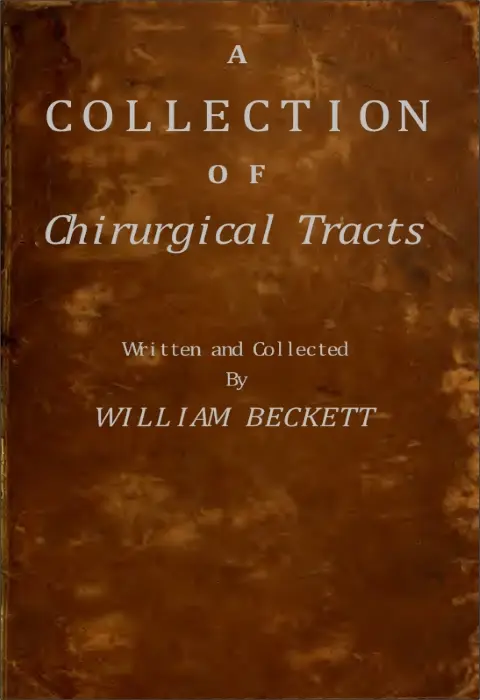
"A Collection of Chirurgical Tracts" by William Beckett is a scientific publication written in the early 18th century. The work consists of various tracts that explore surgical practices and medical discoveries, focusing on topics such as wounds, cancers, and the history of venereal diseases. This compilation aims to present and reflect on Beckett's contributions to the field of surgery based on his extensive experience and observations. The opening of the text introduces readers to William Beckett's life and his notable accomplishments as a surgeon and member of the Royal Society. It outlines his intention to compile various previously published chirurgical pieces into a single collection as a means of documentation and contribution to medical literature. The start of the text also hints at the organization of the subsequent tracts, including discussions on wounds of the head and brain, cancer treatments, and the history of venereal diseases, laying the groundwork for a serious academic exploration of the surgical field in his time.
Introduction adapted from the source catalogue; source summaries may be automatically generated.
Free to read · English · 61,089 words · No account needed
MAKE TIME FOR A GOOD BOOK
On by default. Untick to stop anonymous reading totals. Each page counts after 10 seconds in view. How this works.
Anonymous counting is on unless you have switched it off.
Aristotle, the first Peripatetic, had a Son call’d Nichomacus, by his Concubine Herpilis: He lov’d her so well, that he left her in his Will a Talent of Silver, and the Choice of his Country-Houses; that, as he says, the Damsel might have no Reason to complain: He enjoy’d, besides the Eunuch Hermias, others say only his Concubine Pythais, upon whom he writ a Hymn, call’d, The Inside.
Demetrius Phalereus, who had 360 Statues in Athens, kept Lamia for his Concubine, and at the same time was himself enjoy’d by Cleo: He writ a Treatise, call’d, The Lover, and was nick-nam’d by the Courtezans, Charito, Blespharus, i. e. A Charmer of Ladies; and Lampetes, i. e. A great Boaster of his Abilities.
Diogenes, the Cynic, us’d to say, that Women ought to be in common, and that Marriage was nothing but a Man’s getting a Woman in the Mind to be lain with: He often us’d Manual Venery in the public Market-place, with this Saying. Oh! that I could assuage my Hunger thus with rubbing of my Stomach!
But what Wonder if the old Academics, the Cyrenaics, and Peripatetics, were so lewdly wanton, when the very Stoics, who prided themselves in the Conquest of all their other Passions, were forc’d to submit to this?
Zeno, indeed, the Founder of that Sect, was remarkable for his Modesty, because he rarely made Use of Boys, and took but once an ordinary Maid-Servant to Bed, that he might not be thought to hate the Sex; yet, in his Commonwealth, he was for a Community of Women; and writ a Treatise, wherein he regulated the Motions of getting a Maidenhead, and philosophically prov’d Action and Reaction to be equal.
Chrysippus and Apollodorus agree with Zeno in a Community of Women, and say, that a wise Man may be in Love with handsome Boys.
Erillus, a Scholar of Zeno’s, was a notorious Debauchee.
I need not mention the Epicureans who were remarkable for their
Obscenity.
Epicurus used to make a Pander of his own Brother; and his Scholar, the Great Metrodorus, visited all the noted Courtezans in Athens, and publicly kept the famous Leontium, his Master’s Quondam Mistress. Yet, if you will believe Laertius, he was every Way a good Man.
But what shall we say of our Favourite Seneca, who, with all his Morals, could never acquire the Reputation of Chastity? He was indeed somewhat Nice in his Amours, like the Famous Flora, who was never enjoy’d by any Thing less than a Dictator or a Consul; for he scorn’d to intrigue with any Thing less than the Empress.
Your reading position is saved on this browser. Take it to another device with a library code. Reading pages adapt to text, rather than matching a printed edition.
BEHIND THE BOOK
This eBook is for the use of anyone anywhere in the United States and most other parts of the world at no cost and with almost no restrictions whatsoever. You may copy it, give it away or re-use it under the terms of the Project Gutenberg License included with this eBook or online at www.gutenberg.org. If you are not located in the United States, you will have to check the laws of the country where you are located before using this eBook. Read the source licence.
The original source file, including credits and licence, is retained by this library. Request an original-format copy at no charge. Please include the book title and Project Gutenberg identifier #52993.
KEEP YOUR CURIOSITY GOING
Charles G. (Charles Griffith) Ross
Hannah Webster Foster

Emily Lawless
Edwin Hamlin Carr

Charles De Lano Hine
Andrew Ure