
The Writing of News A Handbook with Chapters on Newspaper Correspondence and Copy Reading
Charles G. (Charles Griffith) Ross
THE CLASSIC COLLECTION · 1740
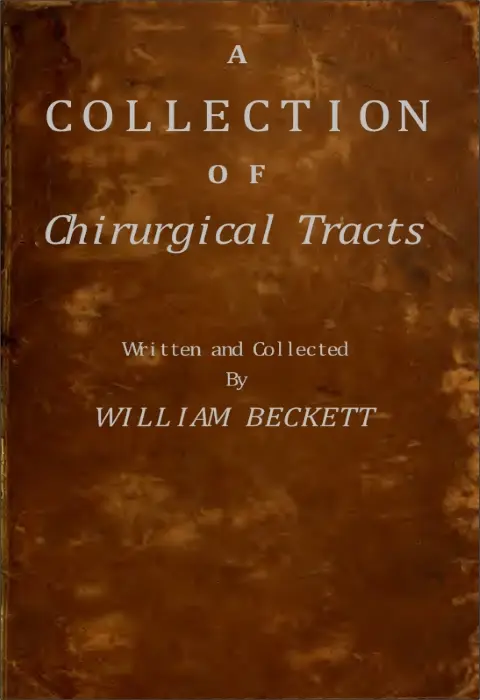
"A Collection of Chirurgical Tracts" by William Beckett is a scientific publication written in the early 18th century. The work consists of various tracts that explore surgical practices and medical discoveries, focusing on topics such as wounds, cancers, and the history of venereal diseases. This compilation aims to present and reflect on Beckett's contributions to the field of surgery based on his extensive experience and observations. The opening of the text introduces readers to William Beckett's life and his notable accomplishments as a surgeon and member of the Royal Society. It outlines his intention to compile various previously published chirurgical pieces into a single collection as a means of documentation and contribution to medical literature. The start of the text also hints at the organization of the subsequent tracts, including discussions on wounds of the head and brain, cancer treatments, and the history of venereal diseases, laying the groundwork for a serious academic exploration of the surgical field in his time.
Introduction adapted from the source catalogue; source summaries may be automatically generated.
Free to read · English · 61,089 words · No account needed
MAKE TIME FOR A GOOD BOOK
On by default. Untick to stop anonymous reading totals. Each page counts after 10 seconds in view. How this works.
Anonymous counting is on unless you have switched it off.
An ancient Philosopher compares Lewdness to a wild, fiery, and headstrong young Colt, which can never be broke till he is rid into a Bog: And Plato, on the same Subject, has these Words; The Gods, says he, have given us one disobedient and unruly Member, which, like a greedy and ravenous Animal that wants Food, grows wild and furious, till having imbib’d the Fruit of the common Thirst, he has plentifully besprinkled and bedewed the Bottom of the Womb.
And now I have mentioned the Philosophers, I must beg Your Patience for a Moment, to hear a short Account of their Amours: For nothing will convince us of the irresistible Force of Love, and the Folly of hoping to suppress it, sooner than reflecting, that those venerable Sages, those Standards of Morality, those great Reformers of the World, were so sensibly touch’d with this tender Passion.
Socrates confess’d, that, in his old Age, he felt a strange tickling all over him for five Days, only by a Girl’s touching his Shoulder.
Xenophon made open Profession of his passionate Love to Clineas.
Aristippus of Cyrene, writ a lewd Book of ancient Delights; he compar’d a Woman to a House or a Ship, that was the better for being used: He asserted, that there was no Crime in Pleasure, but only in being a Slave to it: And often used to say, I enjoy Lais, but Lais does not enjoy me.
Theodorus openly maintain’d, that a wise Man might without Shame or Scandal, keep Company with common Harlots.
Plato, our great Pattern for chaste-Love, proposes, as the greatest Reward for public Service, that he who has perform’d a signal Exploit, should not be deny’d any amorous Favour. He writ a Description of the Loves of his Time, and several amorous Sonnets upon his own Minions: His chief Favorites were Asterus, Dio, Phædrus, and Agatho; but he had, for Variety, his Female Darling Archeanassa; and was so noted for Wantonness, that Antisthenes, gave him the Nick-name of Satho, i. e. Well-furnish’d.
Polemo was prosecuted by his Wife for Male-Venery.
Crantor made no Secret of his Love to his Pupil Arcesilaus.
Arcesilaus made Love to Demetrius and Leocharus; the last, he said, he would fain have open’d: Besides, he publickly visited the two Elean Courtezans, Theodota and Philæta, and was himself enjoy’d by Demochares and Pythocles: He suffer’d the last, he said, for Patience-sake.
Bion was noted for debauching his own Scholars.
Your reading position is saved on this browser. Take it to another device with a library code. Reading pages adapt to text, rather than matching a printed edition.
BEHIND THE BOOK
This eBook is for the use of anyone anywhere in the United States and most other parts of the world at no cost and with almost no restrictions whatsoever. You may copy it, give it away or re-use it under the terms of the Project Gutenberg License included with this eBook or online at www.gutenberg.org. If you are not located in the United States, you will have to check the laws of the country where you are located before using this eBook. Read the source licence.
The original source file, including credits and licence, is retained by this library. Request an original-format copy at no charge. Please include the book title and Project Gutenberg identifier #52993.
KEEP YOUR CURIOSITY GOING
Charles G. (Charles Griffith) Ross
Hannah Webster Foster

Emily Lawless
Edwin Hamlin Carr

Charles De Lano Hine
Andrew Ure