THE CLASSIC COLLECTION✦An outlaw’s diary: the CommuneCLASSIC FREE BOOKS
An outlaw’s diary: the Commune
Cécile Tormay
THE CLASSIC COLLECTION · 1890
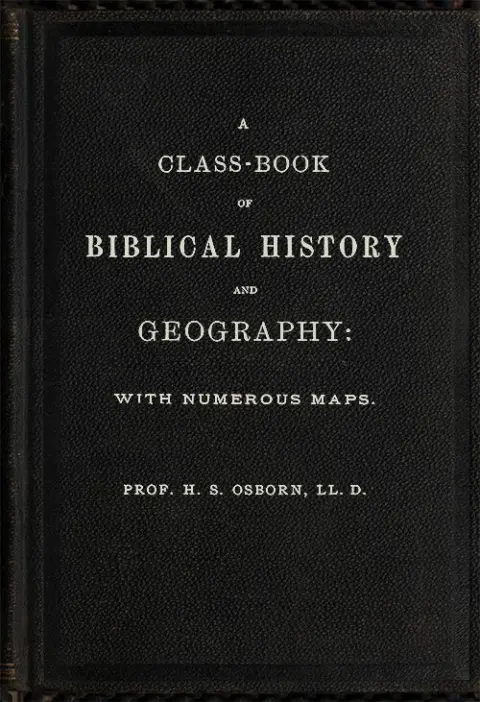
"A Class-Book of Biblical History and Geography" by H. S. Osborn is an educational text that presents a structured historical account of the Bible, focusing on both the Old and New Testaments, and was written in the late 19th century. This work aims to provide a comprehensive overview of biblical events through a historical lens, including the significant periods of Jewish history that bridge the timeframe from the Old Testament's conclusion to the advent of the New Testament. The book also incorporates geographical insights, with maps intended to enhance the reader's understanding of the events discussed. The opening of this class-book begins with a preface outlining its objectives and structure, emphasizing a historical approach devoid of speculative opinions. It introduces the initial chapters by summarizing biblical accounts such as the Creation, the Garden of Eden, and the early generations of humanity, including significant lineage details that contribute to understanding biblical narratives. Moreover, it details the chronological framework utilized to analyze Biblical events and introduces the notion that names and their meanings are crucial for grasping the scriptural context. The narrative is designed to guide readers—especially educators and students—through biblical history in a clear and engaging manner, setting the stage for a deeper exploration of the text's historical richness.
Introduction adapted from the source catalogue; source summaries may be automatically generated.
Free to read · English · 67,754 words · No account needed
MAKE TIME FOR A GOOD BOOK
On by default. Untick to stop anonymous reading totals. Each page counts after 10 seconds in view. How this works.
Anonymous counting is on unless you have switched it off.
52 – Wilkinson’s date is B. C. 1532, but Brugsch gives it as
B. C. 1433.
53 – Sir Henry Rawlinson.
54 – “La Langue Primitive,” p. 376; in Tomkin’s “Times of
Abraham,” p. 181.
55 – Bir es Seba in the Arabic is the same as Beersheba in the
Hebrew.
56 – Sayce, “Ancient Empires,” p. 200.
57 – We have mentioned them on page 37.
58 – Fourth memoir of “The Egypt Exploration Fund,” 1887,
p. 15.
59 – Osborn’s “Ancient Egypt in the Light of Modern Discovery,”
p. 82.
60 – Ebers’ “Konigstöchter,” Vol. I., p. 22 in the note, 40.
61 – Geikie, Vol. I., p. 468.
62 – See Geikie, Vol. I., p. 462.
63 – For illustrations of this fact see “Ancient Empires of the East,” Sayce. Preface.
64 – Dynasty was the term given to kings of the same family or
blood relations.
65 – This view appears to be the correct one, although there is some variation of opinion.
66 – Gray’s “Connection between Sacred and Heathen Authors,” p. 563. Longinus “On the Sublime.”
67 – Lepsius in Geikie, Vol. II., p. 384.
68 – Supposed to have been Debir, south of Hebron.
69 – Wilkinson in Tomkins’ “Studies of the Times of Abraham,”
p. 86.
70 – Tomkins, p. 86.
71 – Odyssey, Book II., l. 521. Gladstone’s “Hom. Synchron.”
pp. 174, 182.
72 – Now called Ain es Sultan.
73 – Ussher’s time as in the margin of our Bibles.
74 – The Talmud is described hereafter.
75 – Bishop Horsley.
76 – Deut. 27:12; 11:30; Num. 34:13‒29; Exod. 21:13; Num. 35:6, 11, 14; Deut. 19:2, 9.
77 – The affix “im” to a word was equivalent to the letter s
in English.
78 – Lenormant, Vol. II., p. 223.
79 – Geikie, Vol. II., p. 466.
80 – Meaning “hamstrung.” Our version puts horses in italics, showing that it is not in the original.
81 – Browne in “Ordo Sæculorum,” Vol. I., chap. 5, sec. 3.
82 – For another solution of the chronology of this period see the “Old Testament Student,” January, 1884.
83 – The place where the courts were held.
84 – Burckhardt’s “Travels,” p. 339.
85 – Osburn’s “Ancient Egypt,” p. 138. London. Samuel Bagster
& Sons.
86 – The place assigned as probable, namely, Astug, is an impossible site, for Ziklag after the Captivity is located between Beersheba and Jerusalem, and Astug was at that time too far off for settlement by returned captives.
87 – 1 Kings 11:42.
88 – “Antiquities,” IX., 11:1.
89 – Strabo, XV., 1:6. Geikie, Vol. V., p. 339.
90 – Jer. 48:40; 49:22.
91 – Ezek. 17:3.
92 – Lenormant, “Ancient History of the East,” 475, in remarkable corroboration of 2 Kings 24:7.
93 – Also spelled Mizpeh, the meaning being watch-tower.
94 – 1 Kings 12:28.
95 – Under the title of Apis; Greek, Ser-apis, for Osiris-Apis.
96 – Ecclus. 36:15 and Maccabees 9:27; 14:41.
97 – T. G. Pinches, in “Trans. Soc. of Biblical Archæology,” May, 1884. Same as Tiglath-pileser, 2 Kings 15:29.
98 – Lenormant and Chev., “Ancient History of the East,” p. 392.
99 – Lenormant, 392.
100 – Idem, 604.
101 – Lenormant etc., “Ancient History of the East,” p. 406. Geikie’s date would make it too late, see authorities in Geikie, V., p. 91., and for the translation of cylinders, “History of Esar-haddon,” Budge, 1881, Boston, Osgood & Co., p. 103.
102 – See Rawlinson’s “Five Great Monarchies,” II., p. 477, English Edition; also Maclear’s “Old Testament History,” p. 445.
103 – Such as Psalms 79, 102, 126, 137, and others.
Your reading position is saved on this browser. Take it to another device with a library code. Reading pages adapt to text, rather than matching a printed edition.
BEHIND THE BOOK
This eBook is for the use of anyone anywhere in the United States and most other parts of the world at no cost and with almost no restrictions whatsoever. You may copy it, give it away or re-use it under the terms of the Project Gutenberg License included with this eBook or online at www.gutenberg.org. If you are not located in the United States, you will have to check the laws of the country where you are located before using this eBook. Read the source licence.
The original source file, including credits and licence, is retained by this library. Request an original-format copy at no charge. Please include the book title and Project Gutenberg identifier #56019.
KEEP YOUR CURIOSITY GOING
Cécile Tormay

Moritz Busch
John L. Ransom
Frances Wright
Cécile Tormay

Mabel Potter Daggett