THE CLASSIC COLLECTION✦An outlaw’s diary: the CommuneCLASSIC FREE BOOKS
An outlaw’s diary: the Commune
Cécile Tormay
THE CLASSIC COLLECTION · 1890
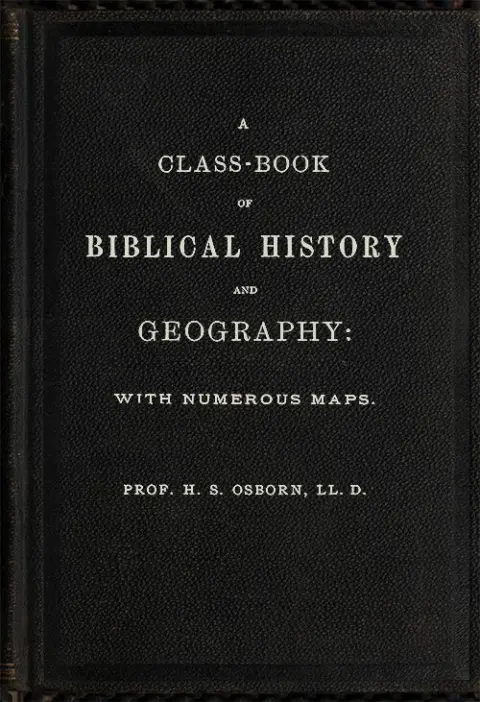
"A Class-Book of Biblical History and Geography" by H. S. Osborn is an educational text that presents a structured historical account of the Bible, focusing on both the Old and New Testaments, and was written in the late 19th century. This work aims to provide a comprehensive overview of biblical events through a historical lens, including the significant periods of Jewish history that bridge the timeframe from the Old Testament's conclusion to the advent of the New Testament. The book also incorporates geographical insights, with maps intended to enhance the reader's understanding of the events discussed. The opening of this class-book begins with a preface outlining its objectives and structure, emphasizing a historical approach devoid of speculative opinions. It introduces the initial chapters by summarizing biblical accounts such as the Creation, the Garden of Eden, and the early generations of humanity, including significant lineage details that contribute to understanding biblical narratives. Moreover, it details the chronological framework utilized to analyze Biblical events and introduces the notion that names and their meanings are crucial for grasping the scriptural context. The narrative is designed to guide readers—especially educators and students—through biblical history in a clear and engaging manner, setting the stage for a deeper exploration of the text's historical richness.
Introduction adapted from the source catalogue; source summaries may be automatically generated.
Free to read · English · 67,754 words · No account needed
MAKE TIME FOR A GOOD BOOK
On by default. Untick to stop anonymous reading totals. Each page counts after 10 seconds in view. How this works.
Anonymous counting is on unless you have switched it off.
16 – Copper is as abundant now as then. There is quite a trade in copper between Bagdad and Bassora near the head of the Persian Gulf. All household utensils are made of copper. When Xenophon arrived with his Ten Thousand, B. C. 400, in this region (in his time it was called the land of the Carduchi) he was astonished at the quantity of metallic utensils. Lenormant, “Ancient History of the East,” Vol. II., p. 203.
17 – Rawlinson, “The Five Great Monarchies,” Vol. I., p. 98.
18 – Perrot & Chipiez, “Art in Chaldæa.”
19 – See “Speaker’s Commentary,” Vol. I., p. 62. Geikie, Vol. I.,
p. 184.
20 – See Vigouroux and Lenormant, as quoted by Geikie, Vol. I.,
p. 86.
21 – So Schrader in Geikie, Vol. I., p. 208.
22 – Osborn’s “Manual of Biblical Geography.”
23 – Full references in Bochart’s “Geography,” pp. 192, 193.
24 – Schrader in Geikie, Vol. I., p. 234.
25 – Bochart, “Geog. Sac.,” p. 157.
26 – Ibid., p. 586.
27 – “Études de l’antiquité historique.” Paris, 1873.
28 – Geikie, p. 234, Vol. I.
29 – Lenormant, Vol. II., “Ancient History of the East,” p. 236.
30 – Some have recently offered a new reading of this text, as follows: “From that land he [Nimrod] went into Assyria;” but, beside what has been above said, Rosenmüller observes that if this had been the meaning the Hebrew would have been different. We may add that the Septuagint translators understood it as it is in our English version, that it was not Nimrod, but Asshur, who built Nineveh.
31 – It has been supposed by some that the word “Rehoboth” does not refer to a city, but to the “wide street” of Nineveh. The term is used in that sense in an inscription of Esar-haddon, in which he says that he paraded the heads of two kings of Sidon through (Rehoboth) “the streets” of Nineveh. W. A. I., Vol. I., p. 45; in “History of Esar-haddon,” Budge, 1881, p. 41.
32 – Herodotus, Vol. II., p. 121.
33 – Geikie, Vol. I., p. 247.
34 – More fully spoken of page 69.
35 – The hieratic is written from right to left, as is the Phœnician. See Sayce’s “Ancient Empires of the East,” Scribner, 1886, p. 84.
36 – Bertheau, as quoted by Geikie, Vol. I., p. 251, and
Lenormant, Vol. II., p. 144.
37 – Job 41:6; Prov. 31:24, where the word “merchant” is
Canaanite in the Hebrew.
38 – “Antiquities,” Vol. I., § 6:4.
39 – Maclear, p. 24.
40 – Oppert, “Journal Asiatique,” Vol. X., p. 220; Vol. IX., p. 503. Lenormant, “Langue Primitive de la Chaldée,” p. 355. Geikie, Vol. I., p. 291.
41 – Lenormant, “Ancient History of the East,” p. 445.
42 – Geikie, Vol. I., p. 274.
43 – “Præp Evang.,” IX., 17. Geikie, Vol. I., p. 295.
44 – A. H. Sayce in the “Hibbert Lectures,” 1887. See also in “Old Testament Student,” 1887, p. 134.
45 – Sayce, translation as referred to in previous note.
46 – See Herzog, article “Ur.”
47 – Pronounced ha´-i.
48 – Pronounced a´-i.
49 – Hale’s date is B. C. 2078.
50 – Gen. 16:7; 20:1; 25:18; Exod. 15:22; 1 Sam. 15:7; 27:8.
Shur means “wall.”
51 – Pronounced Ke´-ops.
Your reading position is saved on this browser. Take it to another device with a library code. Reading pages adapt to text, rather than matching a printed edition.
BEHIND THE BOOK
This eBook is for the use of anyone anywhere in the United States and most other parts of the world at no cost and with almost no restrictions whatsoever. You may copy it, give it away or re-use it under the terms of the Project Gutenberg License included with this eBook or online at www.gutenberg.org. If you are not located in the United States, you will have to check the laws of the country where you are located before using this eBook. Read the source licence.
The original source file, including credits and licence, is retained by this library. Request an original-format copy at no charge. Please include the book title and Project Gutenberg identifier #56019.
KEEP YOUR CURIOSITY GOING
Cécile Tormay

Moritz Busch
John L. Ransom
Frances Wright
Cécile Tormay

Mabel Potter Daggett