THE CLASSIC COLLECTION✦An outlaw’s diary: the CommuneCLASSIC FREE BOOKS
An outlaw’s diary: the Commune
Cécile Tormay
THE CLASSIC COLLECTION · 1890
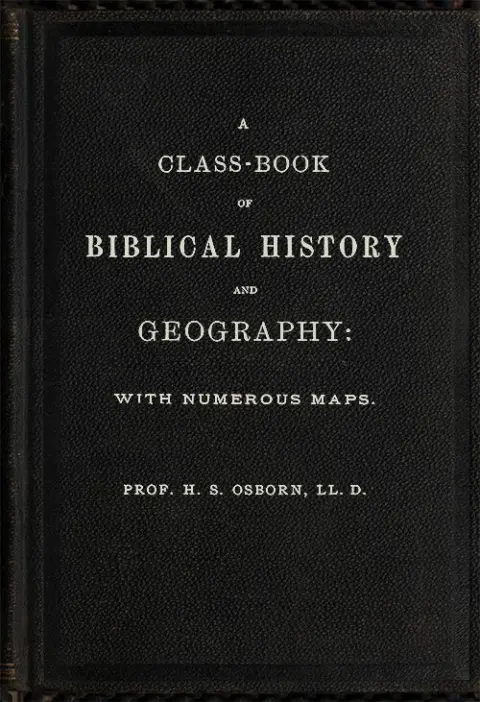
"A Class-Book of Biblical History and Geography" by H. S. Osborn is an educational text that presents a structured historical account of the Bible, focusing on both the Old and New Testaments, and was written in the late 19th century. This work aims to provide a comprehensive overview of biblical events through a historical lens, including the significant periods of Jewish history that bridge the timeframe from the Old Testament's conclusion to the advent of the New Testament. The book also incorporates geographical insights, with maps intended to enhance the reader's understanding of the events discussed. The opening of this class-book begins with a preface outlining its objectives and structure, emphasizing a historical approach devoid of speculative opinions. It introduces the initial chapters by summarizing biblical accounts such as the Creation, the Garden of Eden, and the early generations of humanity, including significant lineage details that contribute to understanding biblical narratives. Moreover, it details the chronological framework utilized to analyze Biblical events and introduces the notion that names and their meanings are crucial for grasping the scriptural context. The narrative is designed to guide readers—especially educators and students—through biblical history in a clear and engaging manner, setting the stage for a deeper exploration of the text's historical richness.
Introduction adapted from the source catalogue; source summaries may be automatically generated.
Free to read · English · 67,754 words · No account needed
MAKE TIME FOR A GOOD BOOK
On by default. Untick to stop anonymous reading totals. Each page counts after 10 seconds in view. How this works.
Anonymous counting is on unless you have switched it off.
=13. The site of this town= has not certainly been identified, but Dr. Robinson has given good reasons for supposing that it was situated at a village now called Taiyibeh, twelve miles a little east of north from Jerusalem. It is off the present main road of travel, to the east, and in the midst of a very rough and untravelled country, but there are the remains of a good Roman road running down from this place to the valley of the Jordan, and about a mile and a half below the village there are two Roman mile-posts still standing on that old road. It is probable that here our Saviour retired from the danger that seemed to threaten him in Jerusalem. After leaving Ephraim he seems to have taken the main road down to the plain of Jordan and crossed to the other side, called Peræa.
=14. Peræa.= Great numbers follow Christ here, and the following is a brief history of what transpired in that region:
He heals the infirm woman on the Sabbath, Luke 13:10.
He is warned against Herod, Luke 13:31.
He dines with a chief Pharisee on the Sabbath, Luke 14:1.
The parables of the lost sheep and of the prodigal son, Luke 15:11‒32.
The parables of the unjust steward and of the rich man and Lazarus,
Luke 16.
The warnings that Christ’s coming will be sudden, Luke 17:20.
The parables of the importunate widow, Luke 18:1, and Pharisee and
publican, Luke 18:10.
He gives precepts respecting divorce, Matt. 19:3.
He blesses little children, Matt. 19:13; Mark 10:13; Luke 18:15.
The visit of the rich young man, Matt. 19:16; Mark 10:17; Luke 18:18.
Parable of the laborers in the vineyard, Matt. 20:1.
=On the way up to Jerusalem.= Jesus for the third time foretells his crucifixion and resurrection, but his disciples do not understand him, Matt. 20:17; Mark 10:32; Luke 18:31.
=15. Near the Jordan.= James and John make their ambitious request through their mother, Matt. 20:20; Mark 10:35.
=West of Jericho.= He heals two blind men, Matt. 20:30; Mark 10:46;
Luke 18:35.
Visits Zacchæus, Luke 19:1‒10.
=Nearer to Jerusalem.= Parable of the ten pounds, Matt. 25:14‒30;
Luke 19:11‒27.
=Bethany.= The supper given by Simon the leper, Matt. 26:6‒13; Mark 14:3‒9; John 12:1‒11; from John it seems that this feast took place six days before the Passover, and on the next day was the triumphal entry into Jerusalem.
=Just east of Bethany.= The sending for the ass and colt, followed by the triumphal entry of our Saviour into Jerusalem. Matt. 21:17. Mark 11:1‒11 and Luke 19:29‒40 speak only of the colt.
=16. Descending the Mount of Olives.= Christ weeps over Jerusalem,
Luke 19:41‒44.
Your reading position is saved on this browser. Take it to another device with a library code. Reading pages adapt to text, rather than matching a printed edition.
BEHIND THE BOOK
This eBook is for the use of anyone anywhere in the United States and most other parts of the world at no cost and with almost no restrictions whatsoever. You may copy it, give it away or re-use it under the terms of the Project Gutenberg License included with this eBook or online at www.gutenberg.org. If you are not located in the United States, you will have to check the laws of the country where you are located before using this eBook. Read the source licence.
The original source file, including credits and licence, is retained by this library. Request an original-format copy at no charge. Please include the book title and Project Gutenberg identifier #56019.
KEEP YOUR CURIOSITY GOING
Cécile Tormay

Moritz Busch
John L. Ransom
Frances Wright
Cécile Tormay

Mabel Potter Daggett