
The story of the world a thousand years hence
Henry Olerich
THE CLASSIC COLLECTION · 1893
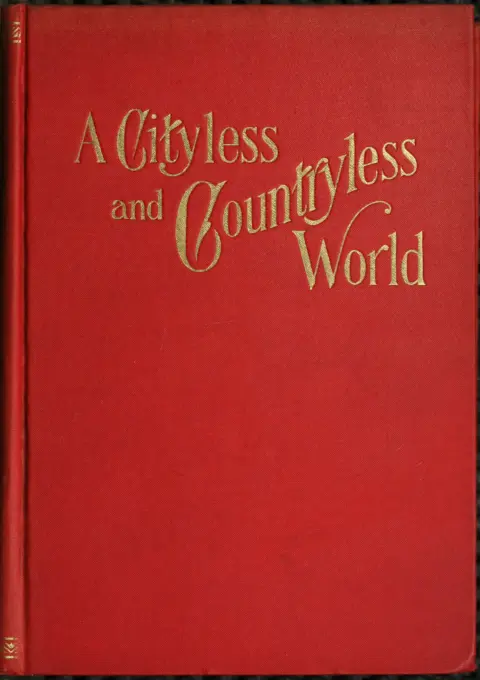
"A cityless and countryless world : An outline of practical cooperative…." by Henry Olerich is a utopian novel written in the late 19th century. It presents a visionary program of “practical co‑operative individualism” through the account of a Martian visitor who contrasts his advanced, harmonious society with Earth’s wasteful cities and isolated farms. The work lays out a full social and economic design—large communal “big-houses,” electrified infrastructure, efficient agriculture, rational education, voluntary governance, and equitable sex relations and property norms—aimed at maximizing freedom, health, and happiness. The opening of this work begins with a preface that applauds scientific achievements while indicting pervasive social evils, and declares the aim to outline a system uniting voluntary cooperation with individual liberty. The narrative then shifts to the exemplary Uwins household in the village of Dozen, where a charismatic stranger, Midith, arrives during a storm; he soon reveals he was born on Mars and, after winning the family’s trust, explains Mars–Earth differences, the feasibility of interplanetary travel, and offers a sharp critique of Earth’s poverty, exploitation, coercive government, money and land systems, gender inequities, schooling, and cruelty to animals. He expounds a Marsian worldview grounded in evolution and the nebular hypothesis, then sketches their living arrangements: no cities or countryside, but “big-houses” of about a thousand people set along electric motor-lines amid parks, gardens, and conservatories, with nearly all domestic and industrial functions powered by centralized engines. Early chapters also redefine wealth (healthy bodies and minds, material sufficiency, and mental riches) and begin a taxonomy of labor (productive, unproductive, destructive), before the excerpt breaks off.
Introduction adapted from the source catalogue; source summaries may be automatically generated.
Free to read · English · 122,946 words · No account needed
MAKE TIME FOR A GOOD BOOK
On by default. Untick to stop anonymous reading totals. Each page counts after 10 seconds in view. How this works.
Anonymous counting is on unless you have switched it off.
“Now, I do not wish to be understood that I am ridiculing your social and industrial institutions, or that I blame any one for these poor, pitiable conditions we find existing here on earth. We passed through the same woful stages. Every well-informed person knows that your world, as a whole, is better to-day than it ever was before. You enjoy more security, more kindness, more intelligence and more freedom than you ever did in any preceding age. The conditions which we find on earth are, as a whole, undoubtedly nearly in tune with your social and industrial culture; and the only known power in the universe that can substitute a higher and nobler order of things is additional intelligence. Acts, as we have seen, are always in harmony with the intelligence of the actor.
“We can not hope to find much good work done in a world where the division of labor is so imperfect as it is here with you. Your so-called farmer is, as a rule, at the same time agriculturist, horticulturist, stockbreeder, butcher, dairyman, shepherd, carpenter and poultry raiser. On the other hand, your city laborer must frequently be idle, or accept any kind of labor he can get, whether he is proficient in it or whether he is a bungler at it.”
“There must be a great difference between our institutions and yours,”
said Mrs. Uwins.
“In some respects there is,” replied Mr. Midith. “Just compare the appearance and conditions of our social and industrial world with that of yours. Think of our magnificent residences--grand edifices, furnished on the interior with all the domestic conveniences that human ingenuity can contrive. The outer appearance is very imposing; numerous large windows through which are seen the rich curtains and through which the blitheful laugh of the inmates can be heard, and the healthy countenances of free, rich men, women, and children can be seen. Think how all these fine dwellings are located in the grandest parks that nature and art can produce; how all varieties of flowers and ornamental trees may be seen in all directions. Think of the green, closely-mowed lawn; the cool, refreshing fountain playing on the bosom of the artificial lakes in which men, women and children are sportively swimming and bathing. Think how the odoriferous, life-giving breeze enters every apartment of our palatial homes, which are neither crowded in populous cities nor isolated in a lonely country. Think of the smooth, shady boulevard on which numerous men, women and children are seeking healthful, sportive exercise. Think of the spacious conservatory and green-house, surrounded by glass, and containing luxuriant tropical plants, whose foliage is as green, even when the snow is two feet deep, as it is in its native climate. Think of the productive garden, bearing the choicest vegetables that evolution through the hand of the horticulturist has been able to produce; of the enticing orchard with its endless variety of fruit trees and shrubbery, its green lawns, and clean walks. Think of the ease with which our farming is done, and the immense amount of agricultural work we can do in a short time. Think how all our labor has turned almost into play, and how much leisure time we enjoy. And lastly, think of the intelligent free, rich, healthy inhabitants who have all learned that the happiness of self includes the happiness of others. Such, upon a brief, superficial contemplation, are a few of the more conspicuous differences existing between our system and yours. Yet you should always bear in mind that we have nothing on Mars but what you can have right here on earth with a little additional intelligence, a little more knowledge of yourselves and your fellowman. A little more kindness and a little less cruelty. A little more peace and a little less discord. A little more freedom and a little less jealousy. A little wider and more voluntary co-operation and a little less single-handed effort. A little more individualism and a little less paternalism and co-operative coercion. A little more confidence in the operations and uniformity of the so-called laws of nature, and a little less trust in the pretended virtue of superstition. I, therefore, repeat again that thousands of your foremost cultivated men and women here on earth are already prepared to live a Marsian life, if they were not prevented by your existing institutions and by the masses who are not yet ready for such a harmonious life.”
Your reading position is saved on this browser. Take it to another device with a library code. Reading pages adapt to text, rather than matching a printed edition.
BEHIND THE BOOK
This eBook is for the use of anyone anywhere in the United States and most other parts of the world at no cost and with almost no restrictions whatsoever. You may copy it, give it away or re-use it under the terms of the Project Gutenberg License included with this eBook or online at www.gutenberg.org. If you are not located in the United States, you will have to check the laws of the country where you are located before using this eBook. Read the source licence.
The original source file, including credits and licence, is retained by this library. Request an original-format copy at no charge. Please include the book title and Project Gutenberg identifier #76123.
KEEP YOUR CURIOSITY GOING
Coulson Kernahan

Maurice Baring
Frances Wright
Cécile Tormay
Francis Greenleaf Allinson & Anne C. E. (Anne Crosby Emery) Allinson

Frederic Jesup Stimson