
The story of the world a thousand years hence
Henry Olerich
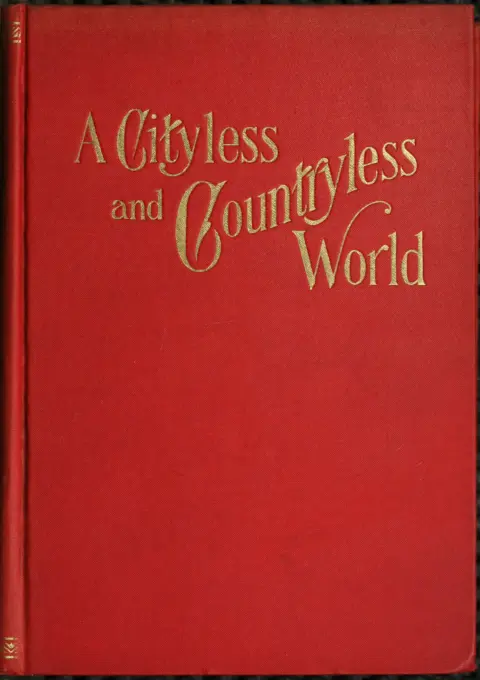
THE CLASSIC COLLECTION · 1893
"A cityless and countryless world : An outline of practical cooperative…." by Henry Olerich is a utopian novel written in the late 19th century. It presents a visionary program of “practical co‑operative individualism” through the account of a Martian visitor who contrasts his advanced, harmonious society with Earth’s wasteful cities and isolated farms. The work lays out a full social and economic design—large communal “big-houses,” electrified infrastructure, efficient agriculture, rational education, voluntary governance, and equitable sex relations and property norms—aimed at maximizing freedom, health, and happiness. The opening of this work begins with a preface that applauds scientific achievements while indicting pervasive social evils, and declares the aim to outline a system uniting voluntary cooperation with individual liberty. The narrative then shifts to the exemplary Uwins household in the village of Dozen, where a charismatic stranger, Midith, arrives during a storm; he soon reveals he was born on Mars and, after winning the family’s trust, explains Mars–Earth differences, the feasibility of interplanetary travel, and offers a sharp critique of Earth’s poverty, exploitation, coercive government, money and land systems, gender inequities, schooling, and cruelty to animals. He expounds a Marsian worldview grounded in evolution and the nebular hypothesis, then sketches their living arrangements: no cities or countryside, but “big-houses” of about a thousand people set along electric motor-lines amid parks, gardens, and conservatories, with nearly all domestic and industrial functions powered by centralized engines. Early chapters also redefine wealth (healthy bodies and minds, material sufficiency, and mental riches) and begin a taxonomy of labor (productive, unproductive, destructive), before the excerpt breaks off.
Introduction adapted from the source catalogue; source summaries may be automatically generated.
Free to read · English · 122,946 words · No account needed
MAKE TIME FOR A GOOD BOOK
On by default. Untick to stop anonymous reading totals. Each page counts after 10 seconds in view. How this works.
Anonymous counting is on unless you have switched it off.
“In the private apartment, when alone, we read, write, study, paint, draw, study music, listen to phonographic books, and do countless other things for amusement, of which I can not tell you now, for you are not familiar with them, because they do not yet exist on earth. After all this, we often desire the company of a little child only. If so, we invite one. Children are nearly always fond of such invitations, because when an adult desires the company of a child in that way, he will always amuse and delightfully instruct it. When we desire the private company of adults, either man or woman, we invite some agreeable companion or companions who are willing to become our private guests. In company with these we study, sing, paint, converse, laugh and joke, tell our experience, play all kinds of appropriate games, and do all such other things as we find mutually agreeable and pleasant.
“For amusement, in the public parts of the big-house, we visit and amuse ourselves in the different parlors, eat in the restaurant, sport with the children and babies in the nurseries, attend grand operas, lectures, scientific demonstrations, promenade and cycle in the large exercise hall, listen to charming concerts, and play countless games, for which both ladies and gentlemen are attired in appropriate, convenient costumes.
“Our outdoor sports and amusements are so numerous, varied and complex that I can tell you only a few of them, for, in a world like that of the earth, where the vast masses are compelled to expend nearly all their vitality for the mere acquisition of their scanty material subsistence, refined and complex sports and amusements can not well be understood, nor can they have a conspicuous place in man’s daily activity under such conditions.
“Our simplest outdoor exercise for amusement is walking, either alone or in company with a companion or companions. On a fine day or evening our granite walks are usually dotted with men, women and children walking for amusement. We take these outdoor promenades most any place. In the garden we stroll to admire the endless variety of flowers, the luxuriant vegetation, which is everywhere cultivated with the greatest success and perfection. From the garden, perhaps, we rove to the orchard, among the laden fruit trees, bearing the delicious fruit on their boughs and having the green, closely-cut lawn beneath. Sometimes our sportive walks extend from community to community, admiring all the rich, varied and diversified things we meet, for the Marsites have long discovered that variety of color, form, etc., is pleasing to the sight. In every community we find a large variety of new forms and arrangements in the park, in the conservatory (or green-house), in the gardens, in the orchards, on the walks, and, in fact, everywhere. In the winter we take our leisure walks in the grand conservatory, which extends from one community to the other, and in which the flowers, plants, fruit and trees are growing as luxuriantly as they do in a tropical climate, even when the snow is a foot deep on the outside. Every step, as we go forward from community to community, presents new scenes in colors and forms. Thus a number of companions often go from community to community, stopping for rest or for night whenever they get tired. You see, we can stop as cheap at any ‘big-house’ as we can at our own. During these walking expeditions our baggage always follows us on the motor cars.
Your reading position is saved on this browser. Take it to another device with a library code. Reading pages adapt to text, rather than matching a printed edition.
BEHIND THE BOOK
This eBook is for the use of anyone anywhere in the United States and most other parts of the world at no cost and with almost no restrictions whatsoever. You may copy it, give it away or re-use it under the terms of the Project Gutenberg License included with this eBook or online at www.gutenberg.org. If you are not located in the United States, you will have to check the laws of the country where you are located before using this eBook. Read the source licence.
The original source file, including credits and licence, is retained by this library. Request an original-format copy at no charge. Please include the book title and Project Gutenberg identifier #76123.
KEEP YOUR CURIOSITY GOING
Coulson Kernahan

Maurice Baring
Frances Wright
Cécile Tormay
Francis Greenleaf Allinson & Anne C. E. (Anne Crosby Emery) Allinson

Frederic Jesup Stimson