
The story of the world a thousand years hence
Henry Olerich
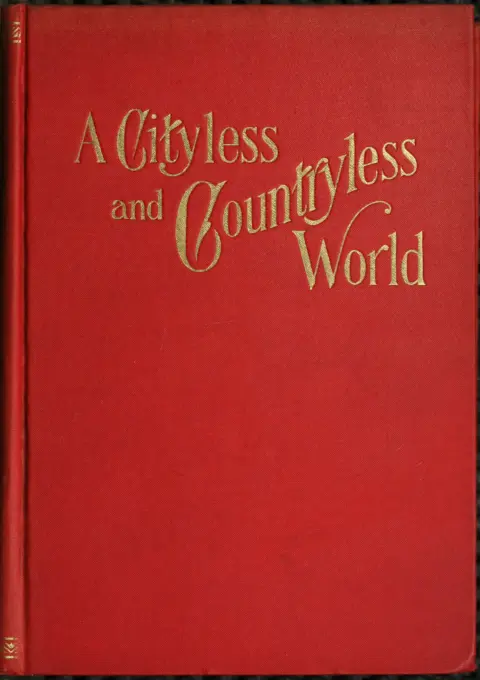
THE CLASSIC COLLECTION · 1893
"A cityless and countryless world : An outline of practical cooperative…." by Henry Olerich is a utopian novel written in the late 19th century. It presents a visionary program of “practical co‑operative individualism” through the account of a Martian visitor who contrasts his advanced, harmonious society with Earth’s wasteful cities and isolated farms. The work lays out a full social and economic design—large communal “big-houses,” electrified infrastructure, efficient agriculture, rational education, voluntary governance, and equitable sex relations and property norms—aimed at maximizing freedom, health, and happiness. The opening of this work begins with a preface that applauds scientific achievements while indicting pervasive social evils, and declares the aim to outline a system uniting voluntary cooperation with individual liberty. The narrative then shifts to the exemplary Uwins household in the village of Dozen, where a charismatic stranger, Midith, arrives during a storm; he soon reveals he was born on Mars and, after winning the family’s trust, explains Mars–Earth differences, the feasibility of interplanetary travel, and offers a sharp critique of Earth’s poverty, exploitation, coercive government, money and land systems, gender inequities, schooling, and cruelty to animals. He expounds a Marsian worldview grounded in evolution and the nebular hypothesis, then sketches their living arrangements: no cities or countryside, but “big-houses” of about a thousand people set along electric motor-lines amid parks, gardens, and conservatories, with nearly all domestic and industrial functions powered by centralized engines. Early chapters also redefine wealth (healthy bodies and minds, material sufficiency, and mental riches) and begin a taxonomy of labor (productive, unproductive, destructive), before the excerpt breaks off.
Introduction adapted from the source catalogue; source summaries may be automatically generated.
Free to read · English · 122,946 words · No account needed
MAKE TIME FOR A GOOD BOOK
On by default. Untick to stop anonymous reading totals. Each page counts after 10 seconds in view. How this works.
Anonymous counting is on unless you have switched it off.
“8. Your compulsory attendance, whether enforced by parents or state, tends to make fibbers and schemers out of many pupils who desire to be excused before school lets out, or who desire to be excused by parent or state. It is natural that after a pupil’s mental faculties are exhausted for the time being, it can not continue to pursue its studies without great bodily and mental injury. Under these conditions the child’s healthful instinct generally prompts it to cease studying, after which it begins its ‘mischievous pranks’ as you call them. It is a well known fact that all minds are not endowed with like power of endurance, yet your public schools, as a rule, make no provision for such difference of mental endurance. You compel all to attend school for six hours daily. Thus your compulsion tends to make fibbers and miscreants; it injures the child’s health, prevents the spontaneous development of its faculties and sets it against learning.
“9. Probably about one-fourth of the pupils attending school are what you call ‘bad boys’ and ‘bad girls.’ They have little or no desire to attend school and to study the assigned lessons and branches at such a time and for such a length of time. They greatly annoy those who do have a taste for study, and their compulsory attendance constantly causes an increased repugnance for the school-room and for all the work connected with it. They become thoroughly disgusted with all learning. Thus, instead of creating a pleasurable desire for learning, you do not even let it sprout by giving them a little freedom and opportunity.
“10. We have seen that not all pupils have a like mental endurance. Some are mentally exhausted before others. The mental endurance of the same pupil also differs from day to day. Again, some delight in study one day and dislike it the next. But your ‘school week’ consists of five days and your ‘school day’ consists of six hours, no matter what the other conditions are. The pupil who is through studying must remain just as long as the one who is not. Thus you are largely obliged to enforce attendance and order on those pupils who are not in a mood for mental work at that time. This condition of things necessarily causes a constant friction between teachers and pupils. It makes a cruel, crabbed, despotic teacher and a ruthless, stubborn pupil. I believe this to be one of the reasons why so many of your professional teachers are so overbearing, cruel and despotic, caring so little for the rights, freedom and welfare of others. My profession has called me to many of your teachers’ associations, and I am sorry to say that, as a rule, I have invariably found these assemblies composed of very narrow-minded men and women. As a rule, they have very little idea of freedom, equity, and the psychological principles upon which all successful instruction must be based. They generally hoot at any truth that does not lie within their narrow path of a little impractical book-learning. But this is all natural and inevitable when we understand the circumstances which produce your public school-teacher. To begin with, the teacher must generally get his position by more or less scheming, and when he has secured it he becomes a kind of lord and master over his pupils. If he is a principal or superintendent, his assistant teachers are generally more or less at his mercy. The assistants know this and often flatter him in order to stand well in his estimation. The less learned patrons also look upon him as a distinguished personage. This subordination of his companions, the absolute authority he exercises over his pupils, his real or supposed learning, and other advantages make a kind of baron out of him, and generally cover him more or less with ‘cheap’ vanity and ostentation. It also makes him very intolerant, so that an assembly of principals and superintendents who pretend to lead the intellectual world, nearly always lack breadth and depth of learning. They often know more Greek and Latin than they know of human nature and the phenomena of the universe. Their narrow views seldom reach the depth of man’s psychical nature. They are nearly always dealing with immediate superficial results and scarcely ever think about the real, the fundamental, and the remote. They try to get rid of an effect without touching the cause.
Your reading position is saved on this browser. Take it to another device with a library code. Reading pages adapt to text, rather than matching a printed edition.
BEHIND THE BOOK
This eBook is for the use of anyone anywhere in the United States and most other parts of the world at no cost and with almost no restrictions whatsoever. You may copy it, give it away or re-use it under the terms of the Project Gutenberg License included with this eBook or online at www.gutenberg.org. If you are not located in the United States, you will have to check the laws of the country where you are located before using this eBook. Read the source licence.
The original source file, including credits and licence, is retained by this library. Request an original-format copy at no charge. Please include the book title and Project Gutenberg identifier #76123.
KEEP YOUR CURIOSITY GOING
Coulson Kernahan

Maurice Baring
Frances Wright
Cécile Tormay
Francis Greenleaf Allinson & Anne C. E. (Anne Crosby Emery) Allinson

Frederic Jesup Stimson