
The story of the world a thousand years hence
Henry Olerich
THE CLASSIC COLLECTION · 1893
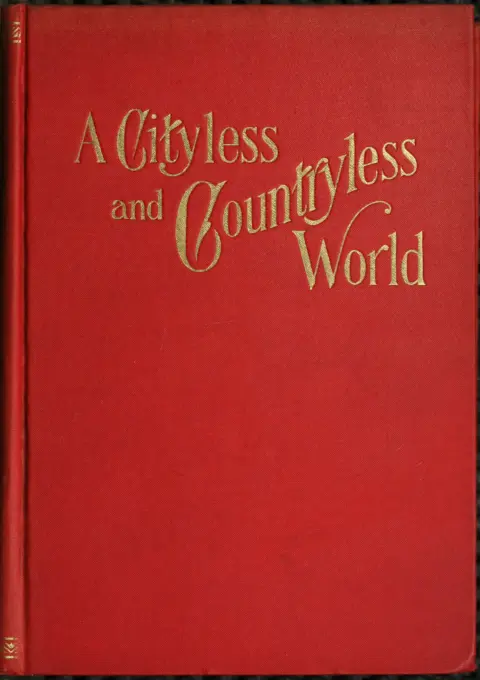
"A cityless and countryless world : An outline of practical cooperative…." by Henry Olerich is a utopian novel written in the late 19th century. It presents a visionary program of “practical co‑operative individualism” through the account of a Martian visitor who contrasts his advanced, harmonious society with Earth’s wasteful cities and isolated farms. The work lays out a full social and economic design—large communal “big-houses,” electrified infrastructure, efficient agriculture, rational education, voluntary governance, and equitable sex relations and property norms—aimed at maximizing freedom, health, and happiness. The opening of this work begins with a preface that applauds scientific achievements while indicting pervasive social evils, and declares the aim to outline a system uniting voluntary cooperation with individual liberty. The narrative then shifts to the exemplary Uwins household in the village of Dozen, where a charismatic stranger, Midith, arrives during a storm; he soon reveals he was born on Mars and, after winning the family’s trust, explains Mars–Earth differences, the feasibility of interplanetary travel, and offers a sharp critique of Earth’s poverty, exploitation, coercive government, money and land systems, gender inequities, schooling, and cruelty to animals. He expounds a Marsian worldview grounded in evolution and the nebular hypothesis, then sketches their living arrangements: no cities or countryside, but “big-houses” of about a thousand people set along electric motor-lines amid parks, gardens, and conservatories, with nearly all domestic and industrial functions powered by centralized engines. Early chapters also redefine wealth (healthy bodies and minds, material sufficiency, and mental riches) and begin a taxonomy of labor (productive, unproductive, destructive), before the excerpt breaks off.
Introduction adapted from the source catalogue; source summaries may be automatically generated.
Free to read · English · 122,946 words · No account needed
MAKE TIME FOR A GOOD BOOK
On by default. Untick to stop anonymous reading totals. Each page counts after 10 seconds in view. How this works.
Anonymous counting is on unless you have switched it off.
“Why, uncle,” said Viola, “it seems to me that we would be much better off without those relics of barbarism than with them, and I shall do all I can to elevate the mind of man high enough so that he feels no need for them.”
“It is doubtless true,” said Mr. Midith, “that those who have always lived in a world where a certain class of people have always ruled, or at least have tried to rule, the remainder of mankind by physical force, it may seem that no family, community or nation can do without a ruler backed by physical force. In primitive times the force process begins soon after birth and continues until death. First the child is scolded, cuffed and flogged by the parent and nurse, then by the teacher and preacher, then by his playmates and street-ruffians; when he wants to marry, the church and state begin to interfere; the policeman clubs his victim into submission, the hangman hangs him, the tax-collector forces him to pay taxes, and finally the landlord compels him or his friends to pay for the little patch of earth in which he is buried. Consequently all but a few of your foremost thinkers believe that the ruler and the force system is absolutely necessary to the welfare of an orderly society. But when we examine the pages of your history, as well as our own ancient history when our ancestors practiced the same despotism as you now practice, we find that the ruler, either directly or indirectly, has played all the cruel mischief that ever was played in the human family.
“The ruler calls the soldier to war to shoot his neighbor. The ruler instituted the practice of suttee, and exhorts the slavish widow to practice it. The ruler induces the Hindoo mother to throw her newly-born babe in the Ganges, by which the mother becomes a ruler over the child, to satisfy the ruler’s created Deity, who is supposed to be the supreme ruler. The ruler tortured and killed every so-called heretic--the cream of the mental world, during the dark ages. The ruler kindled every witch fire that consumed thousands and millions of innocent persons supposed to be witches. The ruler did all the wife and child flogging. The ruler gave all the unjust decisions that were ever given in any court of so-called justice. The ruler made all the millions of laws that have already been repealed, and are now considered wrong and cruel. The ruler had every national building and monument built and erected with the life and labor of his ruled. The ruler is the author of every battle. The ruler has been the suppressor of all liberty and freedom. The ruler has drafted every soldier, and forced him to burn and kill. The ruler has preached all superstitious doctrines, whether religious, industrial, social, political or sexual. The ruler has grown rich without productive labor, on profit, interest, rent, taxes, and the varying purchasing power of the dollar. The ruler has compelled children to attend school in which they were forced to act in direct opposition to the known laws of life and health. The ruler, whether individual, state or nation, has committed every murder. The ruler is the author of every ravishment. The ruler has received all the boodle. The ruler has so far, in your world, made slaves of women and children, and has thereby indirectly made a slave of himself. The ruler has committed every theft, robbery and burglary. The ruler has, in many cases, demanded prayer and shrine cure, instead of resorting to sanitary measures. The ruler has caused every quarrel and fight. The ruler has, in countless cases, commended the infamous and prohibited the virtuous. The ruler is the invader of all personal right and personal liberty. The ruler has done all this and much more. He has caused all the social and industrial discord. Why, then, should the ruled pay the ruler for ruling them, after having made so many errors and committed so many crimes? What guarantee have the ruled now that the ruler will not err in the present and future as he has done in the past?”
Your reading position is saved on this browser. Take it to another device with a library code. Reading pages adapt to text, rather than matching a printed edition.
BEHIND THE BOOK
This eBook is for the use of anyone anywhere in the United States and most other parts of the world at no cost and with almost no restrictions whatsoever. You may copy it, give it away or re-use it under the terms of the Project Gutenberg License included with this eBook or online at www.gutenberg.org. If you are not located in the United States, you will have to check the laws of the country where you are located before using this eBook. Read the source licence.
The original source file, including credits and licence, is retained by this library. Request an original-format copy at no charge. Please include the book title and Project Gutenberg identifier #76123.
KEEP YOUR CURIOSITY GOING
Coulson Kernahan

Maurice Baring
Frances Wright
Cécile Tormay
Francis Greenleaf Allinson & Anne C. E. (Anne Crosby Emery) Allinson

Frederic Jesup Stimson