
The story of the world a thousand years hence
Henry Olerich
THE CLASSIC COLLECTION · 1893
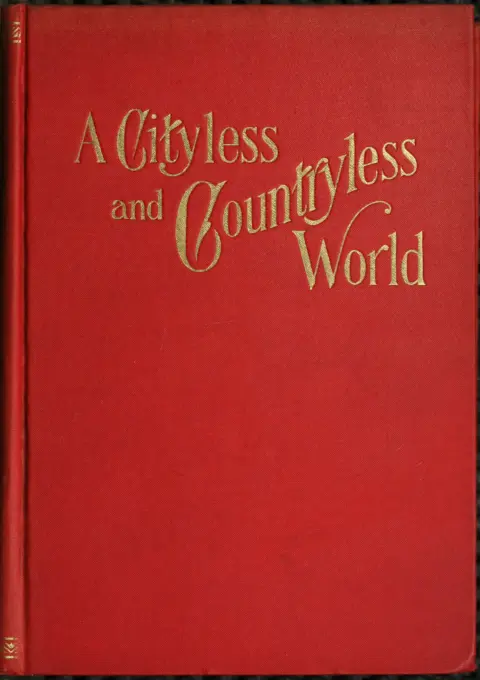
"A cityless and countryless world : An outline of practical cooperative…." by Henry Olerich is a utopian novel written in the late 19th century. It presents a visionary program of “practical co‑operative individualism” through the account of a Martian visitor who contrasts his advanced, harmonious society with Earth’s wasteful cities and isolated farms. The work lays out a full social and economic design—large communal “big-houses,” electrified infrastructure, efficient agriculture, rational education, voluntary governance, and equitable sex relations and property norms—aimed at maximizing freedom, health, and happiness. The opening of this work begins with a preface that applauds scientific achievements while indicting pervasive social evils, and declares the aim to outline a system uniting voluntary cooperation with individual liberty. The narrative then shifts to the exemplary Uwins household in the village of Dozen, where a charismatic stranger, Midith, arrives during a storm; he soon reveals he was born on Mars and, after winning the family’s trust, explains Mars–Earth differences, the feasibility of interplanetary travel, and offers a sharp critique of Earth’s poverty, exploitation, coercive government, money and land systems, gender inequities, schooling, and cruelty to animals. He expounds a Marsian worldview grounded in evolution and the nebular hypothesis, then sketches their living arrangements: no cities or countryside, but “big-houses” of about a thousand people set along electric motor-lines amid parks, gardens, and conservatories, with nearly all domestic and industrial functions powered by centralized engines. Early chapters also redefine wealth (healthy bodies and minds, material sufficiency, and mental riches) and begin a taxonomy of labor (productive, unproductive, destructive), before the excerpt breaks off.
Introduction adapted from the source catalogue; source summaries may be automatically generated.
Free to read · English · 122,946 words · No account needed
MAKE TIME FOR A GOOD BOOK
On by default. Untick to stop anonymous reading totals. Each page counts after 10 seconds in view. How this works.
Anonymous counting is on unless you have switched it off.
“Let us in a few words compare your commercial and mercantile system with ours, not with a view of fault-finding, not with a view of casting reflections, but with a view of instruction. We all need all the information we can get; if it is not in one thing it is in another. Nobody knows it all. Very likely there is much more that we do not know than the little we do know. Perhaps there is no better evidence of mental narrowness than our ostentatious pretention of knowing it all. With this view in mind let us proceed.
“You either live in the country, almost cut off from trade and commerce, or you live in a crowded city or town where the smoke and offensive odor enters every crevice, door and window, and where you are more or less starving for want of wholesome air. Where scarcely a vegetation opens its mouth to exhale the life-giving oxygen and to inhale the excessive carbonic acid which impairs the health of animal life. Where a portion of mankind are living an idle, wasteful life in a palace built by the labor of the poor, and another large class of industrious persons are eking out a miserable existence in a poor, filthy hovel. Under your profit system each must grab all he can or he must starve. In order that a few may amass comparatively worthless fortunes, many are trampled in the mire who can never rise again under the burden of your social and industrial system. Perhaps from one-half to three-fourths of your commercial and mercantile work is unproductive and destructive labor.
“Your railroad corporations not unfrequently receive large public donations of land, etc., to build the roads with, and after they are built they become the gambling stock on which large dividends are paid by the hand of labor. You have so many places of business where goods are spoiling for want of customers; and with your monopolistic profit system, every merchant is trying to freeze out his neighbor. We have no ‘middle-men’ who have to live from profit which must be taxed to the goods when sold to the consumer or producer; no army of mercantile schemers, the successful ones of whom live and grow rich from the labor and wrecked fortunes of others; no traveling salesmen; no countless warehouses and elevators, in which the rich speculator stores the grain and other commodities in order to create a fictitious market. Each one of our communities buys and preserves what it needs for its own consumption directly from some other community; and so each community also sells what it has to spare to some other purchasing community. Thus each purchase and sale is a wholesale, even if it amounts to only a nickle’s worth. With you a business man must live from the profits of his sales. He must sell or become impoverished. Under such a condition, in order to save himself from bankruptcy, he is tempted to lie, to misrepresent on the one hand and to suppress the truth on the other; he is tempted to persuade customers by deceptive means to purchase things they do not really want. He must strain every nerve and muscle to keep want from his door. His wife and children in many cases, where the business place is remote from the residence, scarcely ever see him. In the morning he leaves early and in the evening he returns late. Many of your business men have lost nearly all their social qualities and are little more than mere business worms with the shadow of death hovering on their countenances. Your business man is a mental slave also. In order to be successful in his business he must either be ignorant and superstitious himself, living in a little narrow, mental world, or he must tacitly, and sometimes even avowedly, sanction the ignorance and superstition of his customers. For, very likely, if he expresses his honest convictions concomitant with a higher state of culture in all directions, he offends some of his customers from the profit of whose purchases he must live, and financial ruin would be the result.”
Your reading position is saved on this browser. Take it to another device with a library code. Reading pages adapt to text, rather than matching a printed edition.
BEHIND THE BOOK
This eBook is for the use of anyone anywhere in the United States and most other parts of the world at no cost and with almost no restrictions whatsoever. You may copy it, give it away or re-use it under the terms of the Project Gutenberg License included with this eBook or online at www.gutenberg.org. If you are not located in the United States, you will have to check the laws of the country where you are located before using this eBook. Read the source licence.
The original source file, including credits and licence, is retained by this library. Request an original-format copy at no charge. Please include the book title and Project Gutenberg identifier #76123.
KEEP YOUR CURIOSITY GOING
Coulson Kernahan

Maurice Baring
Frances Wright
Cécile Tormay
Francis Greenleaf Allinson & Anne C. E. (Anne Crosby Emery) Allinson

Frederic Jesup Stimson