THE CLASSIC COLLECTION✦An outlaw’s diary: the CommuneCLASSIC FREE BOOKS
An outlaw’s diary: the Commune
Cécile Tormay
THE CLASSIC COLLECTION · 1584
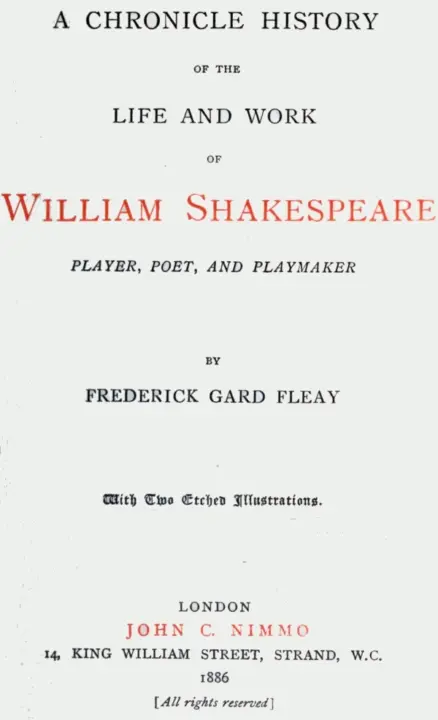
"A Chronicle History of the Life and Work of William Shakespeare" by Frederick Gard Fleay is a historical account written in the late 19th century. This work delves into the life and career of the iconic playwright William Shakespeare, examining his public and personal connections with other poets and dramatists of his time. Fleay not only recounts Shakespeare's biographical details but also analyzes the significant influence he had on English literature. The opening of the text sets the tone for a comprehensive examination of Shakespeare's career, emphasizing the importance of understanding his interactions with other figures in the theatrical community. Fleay critiques previous biographers for focusing excessively on trivial aspects of Shakespeare's personal life and instead aims to highlight the public dimensions of his career, such as the nature of the acting companies he was part of and the chronological order of his plays. The thorough introduction serves as a foundation for the detailed exploration of Shakespeare's life and work that unfolds in the subsequent sections of the book.
Introduction adapted from the source catalogue; source summaries may be automatically generated.
Free to read · English · 76,096 words · No account needed
MAKE TIME FOR A GOOD BOOK
On by default. Untick to stop anonymous reading totals. Each page counts after 10 seconds in view. How this works.
Anonymous counting is on unless you have switched it off.
[ bourne
The undiscover'd country from whose sight
no passenger ever return'd.
Ay, that]
"To be, or not to be? Ay, there's the point.
To die--to sleep--is that all? Ay. All? No.
To sleep--to dream--ay, marry, there it goes.
For in that dream of death when we, awake,
Are doom'd before an everlasting Judge,
The happy smile and the accurst are damn'd.
But for the joyful hope of this, who'ld bear
The scorns and flattery of the world, the right
Scorn'd by the rich, the rich curst of the poor,
The widow being opprest, the orphan wrong'd,
The taste of hunger, or a tyrant's reign,
And thousand more calamities besides,
When that he may his full quietus make
With a bare bodkin? Who would this endure,
But for a hope of something after death,
The undiscover'd country, from whose bourne
No passenger has e'er return'd? Ay that
Puzzles the brain and doth confound the sense;
Which makes us rather bear the ills we have,
Than fly to others that we know not of.
This consciënce makes cowards of us all."
I have put in italics in the text the marginal corrections of "proof" as shown above, inserted in their proper places; a comparison with the first Quarto will show how the printer, not the shorthand man or playdresser, by inserting them in the wrong places, has produced the nonsense that has caused so many groundless hypotheses.
"When we awake,
And borne before an everlasting Judge,
From whence no passenger ever return'd
The undiscover'd country, at whose sight
The happy smile," &c.
And farther on:
"Ay that O this conscience," &c.
The erroneous notions with regard to these imperfect Quartos arise, in a great measure, from their being compared with the carefully edited later versions; were they also edited and emended the differences would appear much smaller than they do now. The earlier (1601) form of this play was evidently hurriedly prepared during the journey to Scotland, in which the company visited the universities, at a time when the public taste for revenge-plays had been revived by the reproduction of Kyd's Jeronymo (Spanish Tragedy) by the Chapel children, probably at Jonson's suggestion; a new version of Kyd's Hamlet naturally followed. Other such plays were: Marston's Antonio and Mellida (Paul's, 1599-1600); Shakespeare's Julius Cæsar (1600); Chettle and Heywood's Hoffman, or Revenge for a Father, also called Like quits Like (Admiral's, January 1603): Chapman's Revenge of Bussy is of later date. A passage in Ram Alley (c. 1609), v. 1, "The custom of thy sin so lulls thy sense," &c., is apparently imitated from iii. 4. 161, &c., a passage not found in the Folio. This would lead to the conjecture that the Folio abridgment was made after 1609; on the other hand, the re-insertion in it of ii. 2. 350-379 points to a date, about 1610, when Underwood and Ostler had "grown to common players," and were admitted among the King's men. It was probably made then by Shakespeare himself. It is indeed most unlikely, that were it not so, its text should have been preferred, by the editors of the Folio, to the fuller one of the Quarto, which lay ready printed to their hands. We have, then, in the forms of this play, an example of Shakespeare's hurried revision of the work of an earlier writer, but it must be remembered in a most mutilated form; of the full working out of his own conception, in the shape fittest for private reading; and finally, of his practical adaptation of it to the requirements of the stage. The date of the printing of the first Quarto, and, therefore, of the revision made in the second, is after 19th May 1603, as the actors are called "King's servants" in the title-page. I. 1. 107-125, which surely allude to the death of Elizabeth, are omitted in the Folio. In iii. 2. 177, iv. 5. 77, alternative readings--
Your reading position is saved on this browser. Take it to another device with a library code. Reading pages adapt to text, rather than matching a printed edition.
BEHIND THE BOOK
This eBook is for the use of anyone anywhere in the United States and most other parts of the world at no cost and with almost no restrictions whatsoever. You may copy it, give it away or re-use it under the terms of the Project Gutenberg License included with this eBook or online at www.gutenberg.org. If you are not located in the United States, you will have to check the laws of the country where you are located before using this eBook. Read the source licence.
The original source file, including credits and licence, is retained by this library. Request an original-format copy at no charge. Please include the book title and Project Gutenberg identifier #46756.
KEEP YOUR CURIOSITY GOING
Cécile Tormay

Moritz Busch
John L. Ransom
Frances Wright
Cécile Tormay

Mabel Potter Daggett