THE CLASSIC COLLECTION✦An outlaw’s diary: the CommuneCLASSIC FREE BOOKS
An outlaw’s diary: the Commune
Cécile Tormay
THE CLASSIC COLLECTION · 1584
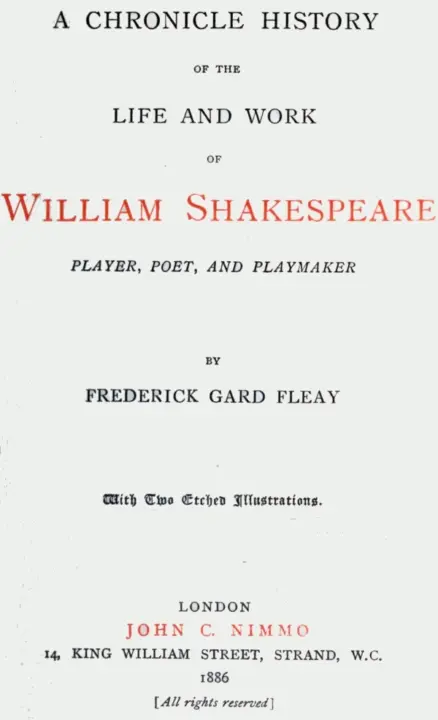
"A Chronicle History of the Life and Work of William Shakespeare" by Frederick Gard Fleay is a historical account written in the late 19th century. This work delves into the life and career of the iconic playwright William Shakespeare, examining his public and personal connections with other poets and dramatists of his time. Fleay not only recounts Shakespeare's biographical details but also analyzes the significant influence he had on English literature. The opening of the text sets the tone for a comprehensive examination of Shakespeare's career, emphasizing the importance of understanding his interactions with other figures in the theatrical community. Fleay critiques previous biographers for focusing excessively on trivial aspects of Shakespeare's personal life and instead aims to highlight the public dimensions of his career, such as the nature of the acting companies he was part of and the chronological order of his plays. The thorough introduction serves as a foundation for the detailed exploration of Shakespeare's life and work that unfolds in the subsequent sections of the book.
Introduction adapted from the source catalogue; source summaries may be automatically generated.
Free to read · English · 76,096 words · No account needed
MAKE TIME FOR A GOOD BOOK
On by default. Untick to stop anonymous reading totals. Each page counts after 10 seconds in view. How this works.
Anonymous counting is on unless you have switched it off.
Hamlet is extant in three forms--the Folio, which is evidently a stage copy considerably shortened for acting purposes; the 1604 Quarto, which is a very fair transcript of the author's complete copy, with a few omissions; and the 1603 Quarto, imperfect and inaccurate. The date of the perfect play is certainly 1603. In ii 2. 346, &c., we find that the tragedians of the city--i.e., Shakespeare's company--are "travelling," and that "their inhibition comes of the late innovation." This has been interpreted in various ways, the most absurd being that which regards the establishment of the Revels children in 1604 as the innovation: hardly less so is Malone's notion that the putting down of the Curtain players in 1600 is the inhibition referred to. The Globe company travelled in 1601 in consequence of Essex' attempt at political innovation, and their acting Richard II. in connection therewith; they travelled again in 1603, the theatres being shut because of the plague: this latter is the time referred to in the final version, for in the latter part of that year the Puritan party had by millenary petitions at Hampton Court conferences, and so forth, attempted a religious "innovation;" and their anxiety to avoid this charge is evident in their continual protests that it was a reformation, not an innovation, that they wanted (see Fuller, Church History, under 1603-4 passim). The immediately succeeding passage, l. 351-379, however, which also occurs in the earlier version, distinctly points to 1601. The "berattling of the common stages by the aery of little eyases," the controversy between poet and player, ended in that year; these lines are not contained in the second Quarto. The words "if they should grow themselves to common players," indicate a possible date of writing c. 1610, when Ostler and Underwood, Chapel boys in 1601, had grown up and been taken into the King's men; but the use of the present tense in the preceding paragraph shows that the same Chapel children who had been engaged in the Jonson and Marston quarrel were still on the stage, and that the date of writing is anterior to their replacement by the Revels boys in January 1604. The growing to common players then must be taken generally, not specifically; unless we suppose a still further revision c. 1610, which on other grounds is not unlikely. It may be worth noting that the play of Dido, in rivalry of which the player's speech in ii. 2 is recited, belonged to these same Chapel children. In like manner the Pyrgus in Jonson's Poetaster recites bits of The Battle of Alcazar in rivalry with Dekker's Captain Stukeley. But although the date of the perfect play is almost certainly 1603, Hamlet had certainly been on the stage some years at that time. Tucca in Satiromastix (1601) says, "My name's Hamlet Revenge," and he comes on, "his boy after him, with two pictures under his cloak." In Marston's Malcontent (1601), "Illo, ho, ho, ho! art thou there, old Truepenny?" must refer to Hamlet. In iii. 2. 42, "Let those that play your clowns speak no more than is set down for them," refers, I think, to extemporising Kempe, who left Shakespeare's company in 1599. Florio's Montaigne, which is implicitly referred to throughout the play (see Mr. Feis, Shakespeare and Montaigne, 1884), was entered S. R. 4th June 1600. On the title-page of the first Quarto it is said that the play had been acted in the Universities of Oxford and Cambridge and elsewhere; i.e., in the travelling of 1601. It is pretty clear, then, that 1601 was the date of its production. Polonius (iii. 2. 108) had already played Julius Cæsar in the University, which could hardly have been before 1601; and Hamlet was entered by Roberts 26th July 1602, in S. R., "as it was lately acted." Plays thus produced during "travels," were almost always hurried and careless performances; indeed, this form of Hamlet seems to have been an unfinished refashioning of the old play by Kyd, that had so long been performed by the Chamberlain's men. The names Corambis and Montano for Polonius and Reynaldo, and a good deal of Acts iii. and iv., seem to be remnants of this old play. The name Corambus is found in the German version, which probably dates c. 1592. It also occurs in All's Well, iv. 3. 185. The first Quarto is in this instance, as in those of Romeo, Henry V., and Merry Wives, in my opinion, printed from a partly revised prompter's copy of the 1601 play, which became useless when the fuller version was made. In this instance there are traces of alterations having been made on this copy similar to that in Romeo, iii. 5. 177. The usual explanation of the peculiar text of imperfect Quartos is, that notes were taken in shorthand at the theatre, which, eked out by the vampings of some playdresser, made up a saleable version, however incorrect. The stronghold of this theory is the soliloquy in iii. 1. 56, &c. The minor errors of "right done" for "write down," i. 2. 222; "invenom'd speech" for "in venom steept," ii. 2. 533; "honor" for "owner," v. 1. 121; and the like, can be easily paralleled in the most authentic copies of printed plays of the period. But a careful examination of the text of that speech of Hamlet's in the first Quarto, shows that its present meaningless shape arises from the displacement of two lines only, an error which is most unlikely to have occurred in shorthand notes, and is completely subversive of the hack play-writing botcher hypothesis. I append this soliloquy, as I suppose it to have stood in the MS. of the prompter's copy, after the partial 1601 correction:
Your reading position is saved on this browser. Take it to another device with a library code. Reading pages adapt to text, rather than matching a printed edition.
BEHIND THE BOOK
This eBook is for the use of anyone anywhere in the United States and most other parts of the world at no cost and with almost no restrictions whatsoever. You may copy it, give it away or re-use it under the terms of the Project Gutenberg License included with this eBook or online at www.gutenberg.org. If you are not located in the United States, you will have to check the laws of the country where you are located before using this eBook. Read the source licence.
The original source file, including credits and licence, is retained by this library. Request an original-format copy at no charge. Please include the book title and Project Gutenberg identifier #46756.
KEEP YOUR CURIOSITY GOING
Cécile Tormay

Moritz Busch
John L. Ransom
Frances Wright
Cécile Tormay

Mabel Potter Daggett