THE CLASSIC COLLECTION✦An outlaw’s diary: the CommuneCLASSIC FREE BOOKS
An outlaw’s diary: the Commune
Cécile Tormay
THE CLASSIC COLLECTION · 1584
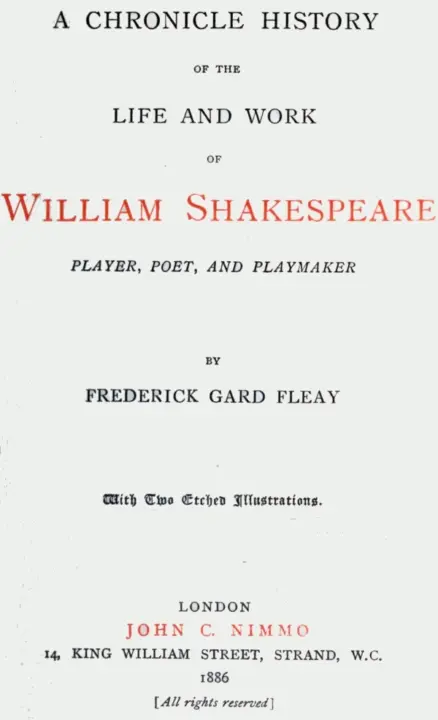
"A Chronicle History of the Life and Work of William Shakespeare" by Frederick Gard Fleay is a historical account written in the late 19th century. This work delves into the life and career of the iconic playwright William Shakespeare, examining his public and personal connections with other poets and dramatists of his time. Fleay not only recounts Shakespeare's biographical details but also analyzes the significant influence he had on English literature. The opening of the text sets the tone for a comprehensive examination of Shakespeare's career, emphasizing the importance of understanding his interactions with other figures in the theatrical community. Fleay critiques previous biographers for focusing excessively on trivial aspects of Shakespeare's personal life and instead aims to highlight the public dimensions of his career, such as the nature of the acting companies he was part of and the chronological order of his plays. The thorough introduction serves as a foundation for the detailed exploration of Shakespeare's life and work that unfolds in the subsequent sections of the book.
Introduction adapted from the source catalogue; source summaries may be automatically generated.
Free to read · English · 76,096 words · No account needed
MAKE TIME FOR A GOOD BOOK
On by default. Untick to stop anonymous reading totals. Each page counts after 10 seconds in view. How this works.
Anonymous counting is on unless you have switched it off.
In March 1601 the Chamberlain's company were in disgrace for having publicly acted "the outdated play of Richard II.," no doubt inclusive of the deposition scene (which had been omitted in the published copies, under the censorship of the Master of the Revels), for the entertainment of the Essex conspirators. They consequently "travelled," having previously produced Shakespeare's All's Well that Ends Well, a considerable portion of which is of much earlier date (c. 1592), but which, in the Parolles scenes, has distinct allusion to Marston's Jack Drum's Entertainment of the preceding year, and to the "war of the theatres," not yet concluded. They also acted the play of Cromwell, Earl of Essex, by W. S., in which the parallel between the careers of Cromwell and the lately executed Earl is strongly brought out. I believe W. S. to have been William Sly, the well-known actor of the Chamberlain's company. In their travels this year the company visited the Universities of Oxford and Cambridge, where they performed Julius Cæsar and Hamlet. The version of this last play so acted was not the old play by Kyd, but one hurriedly remodelled by Shakespeare, which we possess in an imperfect form in the first Quarto. Among the Shakespearian additions occur passages alluding to the theatrical war and the popularity of the Chapel Children, to which the travelling of the company is attributed. This proves that Shakespeare was one of the strolling detachment. Jonson seized on this defence in his Poetaster, and represented that the travelling was due to the inefficiency of their play-writers, and makes Tucca tell Histrio, the Globe player, that if they will employ Marston, who "pens high lofty in a new stalking strain," they "shall not need to travel with thy pumps full of gravel after a blind jade and a hamper, and stalk upon boards and barrel-heads to an old cracked trumpet." The travels, however, were not confined to England. In October they had reached Aberdeen, where they received the title of "the King's Servants," and Laurence Fletcher, their manager, was admitted burgess of guild of the borough. In all probability a version of the old Macbeth play was produced before King James--such a version as that of Hamlet acted at the Universities. Its plot would fit more aptly with the circumstances of the Gowry conspiracy of 1600 than that of Richard II. would with Essex, and anything more pleasing to the King and people of Scotland could not have been selected. During the absence of this strolling detachment Jonson's Poetaster was produced, containing a vigorous attack on the Globe company; and they, in Shakespeare's absence, hired Dekker to reply in his Satiromastix, which, with the aid of the Paul's children, they represented in the public theatre of the Globe, and in the private convocation-room of Paul's. During this same absence, on 8th September Shakespeare's father was buried at Stratford. He apparently died intestate. After the return from Scotland, the appearance of Shakespeare's name, as fellow-contributor to Chester's Love's Martyr with Jonson, Marston, and Chapman, marks the conclusion of the theatrical quarrel, and the reconciliation of all the principal combatants, except Dekker. But although this book bears the date 1601, it could not, I think, have been issued earlier than March 1601-2, after the production of Twelfth Night on February 2 at the Middle Temple. Such presentations as this at Inns of Court were usually of new plays; and there is in this play fairly conclusive internal evidence that the theatrical quarrel was not over when it was acted. With regard to Shakespeare's other play of this year, Troylus and Cressida, it was as clearly produced after the reconciliation. The entry in S. R., "as it is acted by the Lord Chamberlain's men," is absolutely conclusive that it was still on the stage on 1st February 1602-3, and was therefore produced, in all probability, in the later half of 1602. In this play the Prologue, the love story of Troylus, and all the scenes after v. 4, are taken from the old play of c. 1593, in which Shakespeare only wrote as a coadjutor. The Prologue and the later scenes--v. 5-10--are manifestly by the second pen in the main, and printed by mistake, the end of the revised version being shown by the repetition of the lines "Why, but hear you," &c., at the end of v. 3. That the 1602 version of the play was intended to refer to the theatrical quarrel of 1599-1602 is clear from the line "Rank Thersites with his mastick tooth," who is evidently Dekker, of whom Jonson says in the Poetaster (iii. 1), "He has one of the most overflowing rank wits in Rome; he will slander any man that breathes if he disgust him." Dekker had produced the SatiroMASTIX shortly before Troylus was acted; and it has been noted that he was not one of the contributors to Chester's Martyr. I believe the Troylus play to have been the one in which Shakespeare put down all the University men, and purged Ben Jonson's pride, as we learn that he did from the University play of The Return from Parnassus, acted in January 1602-3; the character of Ajax, "Slow as the elephant, into whom nature hath so crowded humours," &c. (i. 2), hits off Jonson exactly, and is a good-humoured reply to Jonson's self-estimate as Crites in Cynthia's Revels (ii. 1), "A creature of a most divine temper, one in whom the elements and humours are peaceably met," &c.
Your reading position is saved on this browser. Take it to another device with a library code. Reading pages adapt to text, rather than matching a printed edition.
BEHIND THE BOOK
This eBook is for the use of anyone anywhere in the United States and most other parts of the world at no cost and with almost no restrictions whatsoever. You may copy it, give it away or re-use it under the terms of the Project Gutenberg License included with this eBook or online at www.gutenberg.org. If you are not located in the United States, you will have to check the laws of the country where you are located before using this eBook. Read the source licence.
The original source file, including credits and licence, is retained by this library. Request an original-format copy at no charge. Please include the book title and Project Gutenberg identifier #46756.
KEEP YOUR CURIOSITY GOING
Cécile Tormay

Moritz Busch
John L. Ransom
Frances Wright
Cécile Tormay

Mabel Potter Daggett