THE CLASSIC COLLECTION✦An outlaw’s diary: the CommuneCLASSIC FREE BOOKS
An outlaw’s diary: the Commune
Cécile Tormay
THE CLASSIC COLLECTION · 1584
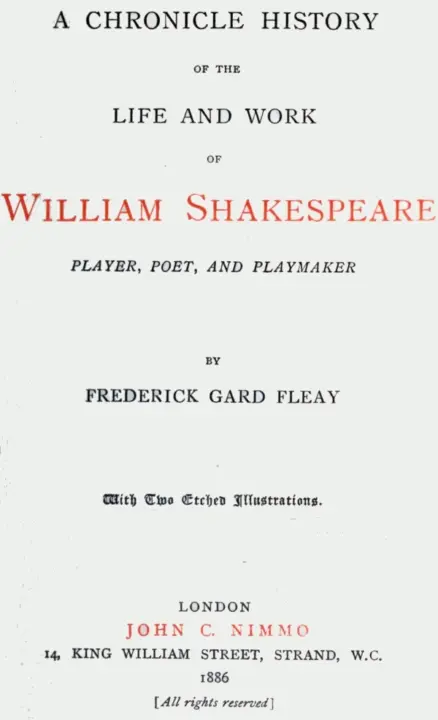
"A Chronicle History of the Life and Work of William Shakespeare" by Frederick Gard Fleay is a historical account written in the late 19th century. This work delves into the life and career of the iconic playwright William Shakespeare, examining his public and personal connections with other poets and dramatists of his time. Fleay not only recounts Shakespeare's biographical details but also analyzes the significant influence he had on English literature. The opening of the text sets the tone for a comprehensive examination of Shakespeare's career, emphasizing the importance of understanding his interactions with other figures in the theatrical community. Fleay critiques previous biographers for focusing excessively on trivial aspects of Shakespeare's personal life and instead aims to highlight the public dimensions of his career, such as the nature of the acting companies he was part of and the chronological order of his plays. The thorough introduction serves as a foundation for the detailed exploration of Shakespeare's life and work that unfolds in the subsequent sections of the book.
Introduction adapted from the source catalogue; source summaries may be automatically generated.
Free to read · English · 76,096 words · No account needed
MAKE TIME FOR A GOOD BOOK
On by default. Untick to stop anonymous reading totals. Each page counts after 10 seconds in view. How this works.
Anonymous counting is on unless you have switched it off.
In this year a perfect edition of Romeo and Juliet was published, probably on leaving the Curtain; and The Passionate Pilgrim was impudently issued by W. Jaggard as by William Shakespeare. Beyond two sonnets and a few lines from Love's Labour's Lost, published in 1598, there is nothing in this book that can be shown to be Shakespeare's, but much that cannot. Somewhere about this date an unsuccessful application was made to impale the arms of Shakespeare with those of Arden. The Chamberlain's men performed three plays at Court during the Christmas festivities, viz.: on 26th December, probably As You Like It; 5th January, probably Henry V.; and another play on 4th February. I think this was the occasion for which The Merry Wives of Windsor was written, or rather rewritten on the foundation of The Jealous Comedy of 1592. The Queen, whose admiration for the character of Falstaff is well known, was sorely disappointed that Shakespeare had not fulfilled his promise made in the Epilogue to 2 Henry IV., that he would again introduce him on the stage; and there is no reason to doubt the tradition that, wishing to see him under new conditions, she ordered Shakespeare to represent him in love, which order he obeyed by writing The Merry Wives within a fortnight. The dates all suit this hypothesis, and in any case there can be no doubt that this comedy stands apart from the Henry V. histories, and was last in point of time. Another play of this year was Julius Cæsar. There is no evidence of any other writer than Shakespeare for the company this year, in which the 2 and 3 Henry VI. (alluded to as recast in Jonson's Prologue to his revised version of Every Man in his Humour, acted by the Chapel children early in 1601) were revised and partly rewritten by him. As usual in such cases, the old abridged acting copies of the plays in their earlier shape were reprinted. But there is more interesting matter connected with the publishers in the 1600 entries. On August 4, As You Like It, enry V., Much Ado about Nothing, and Every Man in his Humour, all Chamberlain's plays, were ordered to be "stayed;" they were probably suspected of being libellous, and reserved for further examination. Since the "war of the theatres" was at its height, they may have been restrained as not having obtained the consent of the Chamberlain, on behalf of his company, to their publication. Subsequently, Every Man in his Humour was licensed on 14th August, but not printed till 1601. Much Ado was also licensed 23d August, and printed; As You Like It was not allowed to appear, the company probably objecting that it had only been on the stage for one year, but Henry V. was printed surreptitiously by T. Millington and T. Busby before 14th August, on which date it appears in S. R. as the property of T. Pavier, who reprinted it in 1602. The peculiarity of this Quarto issue is, that it contains no matter which does not also appear in the complete Folio version, whereas, in the somewhat similar cases of Romeo and Juliet, The Merry Wives, and Hamlet, there is in every instance some portion of the Quarto which is palpably by another hand. This agrees with my view that these three plays, as in the Folio, were founded on earlier plays, in which Shakespeare was at most a coadjutor, while the Folio Henry V. is a revision of his own play, produced not long before. Another entry in S. R. is interesting. On October 28, The Merchant of Venice was entered to T. Hayes, with Pavier's consent; Roberts had already entered it 22d July 1598, but it had not been allowed to appear, probably because, like those mentioned above, it had then been only one year on the stage. On October 8, Midsummer Night's Dream was also entered. Of the editions of these two plays published in this year information will be found in another part of this book. On 11th August the two plays on Sir John Oldcastle, of which only one has reached us, were entered. They had been acted in 1599 at the Rose by the Admiral's men, and were directed against the presumed scandal thrown on the "martyr" in Shakespeare's Henry V. series. It should be especially noted that the principal author of these plays was Drayton, formerly fellow-worker with Shakespeare for the Chamberlain's men, and introducer of Sir John Oldcastle as a profligate parson in The Merry Devil of Edmonton. Of Shakespeare's personal movements during this year we merely know that he was in London in April recovering a debt of £7 of one Clayton, and no doubt acting in the three plays performed at Court in the winter.
Your reading position is saved on this browser. Take it to another device with a library code. Reading pages adapt to text, rather than matching a printed edition.
BEHIND THE BOOK
This eBook is for the use of anyone anywhere in the United States and most other parts of the world at no cost and with almost no restrictions whatsoever. You may copy it, give it away or re-use it under the terms of the Project Gutenberg License included with this eBook or online at www.gutenberg.org. If you are not located in the United States, you will have to check the laws of the country where you are located before using this eBook. Read the source licence.
The original source file, including credits and licence, is retained by this library. Request an original-format copy at no charge. Please include the book title and Project Gutenberg identifier #46756.
KEEP YOUR CURIOSITY GOING
Cécile Tormay

Moritz Busch
John L. Ransom
Frances Wright
Cécile Tormay

Mabel Potter Daggett