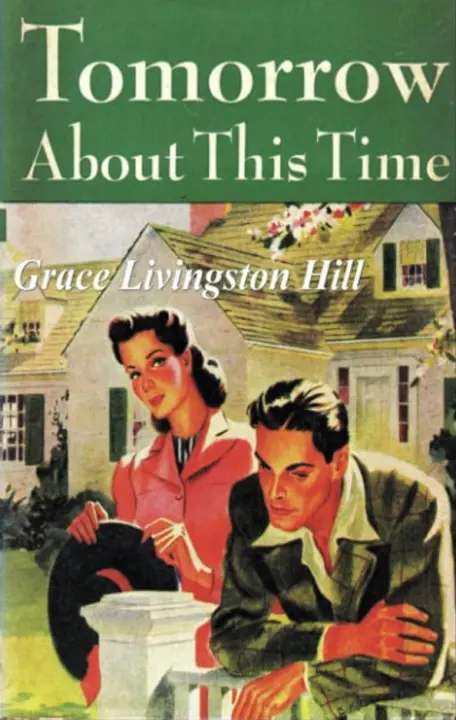
Tomorrow about this time
Grace Livingston Hill
THE CLASSIC COLLECTION · 1887
"A Chautauqua Idyl" by Grace Livingston Hill is a narrative written in the late 19th century that falls under the category of a philosophical allegory. The book centers around the Chautauqua movement, highlighting themes of education, spirituality, and community. It weaves a story through the perspectives of various flower and animal characters who discuss their desire for gathering and learning in a celebratory way that honors their creator. In the story, a group of flowers and creatures living near a brook yearn for something meaningful to do, leading to the idea of creating a Chautauqua gathering. They talk about the experiences of a new arrival, a bachelor button, who shares tales of a beautiful place where people come together to study and sing about God and nature. As they debate what their own Chautauqua should consist of, they explore topics such as theology, literature, and art. Each character brings their own unique contributions to the committee planning their event, culminating in a hopeful undertaking designed to celebrate their existence and the beauty of God's creation. The narrative illustrates the joy of collaboration, the importance of knowledge, and the power of collective praise.
Introduction adapted from the source catalogue; source summaries may be automatically generated.
Free to read · English · 10,364 words · No account needed
MAKE TIME FOR A GOOD BOOK
On by default. Untick to stop anonymous reading totals. Each page counts after 10 seconds in view. How this works.
Anonymous counting is on unless you have switched it off.
“We can all pray,” said the elm. “Let us have a prayer meeting first every morning to thank the dear God for the new day, and let the rising sun be the leader.”
“That is good,” said the flowers, and bright rays of light, the sun’s little children, kissed them tenderly.
“What is next?”
“They have a large choir, and every morning after the prayer meeting they meet and practise with the great organ and piano and band.”
“We will be the singers,” chorused the birds.
“I will tinkle, tinkle, like a piano,” sang the brook, “tinkle, tinkle,
tinkle,—”
“I will play the band, for I have very many instruments at my command, and my friend the thunder will play the organ, while you, dear old trees, shall be my violins and harps, and every morning we will practise,” said the wind.
“What do they have next at Chautauqua?” asked a pert blackbird.
“Lectures,” said the fish.
“What are lectures?”
“Talks about things.”
“What things?”
“Oh! evolution and literature and theology and philosophy and art and poetry and science, and a great many other things.”
The high-sounding words rolled out from that fish’s mouth as if he actually thought he understood them.
Silence reigned for a few minutes, deep and intense, at last broken by
the white violet:
“We never could have all those, for we don’t know anything about them. And who could talk about such things? None of us.”
Silence again. They were all thinking earnestly.
“I don t believe it. Not one word,” chattered a saucy squirrel. “That’s a fish story. As if you could get on dry land and go to lectures.”
“Oh! very well, you needn’t believe it if you don’t want to,” answered the fish in a hurt tone, “but I heard a man on board the steamer read the programme, and those are the very words he read.”
“If we only had a dictionary,” again sighed the rose.
“Dictionary, dictionary, dic, dic, dictionary,” murmured the brook,
thoughtfully.
“A dictionary is absolutely necessary before we can proceed any further,” said the south wind. “And as I am obliged to travel to New York this evening, I will search everywhere, and if possible bring one back with me. Anything can be had in New York. It is getting late, and I think we had better adjourn to meet again to-morrow. I hope to be able to return by two o’clock. In the meantime, let us all think deeply of what we have heard, and if any one can see a way out of our difficulty, let him tell us then.”
Your reading position is saved on this browser. Take it to another device with a library code. Reading pages adapt to text, rather than matching a printed edition.
Grace Livingston Hill
Grace Livingston Hill
Grace Livingston Hill
Grace Livingston Hill
BEHIND THE BOOK
This eBook is for the use of anyone anywhere in the United States and most other parts of the world at no cost and with almost no restrictions whatsoever. You may copy it, give it away or re-use it under the terms of the Project Gutenberg License included with this eBook or online at www.gutenberg.org. If you are not located in the United States, you will have to check the laws of the country where you are located before using this eBook. Read the source licence.
The original source file, including credits and licence, is retained by this library. Request an original-format copy at no charge. Please include the book title and Project Gutenberg identifier #51103.
KEEP YOUR CURIOSITY GOING

David Patterson (Spirit) Hatch

David Patterson (Spirit) Hatch

David Patterson (Spirit) Hatch
Coulson Kernahan

Maurice Baring
Frances Wright