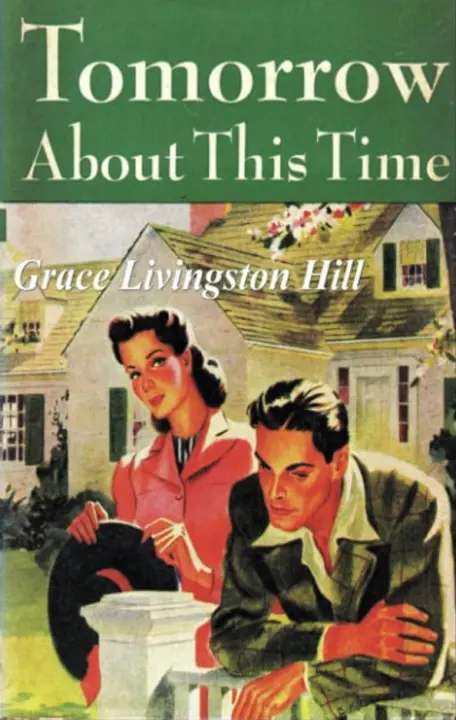
Tomorrow about this time
Grace Livingston Hill
THE CLASSIC COLLECTION · 1887
"A Chautauqua Idyl" by Grace Livingston Hill is a narrative written in the late 19th century that falls under the category of a philosophical allegory. The book centers around the Chautauqua movement, highlighting themes of education, spirituality, and community. It weaves a story through the perspectives of various flower and animal characters who discuss their desire for gathering and learning in a celebratory way that honors their creator. In the story, a group of flowers and creatures living near a brook yearn for something meaningful to do, leading to the idea of creating a Chautauqua gathering. They talk about the experiences of a new arrival, a bachelor button, who shares tales of a beautiful place where people come together to study and sing about God and nature. As they debate what their own Chautauqua should consist of, they explore topics such as theology, literature, and art. Each character brings their own unique contributions to the committee planning their event, culminating in a hopeful undertaking designed to celebrate their existence and the beauty of God's creation. The narrative illustrates the joy of collaboration, the importance of knowledge, and the power of collective praise.
Introduction adapted from the source catalogue; source summaries may be automatically generated.
Free to read · English · 10,364 words · No account needed
MAKE TIME FOR A GOOD BOOK
On by default. Untick to stop anonymous reading totals. Each page counts after 10 seconds in view. How this works.
Anonymous counting is on unless you have switched it off.
“But,” objected white Violet, “we can’t. We must invite all the flowers and birds and brooks and trees all over the world, and they will have to get ready. It will take the flowers the rest of this summer and all of next winter to get their dresses made and packed in their brown travelling seed trunks. I’m sure it would me if I were to go away from here for the summer, and it is late in the season already. We couldn’t get word to them all in time.”
“Yes,” said the fish, “and there are the travelling expenses to be arranged for such a large company. We should have to secure reduced rates. They always do on Chautauqua Lake.”
“Oh! as to that,” said the wind, “I and the birds would do the transportation free of charge, and the brook would do all it could, I’m sure.”
“Of course, of course,” babbled the brook.
“That is very kind of you indeed,” said Bachelor. “But I should think that the earliest possible beginning that we could hope to have would be next spring.”
After much impatient arguing on the part of the buttercups and daisies, it was finally agreed that the first meeting of their Chautauqua should be held the following spring.
“It must last all summer,” they said, “because some of us can come early and some late. There is the golden-rod now, it never can come till late in the fall.”
“Of course, of course; certainly, certainly,” chattered the brook.
“What comes next?” softly asked the wild rose.
“The next thing to do is to appoint a committee to make out the programme,” remarked the fish.
“Committee! Who is that?” cried a butterfly.
“Programme! what’s programme?” chirped a sparrow.
“O dear! we need a dictionary,” sighed the roses.
“What’s a dictionary?” asked a little upstart of a fern.
“Silence!” sternly commanded Bachelor. “Will Miss Rose kindly explain the meaning of dictionary, after which Mr. Fish will proceed to tell us about programme and committee.”
Little Rose blushed all over her pretty face, and after thinking a
moment, replied,—
“A dictionary is a book that tells what all words mean.”
“Oh!” sighed the wind, “we must have a dictionary.”
Mr. Fish having made a dash up stream after a fly, now resumed his
sedate manner and spoke:
“My friends, a programme says what we will have every day, and a committee are the ones who make it.”
“Then let’s all be committee,” said the buttercup.
“That’s a very good plan,” said Bachelor. “Now, what shall we have? They always have a prayer meeting first at Chautauqua.”
Your reading position is saved on this browser. Take it to another device with a library code. Reading pages adapt to text, rather than matching a printed edition.
Grace Livingston Hill
Grace Livingston Hill
Grace Livingston Hill
Grace Livingston Hill
BEHIND THE BOOK
This eBook is for the use of anyone anywhere in the United States and most other parts of the world at no cost and with almost no restrictions whatsoever. You may copy it, give it away or re-use it under the terms of the Project Gutenberg License included with this eBook or online at www.gutenberg.org. If you are not located in the United States, you will have to check the laws of the country where you are located before using this eBook. Read the source licence.
The original source file, including credits and licence, is retained by this library. Request an original-format copy at no charge. Please include the book title and Project Gutenberg identifier #51103.
KEEP YOUR CURIOSITY GOING

David Patterson (Spirit) Hatch

David Patterson (Spirit) Hatch

David Patterson (Spirit) Hatch
Coulson Kernahan

Maurice Baring
Frances Wright