READ · DISCOVER · ENJOYClassic literature · Always free
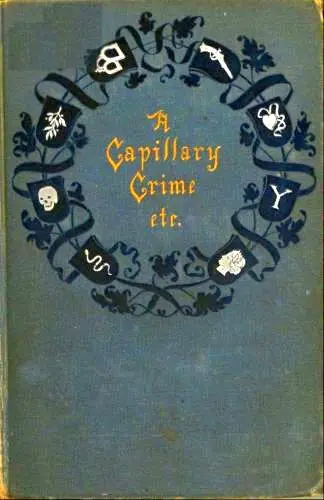
A Capillary Crime, and Other Stories — digital edition cover

THE CLASSIC COLLECTION · 1892

A Capillary Crime, and Other Stories

"A Capillary Crime and Other Stories" by Francis Davis Millet is a collection of short stories written in the late 19th century. The stories explore various themes driven by intrigue, human emotions, and unexpected occurrences, with the titular tale "A Capillary Crime" centering on the mysterious murder of an artist in Paris and the investigation that follows. At the start of "A Capillary Crime," the narrative unfolds in a quiet street in Montmartre, Paris, which reflects a juxtaposition of the bustling city life nearby. The scene sets a foreboding tone as it introduces the sudden death of artist Charles Mandel, whose lifeless body is discovered in his studio under mysterious circumstances. A young woman, familiar with the locality, emerges anxious and flustered, hinting at her connection to the artist, while police officers begin their examinations amid a gathering crowd. As the investigation commences, the tragic incident reveals layers of complex relationships and motivations, capturing the reader's interest in uncovering the truth behind the unsettling events.

Introduction adapted from the source catalogue; source summaries may be automatically generated.

Start reading ↓

Free to read · English · 48,949 words · No account needed

MAKE TIME FOR A GOOD BOOK

A Capillary Crime, and Other Stories

On by default. Untick to stop anonymous reading totals. Each page counts after 10 seconds in view. How this works.

Anonymous counting is on unless you have switched it off.

A Capillary Crime, and Other Stories

The déjeuner went on without further interruption, and the guitar girl drummed away until the table was cleared. We were not at a loss for entertainments after the feast was ended. Tyck’s costumes were drawn upon, and a Flemish musician sang a costume duet with a Walloon sculptor, one being laced up in a blue satin ball-dress, and the other staggering under the weight of a janissary’s uniform. Later on there was a dancing concours, in which the Indian war-dance, the English jig, the negro walk-around, the tarantella, the Flemish reuske, and the Hungarian csárdás each had its nimble-footed performers. The scene was worth putting upon canvas. The confusion of quaint and rare trinkets, the abundance of color-bits, and the picturesque groups of figures in all the costumes that could be improvised for the dance or the song--a museum of bric-à-brac and a carnival of characters--all this made a tableau vivant of great richness and interest.

About the middle of the afternoon the entertainment began to flag a little, and the moment there was a lull in the sport some one proposed a trip to Ponte Molle. The vote was immediately taken and carried, and we marched out to the Piazza del Popolo and engaged an omnibus for the rest of the day.

The straggling suburb outside the Porta del Popolo was lively with pleasure-seeking Romans. The wine-shops were full of sad-eyed peasants and weary, careworn laborers; all the mournful character of a Roman merry-making was unusually prominent on this cheerless holiday, and the cloaked natives chatted as solemnly as if they were mourners at a funeral. Roman festivities are, in general, not calculated to divert the participants to a dangerous extent. Wine-drinking is the chief amusement; and even under the enlivening influences of his potations the Roman rarely loses his habitual seriousness of manner, but bears himself to the end of the orgy as if he expected every moment to be called upon to answer for the sins of his ancestors. As we drove along the straight, broad road that raw afternoon, we met numberless carts and omnibuses filled with laborers returning from the wine-shops in the Campagna; the sidewalks were crowded with people on their way to and from the trattorie near the Tiber; and scarcely a song was heard, rarely a laugh sounded above the rattle of the wheels. The natives were making a business of amusement, and formed a staid and sober procession, on an occasion when in Germany or Belgium the frolics and noisy merriment of the people would have known no bounds short of the limit of physical endurance. We were probably regarded as escaped maniacs because we persisted in breaking the voiceless confusion by our hearty Flemish songs. We left the omnibus in the yard of a trattoria at some distance out in the Campagna, and strolled over the hills for an hour, watching the dark, cold mountains and the broad, sad-tinted waste spread out before us. The solemn beauty of the Campagna is always impressive; under a gray sky it assumes a sombre and mournful aspect. To the north of the city, the low, flat-topped hills combine in a peculiar way to form silhouettes of great nobleness of character and simplicity of line. They are the changeless forms that endure like the granite cliffs, monumental in their grandeur. When moving shadows of the clouds form purple patches across these hills, and the dull gray of the turf comes into occasional relief in a spot of strong sunlight, the scene is one of unique and matchless beauty--a heroic landscape, with wonderful vigor and dignity of line and extraordinary delicacy of tone. That afternoon the dog, which had accompanied Tyck on the excursion, furnished us our chief amusement. We tossed sticks down the steep gravel banks, to watch his lithe black form struggle through the brambles, seize the bit, and return it to us. He, poor animal, had probably been shut up within the walls of Rome longer than the rest of the party, and entered into the outdoor frolics with even more zest than his human companions. Below the trattoria there was a narrow brook bridged by a rail, and we tried to get the poodle to walk this narrow path, but with no success. Tyck at last made the attempt, to encourage the dog, but on his way back he slipped and wet his feet and ankles thoroughly. Most of us thought this accident of not the least importance, but one or two of the old residents advised a return to the wine-shop, hinting of a possible serious illness in consequence of the wetting. At the trattoria Tyck dried himself at the large open fire in the kitchen, and we thought no more of it. The old Porta del Popolo answered our chorus with a welcoming echo as we drove in, shortly after dark, and mingled with the shivering crowd hurrying to their homes. Our Christmas had at least been a merry one to the most of us, but I could not forget the incident of the dog; and as I walked through the streets to my cheerless room a strange dread gradually took entire possession of me in spite of my reason.

Your reading position is saved on this browser. Take it to another device with a library code. Reading pages adapt to text, rather than matching a printed edition.

More from this author

Some Artists at the Fair — digital edition cover
Open book ↗
Essays & Ideas1893

Some Artists at the Fair

Francis Davis Millet & W. Hamilton (William Hamilton) Gibson & Will H. (Will Hicok) Low & John Ames Mitchell & Francis Hopkinson Smith

BEHIND THE WORDS

About Francis Davis Millet

Francis Davis Millet (1846–1912). Explore The Danube from the Black Forest to the Black Sea, A Capillary Crime, and Other Stories, Some Artists at the Fair in this collection. These books span adventure, travel & exploration, classic fiction.

Explore this author’s books →

THE READERS’ VERDICT

How did this story stay with you?

Not rated yet
Your rating for A Capillary Crime, and Other Stories

Be the first to share your verdict.

One rating per browser, which you can change or remove. A necessary browser identifier remembers your vote. How ratings work

A GOOD STORY DESERVES COMPANY

Pass this book along.

A great read is even better when it’s shared.

SEND A LITTLE INSPIRATION

Share this book

BEHIND THE BOOK

Edition & source details.

Title
A Capillary Crime, and Other Stories
Author
Francis Davis Millet
Publication year
1892
Digital edition publisher
Project Gutenberg
Gutenberg release date
2020-05-05
Language
English
Source edition imprint
Not stated in source catalogue
Source identifier
Project Gutenberg #62030
Contributors
No additional named contributors in source metadata

Public-domain source & licence

This eBook is for the use of anyone anywhere in the United States and most other parts of the world at no cost and with almost no restrictions whatsoever. You may copy it, give it away or re-use it under the terms of the Project Gutenberg License included with this eBook or online at www.gutenberg.org. If you are not located in the United States, you will have to check the laws of the country where you are located before using this eBook. Read the source licence.

Full source licence and obtaining an original copy

The original source file, including credits and licence, is retained by this library. Request an original-format copy at no charge. Please include the book title and Project Gutenberg identifier #62030.

the full Project Gutenberg License must appear
prominently whenever any copy of a Project Gutenberg work (any work
on which the phrase “Project Gutenberg” appears, or with which the
phrase “Project Gutenberg” is associated) is accessed, displayed,
performed, viewed, copied or distributed:

This eBook is for the use of anyone anywhere in the United States and most
other parts of the world at no cost and with almost no restrictions
whatsoever. You may copy it, give it away or re-use it under the terms
of the Project Gutenberg™ License included with this eBook or online
at www.gutenberg.org. If you
are not located in the United States, you will have to check the laws
of the country where you are located before using this eBook.

1.E.2. If an individual Project Gutenberg electronic work is
derived from texts not protected by U.S. copyright law (does not
contain a notice indicating that it is posted with permission of the
copyright holder), the work can be copied and distributed to anyone in
the United States without paying any fees or charges. If you are
redistributing or providing access to a work with the phrase “Project
Gutenberg” associated with or appearing on the work, you must comply
either with the requirements of paragraphs 1.E.1 through 1.E.7 or
obtain permission for the use of the work and the Project Gutenberg
trademark as set forth in paragraphs 1.E.8 or 1.E.9.

1.E.3. If an individual Project Gutenberg electronic work is posted
with the permission of the copyright holder, your use and distribution
must comply with both paragraphs 1.E.1 through 1.E.7 and any
additional terms imposed by the copyright holder. Additional terms
will be linked to the Project Gutenberg License for all works
posted with the permission of the copyright holder found at the
beginning of this work.

1.E.4. Do not unlink or detach or remove the full Project Gutenberg
License terms from this work, or any files containing a part of this
work or any other work associated with Project Gutenberg.

1.E.5. Do not copy, display, perform, distribute or redistribute this
electronic work, or any part of this electronic work, without
prominently displaying the sentence set forth in paragraph 1.E.1 with
active links or immediate access to the full terms of the Project
Gutenberg License.

1.E.6. You may convert to and distribute this work in any binary,
compressed, marked up, nonproprietary or proprietary form, including
any word processing or hypertext form. However, if you provide access
to or distribute copies of a Project Gutenberg work in a format
other than “Plain Vanilla ASCII” or other format used in the official
version posted on the official Project Gutenberg website
(www.gutenberg.org), you must, at no additional cost, fee or expense
to the user, provide a copy, a means of exporting a copy, or a means
of obtaining a copy upon request, of the work in its original “Plain
Vanilla ASCII” or other form. Any alternate format must include the
full Project Gutenberg License as specified in paragraph 1.E.1.

1.E.7. Do not charge a fee for access to, viewing, displaying,
performing, copying or distributing any Project Gutenberg works
unless you comply with paragraph 1.E.8 or 1.E.9.

1.E.8. You may charge a reasonable fee for copies of or providing
access to or distributing Project Gutenberg electronic works
provided that:

• You pay a royalty fee of 20% of the gross profits you derive from
the use of Project Gutenberg works calculated using the method
you already use to calculate your applicable taxes. The fee is owed
to the owner of the Project Gutenberg trademark, but he has
agreed to donate royalties under this paragraph to the Project
Gutenberg Literary Archive Foundation. Royalty payments must be paid
within 60 days following each date on which you prepare (or are
legally required to prepare) your periodic tax returns. Royalty
payments should be clearly marked as such and sent to the Project
Gutenberg Literary Archive Foundation at the address specified in
Section 4, “Information about donations to the Project Gutenberg
Literary Archive Foundation.”

• You provide a full refund of any money paid by a user who notifies
you in writing (or by e-mail) within 30 days of receipt that s/he
does not agree to the terms of the full Project Gutenberg™
License. You must require such a user to return or destroy all
copies of the works possessed in a physical medium and discontinue
all use of and all access to other copies of Project Gutenberg™
works.

• You provide, in accordance with paragraph 1.F.3, a full refund of
any money paid for a work or a replacement copy, if a defect in the
electronic work is discovered and reported to you within 90 days of
receipt of the work.

• You comply with all other terms of this agreement for free
distribution of Project Gutenberg™ works.


1.E.9. If you wish to charge a fee or distribute a Project
Gutenberg™ electronic work or group of works on different terms than
are set forth in this agreement, you must obtain permission in writing
from the Project Gutenberg Literary Archive Foundation, the manager of
the Project Gutenberg™ trademark. Contact the Foundation as set
forth in Section 3 below.

1.F.

1.F.1. Project Gutenberg volunteers and employees expend considerable
effort to identify, do copyright research on, transcribe and proofread
works not protected by U.S. copyright law in creating the Project
Gutenberg™ collection. Despite these efforts, Project Gutenberg™
electronic works, and the medium on which they may be stored, may
contain “Defects,” such as, but not limited to, incomplete, inaccurate
or corrupt data, transcription errors, a copyright or other
intellectual property infringement, a defective or damaged disk or
other medium, a computer virus, or computer codes that damage or
cannot be read by your equipment.

1.F.2. LIMITED WARRANTY, DISCLAIMER OF DAMAGES - Except for the “Right
of Replacement or Refund” described in paragraph 1.F.3, the Project
Gutenberg Literary Archive Foundation, the owner of the Project
Gutenberg™ trademark, and any other party distributing a Project
Gutenberg™ electronic work under this agreement, disclaim all
liability to you for damages, costs and expenses, including legal
fees. YOU AGREE THAT YOU HAVE NO REMEDIES FOR NEGLIGENCE, STRICT
LIABILITY, BREACH OF WARRANTY OR BREACH OF CONTRACT EXCEPT THOSE
PROVIDED IN PARAGRAPH 1.F.3. YOU AGREE THAT THE FOUNDATION, THE
TRADEMARK OWNER, AND ANY DISTRIBUTOR UNDER THIS AGREEMENT WILL NOT BE
LIABLE TO YOU FOR ACTUAL, DIRECT, INDIRECT, CONSEQUENTIAL, PUNITIVE OR
INCIDENTAL DAMAGES EVEN IF YOU GIVE NOTICE OF THE POSSIBILITY OF SUCH
DAMAGE.

1.F.3. LIMITED RIGHT OF REPLACEMENT OR REFUND - If you discover a
defect in this electronic work within 90 days of receiving it, you can
receive a refund of the money (if any) you paid for it by sending a
written explanation to the person you received the work from. If you
received the work on a physical medium, you must return the medium
with your written explanation. The person or entity that provided you
with the defective work may elect to provide a replacement copy in
lieu of a refund. If you received the work electronically, the person
or entity providing it to you may choose to give you a second
opportunity to receive the work electronically in lieu of a refund. If
the second copy is also defective, you may demand a refund in writing
without further opportunities to fix the problem.

1.F.4. Except for the limited right of replacement or refund set forth
in paragraph 1.F.3, this work is provided to you ‘AS-IS’, WITH NO
OTHER WARRANTIES OF ANY KIND, EXPRESS OR IMPLIED, INCLUDING BUT NOT
LIMITED TO WARRANTIES OF MERCHANTABILITY OR FITNESS FOR ANY PURPOSE.

1.F.5. Some states do not allow disclaimers of certain implied
warranties or the exclusion or limitation of certain types of
damages. If any disclaimer or limitation set forth in this agreement
violates the law of the state applicable to this agreement, the
agreement shall be interpreted to make the maximum disclaimer or
limitation permitted by the applicable state law. The invalidity or
unenforceability of any provision of this agreement shall not void the
remaining provisions.

1.F.6. INDEMNITY - You agree to indemnify and hold the Foundation, the
trademark owner, any agent or employee of the Foundation, anyone
providing copies of Project Gutenberg™ electronic works in
accordance with this agreement, and any volunteers associated with the
production, promotion and distribution of Project Gutenberg™
electronic works, harmless from all liability, costs and expenses,
including legal fees, that arise directly or indirectly from any of
the following which you do or cause to occur: (a) distribution of this
or any Project Gutenberg work, (b) alteration, modification, or
additions or deletions to any Project Gutenberg work, and (c) any
Defect you cause.

Section 2. Information about the Mission of Project Gutenberg

Project Gutenberg is synonymous with the free distribution of
electronic works in formats readable by the widest variety of
computers including obsolete, old, middle-aged and new computers. It
exists because of the efforts of hundreds of volunteers and donations
from people in all walks of life.

Volunteers and financial support to provide volunteers with the
assistance they need are critical to reaching Project Gutenberg’s
goals and ensuring that the Project Gutenberg collection will
remain freely available for generations to come. In 2001, the Project
Gutenberg Literary Archive Foundation was created to provide a secure
and permanent future for Project Gutenberg and future
generations. To learn more about the Project Gutenberg Literary
Archive Foundation and how your efforts and donations can help, see
Sections 3 and 4 and the Foundation information page at www.gutenberg.org.

Section 3. Information about the Project Gutenberg Literary Archive Foundation

The Project Gutenberg Literary Archive Foundation is a non-profit
501(c)(3) educational corporation organized under the laws of the
state of Mississippi and granted tax exempt status by the Internal
Revenue Service. The Foundation’s EIN or federal tax identification
number is 64-6221541. Contributions to the Project Gutenberg Literary
Archive Foundation are tax deductible to the full extent permitted by
U.S. federal laws and your state’s laws.

The Foundation’s business office is located at 41 Watchung Plaza #516,
Montclair NJ 07042, USA, +1 (862) 621-9288. Email contact links and up
to date contact information can be found at the Foundation’s website
and official page at www.gutenberg.org/contact

Section 4. Information about Donations to the Project Gutenberg
Literary Archive Foundation

Project Gutenberg™ depends upon and cannot survive without widespread
public support and donations to carry out its mission of
increasing the number of public domain and licensed works that can be
freely distributed in machine-readable form accessible by the widest
array of equipment including outdated equipment. Many small donations
($1 to $5,000) are particularly important to maintaining tax exempt
status with the IRS.

The Foundation is committed to complying with the laws regulating
charities and charitable donations in all 50 states of the United
States. Compliance requirements are not uniform and it takes a
considerable effort, much paperwork and many fees to meet and keep up
with these requirements. We do not solicit donations in locations
where we have not received written confirmation of compliance. To SEND
DONATIONS or determine the status of compliance for any particular state
visit www.gutenberg.org/donate.

While we cannot and do not solicit contributions from states where we
have not met the solicitation requirements, we know of no prohibition
against accepting unsolicited donations from donors in such states who
approach us with offers to donate.

International donations are gratefully accepted, but we cannot make
any statements concerning tax treatment of donations received from
outside the United States. U.S. laws alone swamp our small staff.

Please check the Project Gutenberg web pages for current donation
methods and addresses. Donations are accepted in a number of other
ways including checks, online payments and credit card donations. To
donate, please visit: www.gutenberg.org/donate.

Section 5. General Information About Project Gutenberg electronic works

Professor Michael S. Hart was the originator of the Project
Gutenberg concept of a library of electronic works that could be
freely shared with anyone. For forty years, he produced and
distributed Project Gutenberg eBooks with only a loose network of
volunteer support.

Project Gutenberg eBooks are often created from several printed
editions, all of which are confirmed as not protected by copyright in
the U.S. unless a copyright notice is included. Thus, we do not
necessarily keep eBooks in compliance with any particular paper
edition.

Most people start at our website which has the main PG search
facility: www.gutenberg.org.

This website includes information about Project Gutenberg,
including how to make donations to the Project Gutenberg Literary
Archive Foundation, how to help produce our new eBooks, and how to
subscribe to our email newsletter to hear about new eBooks.


KEEP YOUR CURIOSITY GOING

Your next chapter awaits.