THE CLASSIC COLLECTION✦The Danube from the Black Forest to the Black SeaCLASSIC FREE BOOKS
The Danube from the Black Forest to the Black Sea
Francis Davis Millet
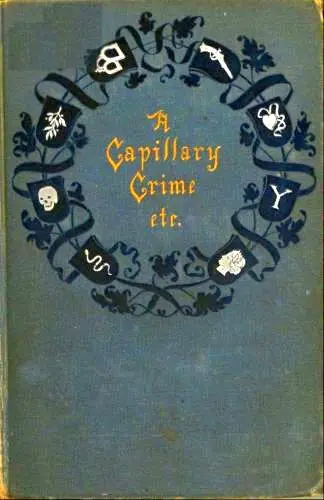
THE CLASSIC COLLECTION · 1892
"A Capillary Crime and Other Stories" by Francis Davis Millet is a collection of short stories written in the late 19th century. The stories explore various themes driven by intrigue, human emotions, and unexpected occurrences, with the titular tale "A Capillary Crime" centering on the mysterious murder of an artist in Paris and the investigation that follows. At the start of "A Capillary Crime," the narrative unfolds in a quiet street in Montmartre, Paris, which reflects a juxtaposition of the bustling city life nearby. The scene sets a foreboding tone as it introduces the sudden death of artist Charles Mandel, whose lifeless body is discovered in his studio under mysterious circumstances. A young woman, familiar with the locality, emerges anxious and flustered, hinting at her connection to the artist, while police officers begin their examinations amid a gathering crowd. As the investigation commences, the tragic incident reveals layers of complex relationships and motivations, capturing the reader's interest in uncovering the truth behind the unsettling events.
Introduction adapted from the source catalogue; source summaries may be automatically generated.
Free to read · English · 48,949 words · No account needed
MAKE TIME FOR A GOOD BOOK
On by default. Untick to stop anonymous reading totals. Each page counts after 10 seconds in view. How this works.
Anonymous counting is on unless you have switched it off.
When we were well along in the bill of fare, a little incident occurred which put me out of the mood for further enjoyment of the breakfast, and for the rest of the day my position was that of silent spectator, watching the amusements with an expression not calculated to encourage sport. To begin with, I was unusually sensitive to nervous shocks, from the fact that my first impression of Rome had been intensely disagreeable. I found myself in a strangely exciting atmosphere, and subject to unpleasant influences. The first night passed in Rome was crowded with visions, and I cannot recall a period of twenty-four hours during my residence in that city that has not its unpleasant souvenir of strange hallucinations, wonderful dreams, or some shock to my nerves. The meeting with Tyck was doubtless the occasion of my visions and restlessness on the night before the Bohemian breakfast. The events of the previous winter in Antwerp came freshly to my mind; I lived over again that dark season of horrors, and the atmosphere of Rome nourished the growth of similar strange fancies. There was, however, in my train of thoughts on Christmas Eve no foreboding that I can recall, no prophetic fear of a continuance of the strange relations with that black poodle which had already taken away the best half of our circle. It needed little, nevertheless, to put me in a state of mind very similar to that which tortured me for months in Antwerp.
But to return to the breakfast. While we were at the table a hired singer and guitar-player, a young girl of sixteen or seventeen years, sang Italian popular songs and performed instrumental pieces. She had nearly exhausted her list when she began to sing the weird, mournful song of Naples, “Palomella,” at that time quite the rage, but since worn threadbare, and its naïve angles and depressions polished down to the meaningless monotony of a popular ditty. We heard a dog howl in the sleeping-room as the singer finished the ballad, and Lisa rose to open the door. My seat on Tyck’s left brought me quite near the door, and I turned on my chair to watch the entrance of the animal. A black poodle, as near as I could judge the exact counterpart of the Flemish dog, quietly walked into the room, evidently perfectly at home. My first calm reflection was that it was an hallucination, a mental reproduction of one of the grim pictures of the past winter; I could not believe my own vision, and it was some time before I came to realize the fact that my senses were not deceived. I was about to ask Tyck if he had noticed in the dog any curious resemblance to our self-appointed companion in Antwerp, when he turned, and, as I thought then, with a lingering touch of the old superstitious fear in his voice, said: “You’ve noticed the dog; he belongs to Lisa. When he first came here, a month ago, I was horrified to find in him the image of our Flemish friend. Lisa laughed me out of my fears, saying that the animal had been in the family for six months or more, and at last I began to look upon him as a harmless pup, and to wonder only at the strange coincidence.” But I could not turn the affair into a joke or forget for a moment past events, now recalled so vividly to my mind. This was the third time that a black poodle had taken a liking to one of us, and two out of the three attachments had already proved fatal to the human partner. It was not by any means clear that the same dog played these different renderings of one part, but to all appearance it was the identical poodle. If in two cases this friendship of the dog for his self-chosen master had proved fatal, it was but a natural inference that the third attachment would terminate in a similar manner. But Tyck was in better health than ever before, notwithstanding the companionship of the dog. Was not this a proof of the folly of my superstition? I asked myself. Reasons were not wanting to disprove the soundness of my logic. It was undoubtedly true that stranger and more wonderful coincidences had happened, and nothing had come of them, and it was undeniable that the imagination might distort facts to such a degree that coincidences would be suspected where none existed. If it were only a coincidence, fears were childish. And the dog manifested no particular friendship for Tyck; he belonged to Lisa, and seemed to take no special notice of any one else.
Your reading position is saved on this browser. Take it to another device with a library code. Reading pages adapt to text, rather than matching a printed edition.
Francis Davis Millet

Francis Davis Millet & W. Hamilton (William Hamilton) Gibson & Will H. (Will Hicok) Low & John Ames Mitchell & Francis Hopkinson Smith
BEHIND THE BOOK
This eBook is for the use of anyone anywhere in the United States and most other parts of the world at no cost and with almost no restrictions whatsoever. You may copy it, give it away or re-use it under the terms of the Project Gutenberg License included with this eBook or online at www.gutenberg.org. If you are not located in the United States, you will have to check the laws of the country where you are located before using this eBook. Read the source licence.
The original source file, including credits and licence, is retained by this library. Request an original-format copy at no charge. Please include the book title and Project Gutenberg identifier #62030.
KEEP YOUR CURIOSITY GOING
Coulson Kernahan

Maurice Baring
Frances Wright
Cécile Tormay

Frederic Jesup Stimson

W. H. P. (William Henry Pope) Jarvis