THE CLASSIC COLLECTION✦An American tragedy, v. 2CLASSIC FREE BOOKS
An American tragedy, v. 2
Theodore Dreiser
THE CLASSIC COLLECTION · 1922
"A Book About Myself" by Theodore Dreiser is a memoir written in the early 20th century. This autobiographical account delves into Dreiser's formative years, exploring his aspirations, encounters, and the complexities of life in late 19th-century Chicago. Dreiser reflects deeply on his desire to become a writer, capturing the vibrant, raw essence of the city that inspired his work, as well as his youthful romantic entanglements. At the start of the memoir, Dreiser recounts his early dreams of writing stirred by the works of local author Eugene Field. Living in Chicago during its rapid growth, he vividly describes the city’s unique atmosphere, blending its bustling life with personal reflections on his ambitions. As he navigates his role as a collector for a furniture company, he yearns to document the life around him and slowly formulates a plan to break into journalism. His encounters with various characters and his infatuation with a young girl named Alice add layers to his journey, highlighting both his aspirations and the challenges he faces, including family dynamics and the harsh realities of economic struggle. This opening sets the tone for a candid exploration of Dreiser's life and ambitions.
Introduction adapted from the source catalogue; source summaries may be automatically generated.
Free to read · English · 181,596 words · No account needed
MAKE TIME FOR A GOOD BOOK
On by default. Untick to stop anonymous reading totals. Each page counts after 10 seconds in view. How this works.
Anonymous counting is on unless you have switched it off.
THE central character of Hazard’s book was an actress, young and very beautiful. Her lover was a newspaper man, deeply in love with her and yet not faithful, in one instance anyhow. This brought about a Zolaesque scene in which she spanked another actress with a hairbrush. There was treacherous plotting on the part of somebody in regard to a local murder, which brought about the arrest and conviction of the newspaper man for something he knew nothing about. This entailed a great struggle on the part of Theo to save him, which resulted in her failure and his death on the guillotine. A priest figured in it in some way, grim, jesuitical.
To this day some of the scenes of this book come back to me as having been forcefully done—the fight between the two actresses, for one thing, a midnight feast with several managers, the gallows scene, a confession. I am not sure of the name of the newspaper man who collaborated with Hazard on this work, but the picture of his death in an opium joint later, painted for me by Hazard, and the eccentricities of his daily life, stand out even now as Poe-like. He must have been blessed or cursed with some such temperament as that of Poe, dark, gloomy, reckless, poetic, for he was a dope-fiend and died of dope.
Be that as it may, this posthumous work, never published, so far as I know, was the opening wedge for me into the realm of realism. Being distinctly imitative of Balzac and Zola, the method was new and to me impressive. It has always struck me as curious that the first novel written by an American that I read in manuscript should have been one which by reason of its subject matter and the puritanic character of the American mind could never be published. These two youths knew this. Hazard handed it to me with the statement: “Of course a thing like this could never be published over here. We’d have to get it done abroad.” That struck me as odd at the time—the fact that if one wrote a fine thing nevertheless because of an American standard I had not even thought of before, one might not get it published. How queer, I thought. Yet these two incipient artists had already encountered it. They had been overawed to the extent of thinking it necessary to write of French, not American life in terms of fact. Such things as they felt called upon to relate occurred only in France, never here—or at least such things, if done here, were never spoken of. I think it nothing less than tragic that these men, or boys, fresh, forceful, imbued with a burning desire to present life as they saw it, were thus completely overawed by the moral hypocrisy of the American mind and did not even dare to think of sending their novel to an American publisher. Hazard was deeply impressed with the futility of attempting to do anything with a book of that kind. The publishers wouldn’t stand for it. You couldn’t write about life as it was; you had to write about it as somebody else thought it was, the ministers and farmers and dullards of the home. Yet here he was, as was I, busy in a profession that was hourly revealing the fact that this sweetness and light code, this idea of a perfect world which contained neither sin nor shame for any save vile outcasts, criminals and vagrants, was the trashiest lie that was ever foisted upon an all too human world. Not a day, not an hour, but the pages of the very newspaper we were helping to fill with our scribbled observations were full of the most incisive pictures of the lack of virtue, honesty, kindness, even average human intelligence, not on the part of a few but of nearly everybody. Not a business, apparently, not a home, not a political or social organization or an individual but in the course of time was guilty of an infraction of some kind of this seemingly perfect and unbroken social and moral code. But in spite of all this, judging by the editorial page, the pulpit and the noble mouthings of the average citizen speaking for the benefit of his friends and neighbors, all men were honest—only they weren’t; all women were virtuous and without evil intent or design—but they weren’t; all mothers were gentle, self-sacrificing slaves, sweet pictures for songs and Sunday Schools—only they weren’t; all fathers were kind, affectionate, saving, industrious—only they weren’t. But when describing actual facts for the news columns, you were not allowed to indicate these things. Side by side with the most amazing columns of crimes of every kind and description would be other amazing columns of sweet mush about love, undying and sacrificial, editorials about the perfection of the American man, woman, child, his or her sweet deeds, intentions and the like—a wonderful dose. And all this last in the face of the other, which was supposed to represent the false state of things, merely passing indecencies, accidental errors that did not count. If a man like Hazard or myself had ventured to transpose a true picture of facts from the news columns of the papers, from our own reportorial experiences, into a story or novel, what a howl! Ostracism would have followed much more swiftly in that day than in this, for today turgid slush approximating at least some of the facts is tolerated. Fifteen years later Hazard told me he still had his book buried in a trunk somewhere, but by then he had turned to adventurous fiction, and a year later, as I have said, be blew his brains out.
Your reading position is saved on this browser. Take it to another device with a library code. Reading pages adapt to text, rather than matching a printed edition.
Theodore Dreiser
Theodore Dreiser
Theodore Dreiser
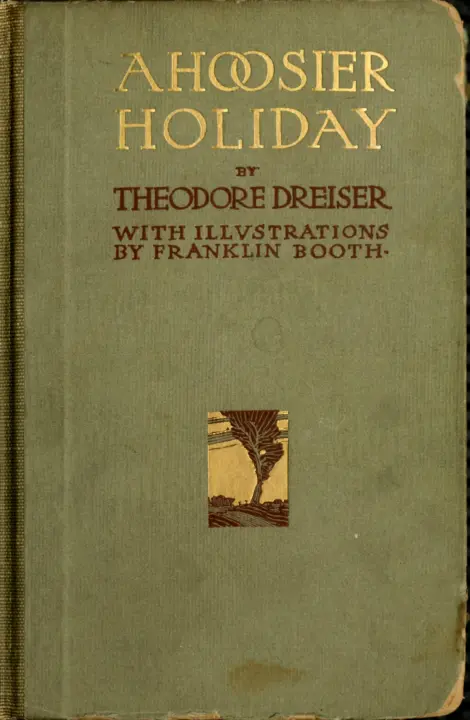
Theodore Dreiser
BEHIND THE BOOK
This eBook is for the use of anyone anywhere in the United States and most other parts of the world at no cost and with almost no restrictions whatsoever. You may copy it, give it away or re-use it under the terms of the Project Gutenberg License included with this eBook or online at www.gutenberg.org. If you are not located in the United States, you will have to check the laws of the country where you are located before using this eBook. Read the source licence.
The original source file, including credits and licence, is retained by this library. Request an original-format copy at no charge. Please include the book title and Project Gutenberg identifier #62995.
KEEP YOUR CURIOSITY GOING
John L. Ransom

Herman W. Mudgett

Harriet Monroe
Daniel Dulany Addison
Charles Lanman

Harold Rosher