THE CLASSIC COLLECTION✦A dead man’s diaryCLASSIC FREE BOOKS
A dead man’s diary
Coulson Kernahan
THE CLASSIC COLLECTION · 1912
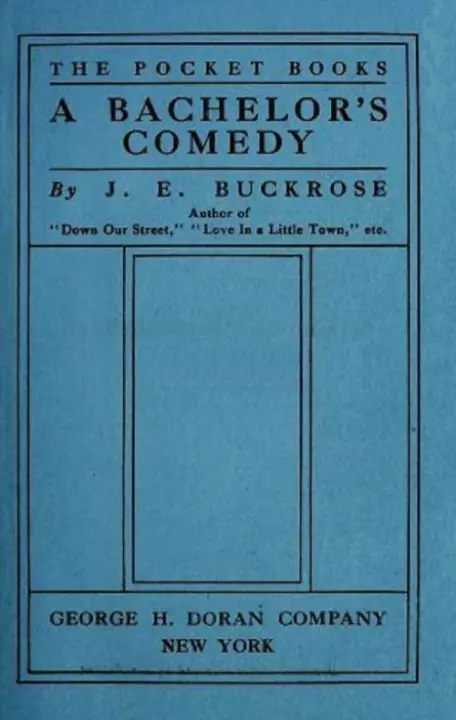
"A Bachelor's Comedy" by J. E. Buckrose is a novel written in the early 20th century. The story centers around the Reverend Andrew Deane, a young vicar navigating his new life in the quaint village of Gaythorpe-on-the-Marsh. As he attempts to establish himself, he grapples with the perception of his youthfulness and the burdens of his clerical responsibilities, all while encountering the charming eccentricities of his new parish's residents. The opening of the novel introduces Andrew as he travels to Gaythorpe, filled with hope and anxiety about his new role. He arrives at the station and is met by the churchwarden, Mr. Thorpe, as they make their way through the pastoral landscape. Andrew is determined to shed his boyish nickname "Andy" and take on the dignity of his position. The narrative unfolds with his interactions at the Vicarage, where he faces the challenge of maintaining discipline with his staff, notably the drunken gardener Sam Petch, while showing kindness to the endearing but needy villagers. This balance of humor, introspection, and the complexities of clerical life lays the groundwork for the deeper themes of community, expectation, and personal growth that will follow in Andrew's journey.
Introduction adapted from the source catalogue; source summaries may be automatically generated.
Free to read · English · 72,222 words · No account needed
MAKE TIME FOR A GOOD BOOK
On by default. Untick to stop anonymous reading totals. Each page counts after 10 seconds in view. How this works.
Anonymous counting is on unless you have switched it off.
“There are as many kinds of sentiment as there are of”—Andy paused for a simile, and concluded somewhat lamely—“of sauce.”
“Elizabeth’s is the sweet kind, then, flavoured with vanilla,” said Norah, with her little upward curve of the lips.
“I expect yours is that tart kind like they have with fried sole, Norah,” laughed Dick Stamford, who had been on intimate terms with them all since he was in petticoats.
“Haven’t got any,” said Norah. “Nor you, either, Mrs. Stamford; have
you?”
“Not a scrap,” said Mrs. Stamford, thinking she was speaking the truth. “Still—it’s nice in Elizabeth,” and she patted the girl’s round arm.
“I am not at all sentimental,” said Elizabeth with indignation. “Sentiment is so squashy!”
“I don’t know,” said Mr. Atterton, quite unexpectedly. “I’ve a sort of idea that—well, that sentiment is the thing that makes it all seem worth while, you know.”
“Oh, if father begins to get sentimental, I’ve done,” said Norah, laughing. “Come on, Elizabeth.”
So the two young ladies followed Mrs. Atterton and Mrs. Stamford through the open door, and after a very brief interval the whole party went into the ballroom.
The usual pianist provided for the class had been supplemented by a violin, and the Lancers were being danced in rather a frozen manner when Mrs. Atterton entered.
“Delighted to see you,” she said to the village schoolmaster, who also acted as dancing-master and choir-master, teacher of singing and mender of broken clocks—a person of such extraordinary energy that no wonder he seemed to be made of wire and India rubber, instead of the ordinary materials, and had never found time to get married.
“The pleasure is mutual,” said Mr. Willie Kirke, bowing; he always prided himself on having the right word ready. “I trust your—er—back is fairly well?”
“You’re very kind. It is troubling me a little this evening, owing to the sudden change of temperature,” said Mrs. Atterton, who was always gratified by any reference to the institution, and would have talked about it with pleasure to a crossing-sweeper.
Mrs. Jebb and Miss Fanny Kirke and Mrs. Will Werrit sat in a corner and looked at Andy as he came in with the Atterton girls.
“I believe he has his eye on Miss Elizabeth,” said Mrs. Jebb. “Of course this is in strict confidence.”
“No! What makes you think so?” said the other women eagerly.
Your reading position is saved on this browser. Take it to another device with a library code. Reading pages adapt to text, rather than matching a printed edition.
BEHIND THE BOOK
This eBook is for the use of anyone anywhere in the United States and most other parts of the world at no cost and with almost no restrictions whatsoever. You may copy it, give it away or re-use it under the terms of the Project Gutenberg License included with this eBook or online at www.gutenberg.org. If you are not located in the United States, you will have to check the laws of the country where you are located before using this eBook. Read the source licence.
The original source file, including credits and licence, is retained by this library. Request an original-format copy at no charge. Please include the book title and Project Gutenberg identifier #49861.
KEEP YOUR CURIOSITY GOING
Coulson Kernahan

Maurice Baring
Frances Wright
Cécile Tormay

Frederic Jesup Stimson

W. H. P. (William Henry Pope) Jarvis