THE CLASSIC COLLECTION✦A dead man’s diaryCLASSIC FREE BOOKS
A dead man’s diary
Coulson Kernahan
THE CLASSIC COLLECTION · 1912
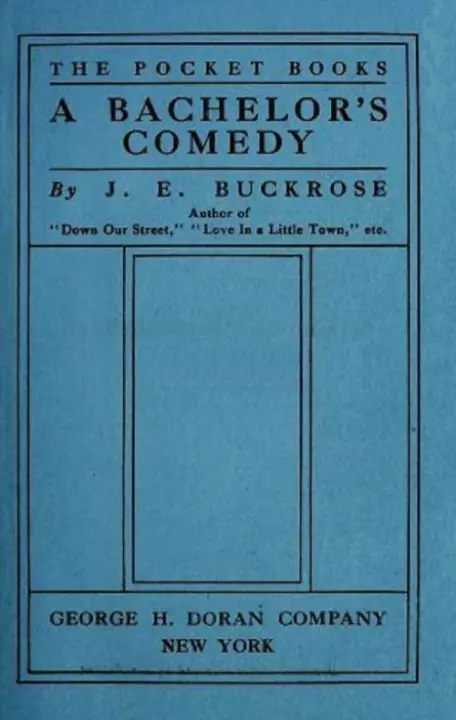
"A Bachelor's Comedy" by J. E. Buckrose is a novel written in the early 20th century. The story centers around the Reverend Andrew Deane, a young vicar navigating his new life in the quaint village of Gaythorpe-on-the-Marsh. As he attempts to establish himself, he grapples with the perception of his youthfulness and the burdens of his clerical responsibilities, all while encountering the charming eccentricities of his new parish's residents. The opening of the novel introduces Andrew as he travels to Gaythorpe, filled with hope and anxiety about his new role. He arrives at the station and is met by the churchwarden, Mr. Thorpe, as they make their way through the pastoral landscape. Andrew is determined to shed his boyish nickname "Andy" and take on the dignity of his position. The narrative unfolds with his interactions at the Vicarage, where he faces the challenge of maintaining discipline with his staff, notably the drunken gardener Sam Petch, while showing kindness to the endearing but needy villagers. This balance of humor, introspection, and the complexities of clerical life lays the groundwork for the deeper themes of community, expectation, and personal growth that will follow in Andrew's journey.
Introduction adapted from the source catalogue; source summaries may be automatically generated.
Free to read · English · 72,222 words · No account needed
MAKE TIME FOR A GOOD BOOK
On by default. Untick to stop anonymous reading totals. Each page counts after 10 seconds in view. How this works.
Anonymous counting is on unless you have switched it off.
But that was, of course, not at all what he really meant to say. What he tried to bring out from the chaotic ideas which surrounded Elizabeth in his mind like the storm-clouds about a pictured saint, was the fact that she did a great deal more than exercise a talent—she created an atmosphere.
Mrs. Atterton glanced at his red face and said, in her comfortable way—
“That’s a tough chicken, I’m afraid, Mr. Deane. We always do have tough fowls, because my husband will grow our own poultry, and we put off killing them. You would be surprised how attached they become to us all.”
“I’m not surprised in the least,” said Andy, with a very pleasant look, half bold, half shy.
And Mrs. Atterton, who had her feelings, though she did measure
thirty-four inches round the waist, smiled very kindly on her young
guest.
“Well, I hope you’ll like us, too, when you get to know us,” she said. Then she turned to her eldest daughter. “What time are we to join the revels, Norah? I shall not be able to stay long as my back is troubling me a little.”
Andy felt very sorry to hear that, because Mrs. Atterton had so enjoyed everything but the chicken that he hoped her back was in abeyance; but Norah’s reply showed rather a want of sympathy.
“Will your back last out for half an hour?” she said. “Because, if so, we will do the country dances from half-past nine to ten.”
“That will do excellently. Then Martin can bring me my cocoa to my room at ten. By the way, Elizabeth, have you seen about the refreshments for the Dancing Class?”
For it was Mrs. Atterton’s second daughter who attended to the domestic arrangements of the establishment.
“Yes, mamma. Mrs. Smith knows all about it,” said Elizabeth.
“I hope you are giving them something decent, Elizabeth,” said Norah. “I hold socialistic principles, Mr. Deane, and I hate the bun-and-mug system of entertaining so-called social inferiors.”
“That’s all right,” said Elizabeth.
“But what are you giving them?” insisted Norah, thinking she perceived a reluctance in her sister’s reply.
“Oh, the usual thing—sandwiches, creams, fruit, hock-cup, iced coffee, strawberry ices——”
“What?” said Norah. “Ices? Quite unnecessary!”
“I know all the girls,” said Elizabeth, defending herself. “I’ve played with Rose Werrit at every school-treat since I could toddle. I wanted them to have things they would like.”
“You’re so sentimental, Elizabeth,” said Norah lightly. “I can’t stand sentiment. Can you, Mr. Deane?”
Your reading position is saved on this browser. Take it to another device with a library code. Reading pages adapt to text, rather than matching a printed edition.
BEHIND THE BOOK
This eBook is for the use of anyone anywhere in the United States and most other parts of the world at no cost and with almost no restrictions whatsoever. You may copy it, give it away or re-use it under the terms of the Project Gutenberg License included with this eBook or online at www.gutenberg.org. If you are not located in the United States, you will have to check the laws of the country where you are located before using this eBook. Read the source licence.
The original source file, including credits and licence, is retained by this library. Request an original-format copy at no charge. Please include the book title and Project Gutenberg identifier #49861.
KEEP YOUR CURIOSITY GOING
Coulson Kernahan

Maurice Baring
Frances Wright
Cécile Tormay

Frederic Jesup Stimson

W. H. P. (William Henry Pope) Jarvis