
The Writing of News A Handbook with Chapters on Newspaper Correspondence and Copy Reading
Charles G. (Charles Griffith) Ross
THE CLASSIC COLLECTION · 1913
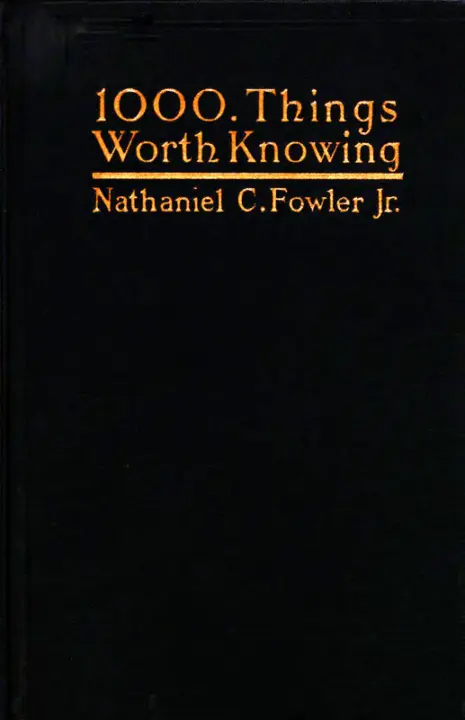
"1000 Things Worth Knowing" by Nathaniel C. Fowler is a non-fiction compilation written in the early 20th century. The book presents a plethora of interesting and lesser-known facts spanning various subjects, aimed at broadening the reader's general knowledge. The author’s intent is to convey these facts in simple English, making them accessible to the average reader. The opening of this work introduces the reader to Fowler’s goal of presenting over a thousand facts that are not commonly known yet hold significance and relevance to humankind. He emphasizes the importance of clarity and simplicity in explanations, thereby avoiding overly technical language. The preface sets the tone for a format that allows readers to easily consult information on diverse topics, which are referenced in an organized manner for quick navigation.
Introduction adapted from the source catalogue; source summaries may be automatically generated.
Free to read · English · 43,934 words · No account needed
MAKE TIME FOR A GOOD BOOK
On by default. Untick to stop anonymous reading totals. Each page counts after 10 seconds in view. How this works.
Anonymous counting is on unless you have switched it off.
1898, November 28, end of the Spanish-American War.
1901, September 6, President McKinley killed by Leon Czolgolz.
1901, September 16, Hay-Pauncefote Canal Treaty ratified by Congress.
1902, July 4, Declaration of Peace with Philippine Islands, and amnesty granted to all insurgents.
1904, May 4, the United States took control of the Panama Canal.
=University Extension.=--A scheme for extending to people at large the advantages of a university education, by means of courses of lectures and classes in various important cities. The scheme originated at the University of Cambridge, England, in 1872, and was introduced into the United States in 1890.
=University Settlements.=--Homes established in the poorer parts of cities, where educated and cultured people may live and try to improve the lives of their neighbors. Lectures, studies, and various other devices are resorted to. The movement started in England in 1867, and appeared in New York in 1887, as a "Neighborhood Guild." University settlements are now found in all the chief cities of the United States.
=Utopia.=--An imaginary island, with an ideal commonwealth, the inhabitants of which enjoy perfect laws and institutions. It is described in Sir Thomas More's political romance, "De Optimo Reipublicae Statu, deque Nova Insula Utopia," published in Latin in 1516, and translated into English in 1551. His purpose was to describe his idea of social arrangements by which the people's most absolute happiness and improvement might be secured.
=Vaccination.=--Vaccination, a preventive of smallpox, was discovered by Dr. Edward Jenner of England. It consists of injecting into the blood a virus made from the sores or scabs of cows suffering from cowpox, or the virus may be taken from the sore coming from vaccination itself. Comparatively few people, properly vaccinated, can have the smallpox, and are largely exempt from any disease resembling it, except that which is known as varioloid, which is a mild form of smallpox. It is not known how long vaccination remains a preventive, but probably for seven years, when one should be vaccinated again. The prejudice against vaccination, which was very intense at its discovery, no longer exists except among a few. Practically every physician advocates it, and it is compulsory in some towns and cities. Deaths have occurred from it, but they are very infrequent.
=Vacuum.=--The perfect vacuum, which it is impossible to produce, is space without air or atmosphere. Vacuums are made by pumping all the air out of a receptacle or chamber. In a vacuum, everything falls at the same rapidity, as there is nothing to buoy it up, a feather descending as rapidly as lead shot.
=Vedas.=--Sacred writings of the Hindus, hymns, prayers, and liturgies, said to have been compiled by Vyasa about 1200 B. C. They are written in Sanskrit, and divided into four parts.
Your reading position is saved on this browser. Take it to another device with a library code. Reading pages adapt to text, rather than matching a printed edition.
BEHIND THE BOOK
This eBook is for the use of anyone anywhere in the United States and most other parts of the world at no cost and with almost no restrictions whatsoever. You may copy it, give it away or re-use it under the terms of the Project Gutenberg License included with this eBook or online at www.gutenberg.org. If you are not located in the United States, you will have to check the laws of the country where you are located before using this eBook. Read the source licence.
The original source file, including credits and licence, is retained by this library. Request an original-format copy at no charge. Please include the book title and Project Gutenberg identifier #56796.
KEEP YOUR CURIOSITY GOING
Charles G. (Charles Griffith) Ross
Hannah Webster Foster

Emily Lawless
Edwin Hamlin Carr

Charles De Lano Hine
Andrew Ure