
The Writing of News A Handbook with Chapters on Newspaper Correspondence and Copy Reading
Charles G. (Charles Griffith) Ross
THE CLASSIC COLLECTION · 1913
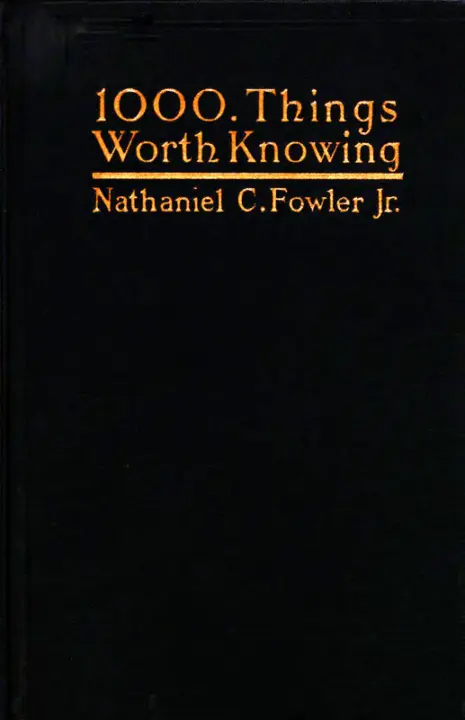
"1000 Things Worth Knowing" by Nathaniel C. Fowler is a non-fiction compilation written in the early 20th century. The book presents a plethora of interesting and lesser-known facts spanning various subjects, aimed at broadening the reader's general knowledge. The author’s intent is to convey these facts in simple English, making them accessible to the average reader. The opening of this work introduces the reader to Fowler’s goal of presenting over a thousand facts that are not commonly known yet hold significance and relevance to humankind. He emphasizes the importance of clarity and simplicity in explanations, thereby avoiding overly technical language. The preface sets the tone for a format that allows readers to easily consult information on diverse topics, which are referenced in an organized manner for quick navigation.
Introduction adapted from the source catalogue; source summaries may be automatically generated.
Free to read · English · 43,934 words · No account needed
MAKE TIME FOR A GOOD BOOK
On by default. Untick to stop anonymous reading totals. Each page counts after 10 seconds in view. How this works.
Anonymous counting is on unless you have switched it off.
1791, August 30, Issue of the first United States patent.
1792, April 2, United States Mint established at Philadelphia,
Pennsylvania.
1793, September 18, Laying of the corner stone of the capitol, at Washington, District of Columbia.
1784, May 8, Congress established the Post-Office Department.
1796, September 17, President Washington issued his Farewell Address.
1799, December 14, death of President Washington.
1807, January 19, birth of General Robert E. Lee.
1807, August 11, first trial trip of a steamboat, by Robert Fulton, its inventor, on the Hudson River.
1809, February 12, birth of Abraham Lincoln.
1813, September 10, Perry's victory on Lake Erie.
1815, January 8, Battle of New Orleans.
1816, December 13, establishment, at Boston, Massachusetts, of the first Savings Bank in the United States.
1819, May 22, the first steam vessel to cross the Atlantic Ocean
sailed from Atlanta, Georgia.
1844, May 27, first telegraph message sent by Professor Morse, the
inventor of telegraphy.
1846, April 23, beginning of the Mexican War.
1847, February 22, Battle of Buena Vista.
1847, September 14, capture of the city of Mexico by the United States
Army.
1851, August 27, the Yacht "America" won the international cup race, at
Cowes, England.
1858, August 16, the Old World and the New World connected by
telegraphic cable.
1859, October 18, capture of John Brown, at Harper's Ferry, Virginia.
1860, December 20, South Carolina seceded from the Union.
1861, April 12, Fort Sumter, South Carolina, bombarded.
1861, April 15, President Lincoln issued his first call for volunteers.
1861, July 21, Battle of Bull Run.
1862, March 9, Fight in Hampton Roads, Virginia, between the "Monitor"
and the "Merrimac."
1862, April 28, New Orleans evacuated.
1862, June 6, capture of Memphis, Tennessee.
1862, September 15, General Stonewall Jackson captured Harper's Ferry.
1862, September 17, Battle of Antietam.
1863, January 1, President Lincoln issued the Proclamation of
Emancipation.
1863, February 25, passage of the National Bank Act.
1863, July 1 to 3, Battle of Gettysburg.
1863, September 19, Battle of Chickmauga.
1864, March 6 to 8, Battle of the Wilderness.
1864, June 19, the Warship "Kearsarge" sank the "Alabama."
1864, September 2, General Sherman captured Atlanta, Georgia.
1865, April 9, General Lee surrendered at Appomattox.
1865, April 14, John Wilkes Booth assassinated President Lincoln.
1867, March 30, Treaty for the purchase of Alaska signed.
1869, May 10, completion of the Union Pacific Railroad.
1871, October 8, great fire at Chicago.
1881, July 2, President Garfield shot by Charles J. Guiteau.
1886, May 4, Haymarket riot at Chicago.
1889, May 31, great flood at Johnstown, Pennsylvania.
1893, February 14, the Hawaiian Islands annexed to the United States.
1897, June 14, Venezuela boundary line treaty ratified by Congress.
1898, February 15, United States Battleship "Maine" blown up in Havana
Harbor.
1898, April 21, Severance of diplomatic relations between Spain and the
United States.
1898, April 27, Matanzas, Cuba, fired upon by American warships.
1898, May 1, Admiral Dewey destroyed the Spanish fleet at Manila.
1898, May 6, United States fleet bombarded Santiago, Cuba.
1898, May 12, Admiral Sampson fired upon San Juan, Porto Rico.
1898, June 3, Hobson sank the Merrimac in the harbor of Santiago, that he might block the channel.
1898, June 22, first landing of the United States troops in Cuba.
1898, July 3, the Spanish fleet destroyed at Santiago.
1898, July 16, Santiago surrendered.
1898, August 13, Manila surrendered.
Your reading position is saved on this browser. Take it to another device with a library code. Reading pages adapt to text, rather than matching a printed edition.
BEHIND THE BOOK
This eBook is for the use of anyone anywhere in the United States and most other parts of the world at no cost and with almost no restrictions whatsoever. You may copy it, give it away or re-use it under the terms of the Project Gutenberg License included with this eBook or online at www.gutenberg.org. If you are not located in the United States, you will have to check the laws of the country where you are located before using this eBook. Read the source licence.
The original source file, including credits and licence, is retained by this library. Request an original-format copy at no charge. Please include the book title and Project Gutenberg identifier #56796.
KEEP YOUR CURIOSITY GOING
Charles G. (Charles Griffith) Ross
Hannah Webster Foster

Emily Lawless
Edwin Hamlin Carr

Charles De Lano Hine
Andrew Ure