THE CLASSIC COLLECTION✦Froth: A NovelCLASSIC FREE BOOKS
Froth: A Novel
Armando Palacio Valdés
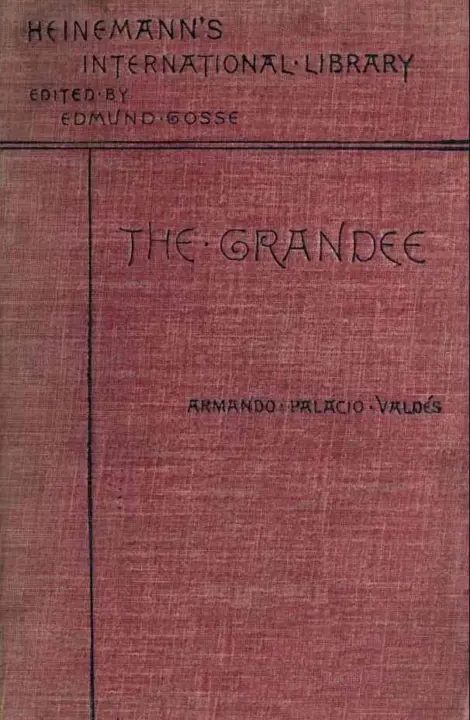
THE CLASSIC COLLECTION · 1894
"The Grandee" by Armando Palacio Valdés is a novel written in the late 19th century. The story is set in a provincial city in Spain, focusing on the life and dynamics within a noble household, particularly that of the protagonist Don Pedro Quiñones de Leon, an aging grandee struggling with his sense of dignity in a changing society. The narrative explores themes of societal hierarchy, pride, and personal turmoil against the backdrop of local customs and the intricacies of family relationships. At the start of "The Grandee," the atmospheric setting of Lancia is established through a wintry night, with elements that reflect the town's old-world charm and the quirks of its inhabitants. We meet Don Pedro Quiñones, who navigates the challenges of his aristocratic status despite facing paralysis and the burden of maintaining respectability. His interactions with guests during a social gathering reveal a tapestry of relationships intertwined with humor, social expectations, and unfulfilled desires, setting the stage for deeper explorations of the characters' motivations and conflicts as the story unfolds. The text hints at underlying tensions, notably regarding Don Pedro's strained marriage to Amalia, and foreshadows the complexities and darker themes that will be explored further in the narrative.
Introduction adapted from the source catalogue; source summaries may be automatically generated.
Free to read · English · 95,134 words · No account needed
MAKE TIME FOR A GOOD BOOK
On by default. Untick to stop anonymous reading totals. Each page counts after 10 seconds in view. How this works.
Anonymous counting is on unless you have switched it off.
E-text prepared by Chuck Greif and the Project Gutenberg Online Distributed Proofreading Team (http://www.pgdp.net) from page images generously made available by Internet Archive (http://www.archive.org)
Note: Images of the original pages are available through
Internet Archive. See
http://www.archive.org/details/grandeenovel00palaiala
Heinemann's International Library
Edited by Edmund Gosse
Heinemann's International Library.
Edited by EDMUND GOSSE.
Crown 8vo, in paper covers, 2s. 6d., or cloth limp, 3s. 6d.
1. IN GOD'S WAY. From the Norwegian of
BJORNSTJERNE BJORNSON
2. PIERRE AND JEAN. From the French of
GUY DE MAUPASSANT.
3. THE CHIEF JUSTICE. From the German
of KARL EMIL FRANZOS.
4. WORK WHILE YE HAVE THE LIGHT.
From the Russian of COUNT LYOF TOLSTOI.
5. FANTASY. From the Italian of MATILDE
SERAO.
6. FROTH. From the Spanish of DON ARMANDO
PALACIO VALDES.
7. FOOTSTEPS OF FATE. From the Dutch
of LOUIS COUPERUS.
8. PEPITA JIMENEZ. From the Spanish of
JUAN VALERA.
9. THE COMMODORE'S DAUGHTERS. From
the Norwegian of JONAS LIE.
10. THE HERITAGE OF THE KURTS. From
the Norwegian of BJORNSTJERNE BJORNSON.
11. LOU. From the German of BARON VON
ROBERTS.
12. DONA LUZ. From the Spanish of JUAN
VALERA.
13. THE JEW. From the Polish of JOSEPH I.
KRASZEWSKI.
14. UNDER THE YOKE. From the Bulgarian
of IVAN VAZOFF.
15. FAREWELL LOVE! From the Italian of
MATILDE SERAO.
16. THE GRANDEE. From the Spanish of DON
ARMANDO PALACIO VALDES.
In preparation.
A COMMON STORY. From the Russian of
GONCHAROF.
NIOBE. From the Norwegian of JONAS LIE.
Each Volume contains a specially written Introduction by the Editor.
A Novel
by
Translated from the Spanish by Rachel Challice
London
William Heinemann
1894
[All rights reserved]
According to the Spanish critics, the novel has flourished in Spain during only two epochs--the golden age of Cervantes and the period in which we are still living. That unbroken line of romance-writing which has existed for so long a time in France and in England, is not to be looked for in the Peninsula. The novel in Spain is a re-creation of our own days; but it has made, since the middle of the nineteenth century, two or three fresh starts. The first modern Spanish novelists were what are called the walter-scottistas, although they were inspired as much by George Sand as by the author of Waverley. These writers were of a romantic order, and Fernan Caballero, whose earliest novel dates from 1849, was at their head. The Revolution of September, 1868, marked an advance in Spanish fiction, and Valera came forward as the leader of a more national and more healthily vitalised species of imaginative work. The pure and exquisite style of Valera is, doubtless, only to be appreciated by a Castilian. Something of its charm may be divined, however, even in the English translation of his masterpiece, Pepita Jimenez. The mystical and aristocratic genius of Valera appealed to a small audience; he has confided to the world that when all were praising but few were buying his books.
Your reading position is saved on this browser. Take it to another device with a library code. Reading pages adapt to text, rather than matching a printed edition.
Armando Palacio Valdés
Armando Palacio Valdés
Armando Palacio Valdés
Armando Palacio Valdés
BEHIND THE BOOK
This eBook is for the use of anyone anywhere in the United States and most other parts of the world at no cost and with almost no restrictions whatsoever. You may copy it, give it away or re-use it under the terms of the Project Gutenberg License included with this eBook or online at www.gutenberg.org. If you are not located in the United States, you will have to check the laws of the country where you are located before using this eBook. Read the source licence.
The original source file, including credits and licence, is retained by this library. Request an original-format copy at no charge. Please include the book title and Project Gutenberg identifier #31056.
KEEP YOUR CURIOSITY GOING
Coulson Kernahan

Maurice Baring
Frances Wright
Cécile Tormay

Frederic Jesup Stimson

W. H. P. (William Henry Pope) Jarvis