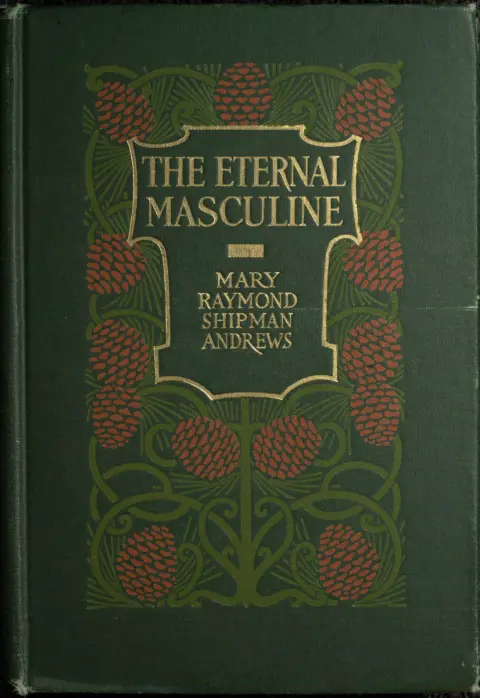
The eternal masculine
Mary Raymond Shipman Andrews
THE CLASSIC COLLECTION · 1906
"A Good Samaritan" by Mary Raymond Shipman Andrews is a fictional narrative written during the early 20th century. This story explores themes of friendship, responsibility, and the social struggles of young men navigating the complexities of life in urban America. The tale revolves around the choices individuals make when confronted with moral dilemmas, showcasing the virtues of compassion and self-sacrifice. The plot centers on Reginald "Rex" Fairfax, a theological student on the brink of an important career opportunity, who finds himself inadvertently taking care of his drunken companion, Billy Strong, instead of attending a crucial dinner meeting with an influential church figure. As Rex struggles to navigate the chaos brought on by Billy's intoxication, he faces a series of humorous yet poignant challenges. Ultimately, Rex's decision to prioritize friendship over personal ambition leads him to a deeper understanding of himself and the value of true character. The story closes with a redemptive turn, highlighting the unexpected rewards that come from being a "good Samaritan."
Introduction adapted from the source catalogue; source summaries may be automatically generated.
Free to read · English · 8,429 words · No account needed
MAKE TIME FOR A GOOD BOOK
On by default. Untick to stop anonymous reading totals. Each page counts after 10 seconds in view. How this works.
Anonymous counting is on unless you have switched it off.
Note: Project Gutenberg also has an HTML version of this file which includes the original illustrations. See 15906-h.htm or 15906-h.zip: (https://www.gutenberg.org/dirs/1/5/9/0/15906/15906-h/15906-h.htm) or (https://www.gutenberg.org/dirs/1/5/9/0/15906/15906-h.zip)
by
Illustrated by Charlotte Harding
New York
McClure, Phillips & Co.
Second Impression
MCMVI
"That'll get even Webster's Union for chargin' me two cents for
'soon,'" he chuckled
"Recky," he bubbled, "good old Recky--bes' fren' ev' had"
"Who's your friend, Billy?"
"Thank you--thank you very much--very, very much--old rhinoceros"
"So tired," he remarked. "Go'n have good nap now"
"Could he--couldn't he?"
At every station the conductor and Rex had to reason with him
The little District Telegraph boy, with a dirty face, stood at the edge of the desk, and, rubbing his sleeve across his cheek, made it unnecessarily dirtier.
"Answer, sir?"
"No--yes--wait a minute." Reed tore the yellow envelope and spread the
telegram. It read:
"Do I meet you at your office or at Martin's and what time?"
"The devil!" Reed commented, and the boy blinked indifferently. He was used to stronger. "The casual Rex all over! Yes, boy, there's an answer." He scribbled rapidly, and the two lines of writing said this:
"Waiting for you at office now. Hurry up. C. Reed."
He fumbled in his pocket and gave the youngster a coin. "See that it's sent instantly--like lightning. Run!" and the sharp little son of New York was off before the last word was well out.
Half an hour later, to Reed waiting at his office in Broadway impatiently, there strolled in a good-looking and leisurely young man with black clothes on his back and peace and good-will on his face. "Hope I haven't kept you waiting, Carty," he remarked in friendly tones. "Plenty of time, isn't there?"
"No, there isn't," his cousin answered, and there was a touch of snap in the accent. "Really, Rex, you ought to grow up and be responsible. It was distinctly arranged that you should call here for me at six, and now it's a quarter before seven."
"Couldn't remember the hour or the place to save my life," the younger man asserted earnestly. "I'm just as sorry as I can be, Carty. You see I did remember we were to dine at Martin's. So much I got all right--and that was something, wasn't it, Carty?" he inquired with an air of wistful pride, and the frown on the face of the other dissolved in laughter.
Your reading position is saved on this browser. Take it to another device with a library code. Reading pages adapt to text, rather than matching a printed edition.
Mary Raymond Shipman Andrews
Mary Raymond Shipman Andrews
Mary Raymond Shipman Andrews
Mary Raymond Shipman Andrews
BEHIND THE BOOK
This eBook is for the use of anyone anywhere in the United States and most other parts of the world at no cost and with almost no restrictions whatsoever. You may copy it, give it away or re-use it under the terms of the Project Gutenberg License included with this eBook or online at www.gutenberg.org. If you are not located in the United States, you will have to check the laws of the country where you are located before using this eBook. Read the source licence.
The original source file, including credits and licence, is retained by this library. Request an original-format copy at no charge. Please include the book title and Project Gutenberg identifier #15906.
KEEP YOUR CURIOSITY GOING
Coulson Kernahan

Maurice Baring
Frances Wright
Cécile Tormay

Frederic Jesup Stimson

W. H. P. (William Henry Pope) Jarvis