Mother Goose for Grown-ups
Guy Wetmore Carryl
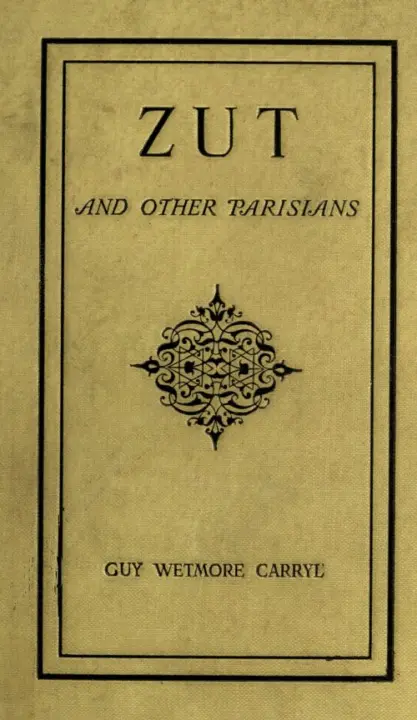
THE CLASSIC COLLECTION · 1903
"Zut and Other Parisians" by Guy Wetmore Carryl is a collection of humorous stories written in the early 20th century. The tales explore the quirks and eccentricities of Parisians, centering around memorable characters like the angora cat named Zut and its owners, the Caille and Sergeot families, who are embroiled in a rivalry fueled by their respective businesses. The book invites readers to experience the whimsical charm and comedic interactions that characterize life in Paris, filled with vibrancy and delightful satire. The opening of "Zut and Other Parisians" introduces readers to the charming yet tumultuous lives of Jean-Baptiste Caille, a grocer, and Hippolyte Sergeot, a hairdresser, whose families are neighbors on the bustling avenue de la Grande Armée. The crux of their conflict stems from the success of Hippolyte's newly opened salon, which incites jealousy in Alexandrine Caille, Jean-Baptiste’s wife. Their rivalry is humorously intensified by the indifference of Zut, a plump white angora cat, who becomes the unsuspecting object of desire between the two households. As the scene unfolds, themes of rivalry, envy, and the comedic absurdity of everyday life in Paris are established, setting the tone for the rest of the collection.
Introduction adapted from the source catalogue; source summaries may be automatically generated.
Free to read · English · 56,931 words · No account needed
MAKE TIME FOR A GOOD BOOK
On by default. Untick to stop anonymous reading totals. Each page counts after 10 seconds in view. How this works.
Anonymous counting is on unless you have switched it off.
They had started later than was usual, and already the daylight had begun to dim, and the west to turn from red to saffron, and from saffron to fawn. Directly below them lay a maze of steep and narrow streets, shelving toward the boulevard de Rochechouart; and far further, to the southwest, the place de l'Opéra was breaking into the alternate deep red and glaring white of electric advertising signs, the lettering of which could not be distinguished from where they stood, but which painted the faint haze of evening with swiftly changing contrasts of color.
Suddenly Marcelle began to speak, her voice eloquent with a strange, new
music.
"Papa Labesse, dost thou comprehend what all this says to us, this wonderful city upon which we look each night, thou and I? From here--what? A bewilderment of lights, a sea of roofs, a murmur of faintly heard cries. But what does it mean? Surely, it is the voice of the mother of us all, of Paris, the great, the beautiful--of a woman, Papa Labesse: that finally, which thou canst never comprehend, pauvre Papa Labesse!--a woman who says but one word--love! Papa Labesse--L'amour, l'amour, l'amour!--again, and again, and again, l'amour!"
There was a long silence. Then, almost timidly, Papa Labesse laid his
hand on hers.
"But thou dost not love, my little one,--thou?" he said.
Marcelle turned suddenly.
"Si, I love!" she answered.
Above the tapering, distant shaft of the Tour Eiffel a tiny cloud caught the last ray of the departed sun, blazed crimson for an instant, and then, as suddenly, gloomed to slate-gray.
"Que Dieu te bénisse!" said Papa Labesse, solemnly.
"It is all so wonderful," continued Marcelle after a moment, "and yet I have never seemed to understand it till to-day,--this great, sweet voice of Paris. It is indeed as if she was the mother of us all, Papa Labesse, and was spreading out her arms, and calling us all to come to her heart. And for each of us she has something good--something better than ever we have imagined for ourselves, or wished to have; and yet, in whatever form, it is really the same thing always--l'amour, Papa Labesse, l'amour!"
Out of the strain of the past half hour a great sob was suddenly wrung from Papa Labesse. He took the girl's radiant face between his knotted hands and looked long into her eyes without speaking.
"Tell me, my pigeon," he said, finally, "is it--is it the young
Fremier?"
Your reading position is saved on this browser. Take it to another device with a library code. Reading pages adapt to text, rather than matching a printed edition.
Guy Wetmore Carryl
Guy Wetmore Carryl
Guy Wetmore Carryl
Guy Wetmore Carryl
BEHIND THE BOOK
This eBook is for the use of anyone anywhere in the United States and most other parts of the world at no cost and with almost no restrictions whatsoever. You may copy it, give it away or re-use it under the terms of the Project Gutenberg License included with this eBook or online at www.gutenberg.org. If you are not located in the United States, you will have to check the laws of the country where you are located before using this eBook. Read the source licence.
The original source file, including credits and licence, is retained by this library. Request an original-format copy at no charge. Please include the book title and Project Gutenberg identifier #43216.
KEEP YOUR CURIOSITY GOING
Coulson Kernahan

Maurice Baring
Frances Wright
Cécile Tormay

Frederic Jesup Stimson

W. H. P. (William Henry Pope) Jarvis