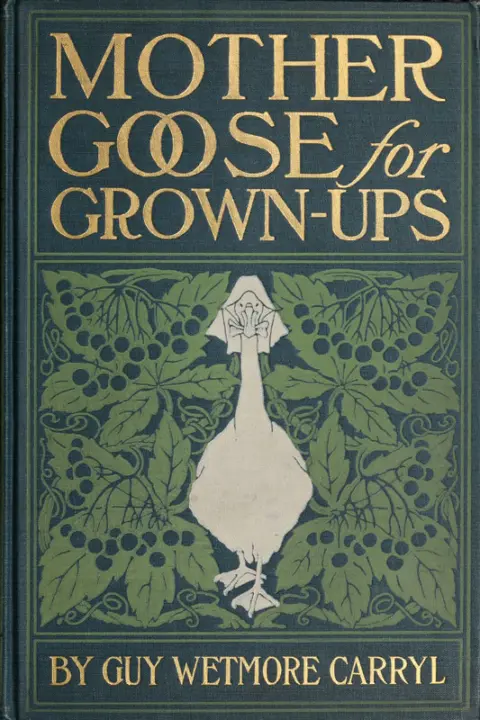
Mother Goose for Grown-ups
Guy Wetmore Carryl
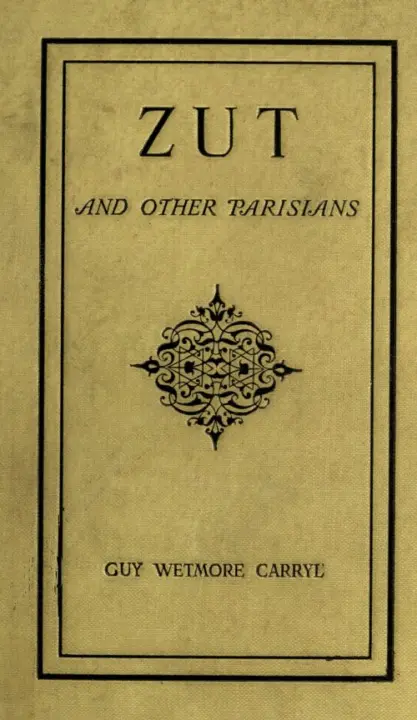
THE CLASSIC COLLECTION · 1903
"Zut and Other Parisians" by Guy Wetmore Carryl is a collection of humorous stories written in the early 20th century. The tales explore the quirks and eccentricities of Parisians, centering around memorable characters like the angora cat named Zut and its owners, the Caille and Sergeot families, who are embroiled in a rivalry fueled by their respective businesses. The book invites readers to experience the whimsical charm and comedic interactions that characterize life in Paris, filled with vibrancy and delightful satire. The opening of "Zut and Other Parisians" introduces readers to the charming yet tumultuous lives of Jean-Baptiste Caille, a grocer, and Hippolyte Sergeot, a hairdresser, whose families are neighbors on the bustling avenue de la Grande Armée. The crux of their conflict stems from the success of Hippolyte's newly opened salon, which incites jealousy in Alexandrine Caille, Jean-Baptiste’s wife. Their rivalry is humorously intensified by the indifference of Zut, a plump white angora cat, who becomes the unsuspecting object of desire between the two households. As the scene unfolds, themes of rivalry, envy, and the comedic absurdity of everyday life in Paris are established, setting the tone for the rest of the collection.
Introduction adapted from the source catalogue; source summaries may be automatically generated.
Free to read · English · 56,931 words · No account needed
MAKE TIME FOR A GOOD BOOK
On by default. Untick to stop anonymous reading totals. Each page counts after 10 seconds in view. How this works.
Anonymous counting is on unless you have switched it off.
"I think we had best drop the discussion here," he said, rising. "There can be no possible profit in continuing it. If my sister was here at all"--
"Her card is there on the table," put in Gabrielle, pointing with her
fan.
"Pardon. I should not have permitted myself the insinuation. I accept your statement, and simply say that it was an unwarrantable intrusion on her part. For you, madame, I have only admiration. Your compliance"--
"It was not that," said Gabrielle, shortly. "I can conceive of nothing less important to me than your sister's wishes. But I dislike Mademoiselle de Trémonceau."
"That," said Dodo, with exaggerated courtesy, "can only be a matter of opinion. I admire Mademoiselle de Trémonceau enormously."
"The force of admiration is undoubtedly strong," snapped Gabrielle, "to reconcile you to riding in another man's carriage, drinking another man's wine, dawdling with another man's"--
"Assez!" said Dodo.
Gabrielle shrugged her shoulders.
"Quite right," she said. "You are old enough to see for yourself. I presume you will not return to her."
"On the contrary, I shall be with her in fifteen minutes."
In the distance an electric bell whirred.
"Sooner than that, I think," smiled Gabrielle, and then La Belle Thaïs was standing at the salon door. She was gowned in scarlet, with a poppy flaring in her hair, and, if she had but lent to her dance at the Folies but half the fury of that entrance, the manager would, no doubt, have tripled her already ample salary. And, at the instant of her appearance, as if by signal,--which indeed it was,--Louis flung wide the opposite door, with a stately "Monsieur et madame sont servis," and there, gleaming with spotless napery, silver shaded candlesticks, and shimmering cut glass, was the daintiest of tables, set for two!
What Thaïs did and what she said, this is not the time or place to detail. She was not wanting in vocabulary, the de Trémonceau, nor sparing thereof in an emergency. A decade of careful training fell from her like a discarded mantle, and she became in an instant the vulgar-tongued fleuriste of the boulevards. From her chaise-longue Gabrielle smiled calmly, the picture of a new Circe, rejoicing in the success of her spells. And, between the two, Dodo, his hands clenched until the knuckles shone white, turned sick with contempt and loathing. At the end Thaïs flung him an unspeakable taunt, and there was a pause. Then,--
"Do you play the black or the red, monsieur?" asked Gabrielle, sweetly, with a glance at her own gown and another at the de Trémonceau's.
Your reading position is saved on this browser. Take it to another device with a library code. Reading pages adapt to text, rather than matching a printed edition.
Guy Wetmore Carryl
Guy Wetmore Carryl
Guy Wetmore Carryl
Guy Wetmore Carryl
BEHIND THE BOOK
This eBook is for the use of anyone anywhere in the United States and most other parts of the world at no cost and with almost no restrictions whatsoever. You may copy it, give it away or re-use it under the terms of the Project Gutenberg License included with this eBook or online at www.gutenberg.org. If you are not located in the United States, you will have to check the laws of the country where you are located before using this eBook. Read the source licence.
The original source file, including credits and licence, is retained by this library. Request an original-format copy at no charge. Please include the book title and Project Gutenberg identifier #43216.
KEEP YOUR CURIOSITY GOING
Coulson Kernahan

Maurice Baring
Frances Wright
Cécile Tormay

Frederic Jesup Stimson

W. H. P. (William Henry Pope) Jarvis