
Letters to a Friend, Written to Mrs. Ezra S. Carr, 1866-1879
John Muir
THE CLASSIC COLLECTION · 1881
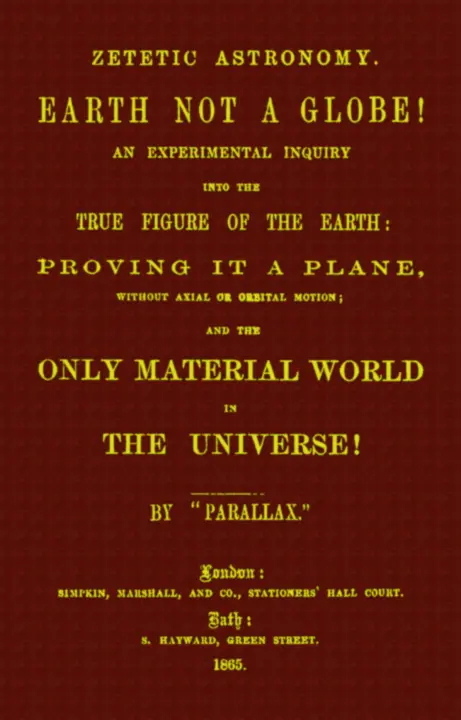
"Zetetic Astronomy: Earth Not a Globe!" by Parallax is a scientific publication written in the mid-19th century. This unique work presents a series of experiments and assertions arguing for the concept that the Earth is a flat plane rather than a globe, challenging widely accepted astronomical theories. The book seeks to dismiss common theories of the Earth's shape and motion through extensive empirical evidence and observations. The opening of this publication sets the stage for its central argument: the advocacy for “zetetic” inquiry, which emphasizes investigation and observation over theoretical assumptions. Parallax critiques established scientific thought and presents a series of observations—ranging from the behavior of water in canals to the visibility of distant landmasses—to support the claim that the Earth's surface is flat and stationary. The author introduces the notion that many phenomena typically attributed to a spherical Earth can be explained through the principles of perspective and the nature of light, laying the groundwork for subsequent chapters that expand on these experiments and claims.
Introduction adapted from the source catalogue; source summaries may be automatically generated.
Free to read · English · 46,039 words · No account needed
MAKE TIME FOR A GOOD BOOK
On by default. Untick to stop anonymous reading totals. Each page counts after 10 seconds in view. How this works.
Anonymous counting is on unless you have switched it off.
Carriages similarly receding will seem to lose that portion of the rim of the wheels which touches the Earth; the axles will seem to get lower; and at the distance of a few miles, the body will appear to drag along in contact with the ground. This is very remarkable in the case of a railway carriage when moving away upon a straight and level portion of line several miles in length. These instances, which are but a few of what might be quoted, will be sufficient to prove, beyond the power of doubt or the necessity for controversy, that upon a plane or horizontal surface, the lowest part of bodies receding from a given point of observation will disappear before the higher. This is precisely what is observed in the case of a ship at sea, when outward bound--the lowest part--the hull, disappearing before the higher parts--the sails and mast head. Abstractedly, when the lowest part of a receding object thus disappears by entering the “vanishing point,” it could be seen again to any and every extent by a telescope, if the power were sufficient to magnify at the distance observed. This is to a great extent practicable upon smooth horizontal surfaces, as upon frozen lakes or canals; and upon long straight lines of railway. But the power of restoring such objects is greatly modified and diminished where the surface is undulating or otherwise moveable, as in large and level meadows, and pasture lands generally; in the vast prairies and grassy plains of America; and especially so upon the ocean, where the surface is always more or less in an undulating condition. In Holland and other level countries, persons have been seen in winter, skating upon the ice, at distances varying from ten to twenty miles. On some of the straight and “level” lines of railway which cross the prairies of America, the trains have been observed for more than twenty miles; but upon the sea the conditions are altered, and the hull of a receding vessel can only be seen for a few miles, and this will depend very greatly--the altitude of the observer being the same, upon the state of the water. When the surface is calm, the hull may be seen much farther than when it is rough and stormy; but under ordinary circumstances, when to the naked eye the hull has just become invisible, or is doubtfully visible, it may be seen again distinctly by the aid of a powerful telescope. Although abstractedly or mathematically there should be no limit to this power of restoring by a telescope a lost object upon a smooth horizontal surface, upon the sea this limit is soon observed; the water being variable in its degree of agitation, the limit of sight over its surface is equally variable, as shown by the following experiments:--In May, 1864, on several occasions when the water was unusually calm, from the landing stairs of the Victoria pier at Portsmouth, and from an elevation of 2 ft. 8 in. above the water, the greater part of the hull of the Nab Light-ship was, through a good telescope, distinctly visible; but on other experiments being made, when the water was less calm, no portion of it could be seen from the same elevation, notwithstanding that the most powerful telescopes were employed. At other times half the hull, and sometimes only the upper part of the bulwarks, were visible. If the hull had been invisible from the rotundity of the Earth, the following calculation will show that it should at all times have been 24 feet below the horizon:--The distance of the light-ship from the pier is 8 statute miles. The elevation of the observer being 32 inches above the water, would require 2 miles to be deducted as the distance of the supposed convex horizon; for the square of 2 multiplied by 8 inches (the fall in the first mile of the Earth’s curvation) equals 32 inches. This deducted from the 8 miles, will leave 6 miles as the distance from the horizon to the light ship. Hence 6² × 8 in. = 288 inches, or 24 feet. The top of the bulwarks, it was said, rose about 10 ft. above the water line; hence, deducting 10 from 24 feet, under all circumstances, even had the water been perfectly smooth and stationary, the top of the hull should have been 14 feet below the summit of the arc of water, or beneath the line of sight! This one fact is entirely fatal to the doctrine of the Earth’s rotundity. But such facts have been observed in various other places--the north-west light-ship in Liverpool Bay, and the light vessels of many other channels near the southern, eastern, and western shores of Great Britain. From the beach of Southsea Common, near Portsmouth, the observer lying down near the water, above the surface of which the eye was 2¹⁄₂ feet, and with a telescope looking across Spithead to the quarantine ship lying in the “Roads,” between Ryde and Cowes, in the Isle of Wight, a distance of 7 miles, the copper sheathing of that vessel was distinctly seen, the depth of which was about 2 feet. Making the usual calculation in accordance with the doctrine of the Earth’s convexity, it will be seen that an arc of water ought to have existed between the two points, the summit of which arc should have been 16 feet above the copper sheathing of the vessel!
Your reading position is saved on this browser. Take it to another device with a library code. Reading pages adapt to text, rather than matching a printed edition.
BEHIND THE BOOK
This eBook is for the use of anyone anywhere in the United States and most other parts of the world at no cost and with almost no restrictions whatsoever. You may copy it, give it away or re-use it under the terms of the Project Gutenberg License included with this eBook or online at www.gutenberg.org. If you are not located in the United States, you will have to check the laws of the country where you are located before using this eBook. Read the source licence.
The original source file, including credits and licence, is retained by this library. Request an original-format copy at no charge. Please include the book title and Project Gutenberg identifier #69892.
KEEP YOUR CURIOSITY GOING
John Muir

Asa Gray
Asa Gray

Florence Nightingale
Elizabeth Robins Pennell
Denison Olmsted