
Letters to a Friend, Written to Mrs. Ezra S. Carr, 1866-1879
John Muir
THE CLASSIC COLLECTION · 1881
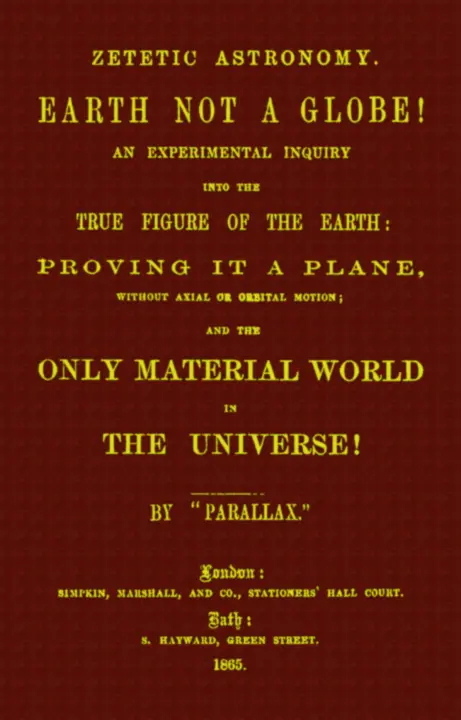
"Zetetic Astronomy: Earth Not a Globe!" by Parallax is a scientific publication written in the mid-19th century. This unique work presents a series of experiments and assertions arguing for the concept that the Earth is a flat plane rather than a globe, challenging widely accepted astronomical theories. The book seeks to dismiss common theories of the Earth's shape and motion through extensive empirical evidence and observations. The opening of this publication sets the stage for its central argument: the advocacy for “zetetic” inquiry, which emphasizes investigation and observation over theoretical assumptions. Parallax critiques established scientific thought and presents a series of observations—ranging from the behavior of water in canals to the visibility of distant landmasses—to support the claim that the Earth's surface is flat and stationary. The author introduces the notion that many phenomena typically attributed to a spherical Earth can be explained through the principles of perspective and the nature of light, laying the groundwork for subsequent chapters that expand on these experiments and claims.
Introduction adapted from the source catalogue; source summaries may be automatically generated.
Free to read · English · 46,039 words · No account needed
MAKE TIME FOR A GOOD BOOK
On by default. Untick to stop anonymous reading totals. Each page counts after 10 seconds in view. How this works.
Anonymous counting is on unless you have switched it off.
MOON’S PHASES.--It has been shown that the Moon is not a reflector of the Sun’s light, but is self-luminous. That the luminosity is confined to one-half its surface is sufficiently shown by the fact that at “New Moon” the whole circle or outline of the Moon is often distinctly visible; but the darker outline is less, or the circle is smaller than the segment which is illuminated. From this it is easily seen that “New Moon,” “Full Moon,” and “Gibbous Moon” are but the different proportions of the illuminated surface which are presented to the observer on earth.
MOON’S APPEARANCE.--Astronomers have indulged their imagination to such a degree that the Moon has been considered to be a solid, opaque, spherical world, having mountains, valleys, lakes, volcanic craters, and other conditions analogous to the surface of the earth. So far has this fancy been carried, that the whole visible disc has been mapped out, and special names given to its various peculiarities, as though they had been carefully observed and measured by a party of terrestrial ordnance surveyors. All this has been done in direct opposition to the fact that whoever looks, without previous bias, through a powerful telescope at the Moon’s surface, will be puzzled to say what it is really like, or how to compare it with anything known. The comparison which may be made, will depend greatly upon the state of mind of the observer. It is well known that persons looking at the rough bark of a tree, or at the irregular lines or veins in certain kinds of marble and stone, or gazing at the red embers in a dull fire, will, according to the degree of activity of the imagination, be able to see different forms, even the outlines of animals and human faces. It is in this way that persons may fancy that the Moon’s surface is broken up into hills and valleys and other arrangements such as are found on earth. But that anything really similar to the surface of our own world is anywhere visible upon the Moon is altogether fallacious. This is admitted by some of those who have written upon the subject “Some persons when they look into a telescope for the first time, having heard that mountains are to be seen, and discovering nothing but these (previously described) unmeaning figures, break off in disappointment, and have their faith in these things rather diminished than increased. I would advise, therefore, before the student takes even his first view of the Moon through a telescope, to form as clear an idea as he can how mountains, and valleys, and caverns situated at such a distance ought to look, and by what marks they may be recognised. Let him seize, if possible, the most favourable periods (about the time of the first quarter), and previously learn from drawings and explanations how to interpret everything he sees.”[31] “Whenever we exhibit celestial objects to inexperienced observers it is usual to precede the view with good drawings of the objects, accompanied by an explanation of what each appearance exhibited in the telescope indicates. The novice is told that mountains and valleys can be seen in the Moon by the aid of the telescope; but on looking he sees a confused mass of light and shade, and nothing which looks to him like either mountains or valleys! Had his attention been previously directed to a plain drawing of the Moon, and each particular appearance interpreted to him, he would then have looked through the telescope with intelligence and satisfaction!”[32] Thus it is admitted by those who teach that the Moon is a spherical world, having hills and dales like the earth, can only see such things in imagination. “Nothing but unmeaning figures” are really visible, and “the students break off in disappointment, and have their faith in such things rather diminished than increased,” “until they previously learn from drawings and explanations how to interpret everything seen.” But who first made the drawings? Who first interpreted the “unmeaning figures” and the “confused mass of light and shade?” Who first declared them to indicate mountains and valleys, and ventured to make drawings and give explanations and interpretations for the purpose of biasing the minds, and fixing or guiding the imaginations of subsequent observers? Whoever they were, they at least had “given the reins to Fancy,” and afterwards took upon themselves to dogmatise and teach their crude and unwarranted imaginings to succeeding investigators. And this is the kind of evidence and “reasoning” which is obtruded in our seats of learning, and spread out in the numerous works which are published for the edification of society!
Your reading position is saved on this browser. Take it to another device with a library code. Reading pages adapt to text, rather than matching a printed edition.
BEHIND THE BOOK
This eBook is for the use of anyone anywhere in the United States and most other parts of the world at no cost and with almost no restrictions whatsoever. You may copy it, give it away or re-use it under the terms of the Project Gutenberg License included with this eBook or online at www.gutenberg.org. If you are not located in the United States, you will have to check the laws of the country where you are located before using this eBook. Read the source licence.
The original source file, including credits and licence, is retained by this library. Request an original-format copy at no charge. Please include the book title and Project Gutenberg identifier #69892.
KEEP YOUR CURIOSITY GOING
John Muir

Asa Gray
Asa Gray

Florence Nightingale
Elizabeth Robins Pennell
Denison Olmsted